
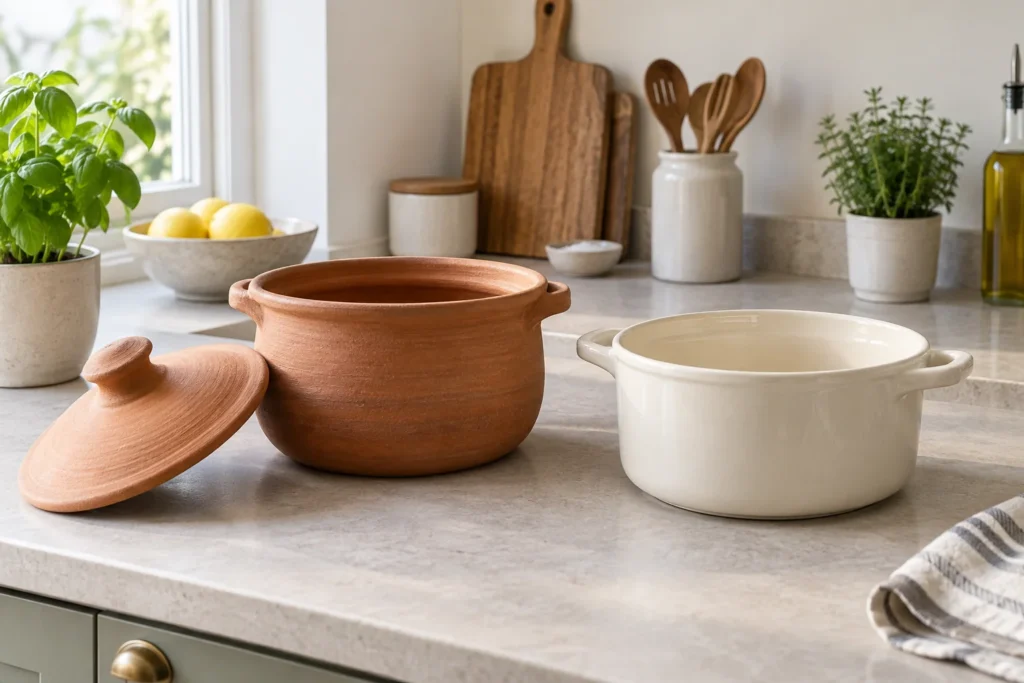
All-ceramic cookware and ceramic-coated cookware describe different constructions. The first refers to a ceramic body; the second usually describes a surface applied to a metal pan. Read the material specification for the body and cooking surface separately, because the word “ceramic” alone does not tell you how the complete item is made or where it can be used.
Image: AI-generated editorial illustration of generic equipment; not a photograph of a reviewed product.
Table of Contents
Look for the body material
Xtrema: its all-ceramic construction identifies its cookware as ceramic without a metal core. That is a useful example of a manufacturer stating the underlying construction clearly. It is different from a metal-bodied pan carrying a ceramic non-stick surface, even if both appear under the same broad shopping category.
For contrast, GreenPan UK construction comparison describes hard-anodised aluminium and layered stainless-steel/aluminium bodies within its cookware ranges. The ceramic surface description does not remove those underlying metals from the construction. Neither example establishes that one family is the right choice for every kitchen.
Read three layers of information
| Specification question | Why it matters |
|---|---|
| What is the body made from? | Identifies the main construction rather than the appearance |
| What is the cooking surface? | Establishes whether the food contacts a coating or another surface |
| What is underneath? | Helps identify the base and stated hob compatibility |
A glazed ceramic vessel also needs its own product description. Do not assume that every ceramic bowl, oven dish or decorative pot is intended for hob cooking. Likewise, a pale or speckled interior is not enough to identify the coating chemistry of a metal pan.
Check the intended heat source
Look for explicit permission for your hob type and any oven use you plan. A material name is not a substitute for a compatibility statement. Induction suitability, in particular, should be checked on the complete product and against the hob's requirements rather than inferred from the rim or handle.
Read the manufacturer's instructions for preheating and changes of temperature. Different constructions can have different use routines. Do not transfer an instruction from a metal frying pan to an all-ceramic vessel simply because both product pages use the same headline word.
Compare handling with a real task
Choose a familiar meal and consider how you will move the pan from storage to the cooking position, stir or turn the food, and wash it afterwards. Check the empty weight, handle spacing and overall dimensions. A body material does not determine whether a particular handle feels comfortable in your hand.
If possible, hold a display item and compare its balance with a pan you already use. Think about the additional contents without attempting an unsafe lifting test. A larger vessel may have useful capacity but become impractical for the way you normally serve or drain food.
Separate surface care from broad claims
Read the exact cleaning and utensil advice. A ceramic-coated metal pan may have restrictions designed around its coating; an all-ceramic vessel may have different requirements concerning handling, deposits or changes of temperature. Follow the supplied instructions rather than treating either construction as maintenance-free.
Be cautious about shopping descriptions that rely mainly on “healthy”, “natural” or “chemical-free”. Those words do not answer the construction and compatibility questions in this guide. This comparison makes no health ranking between the materials and does not claim that a pan is safer because of its colour, coating name or absence of a metal core.
Make the choice around the whole pan
Prepare a short comparison with body, cooking surface, hob permission, oven limits, empty weight and care routine. Leave a blank where the maker has not supplied an answer and ask for clarification. A missing detail should remain a question, not become an assumption based on a photograph.
Choose the item that fits your intended cooking method and handling needs with instructions you can follow. If your existing cookware already does that job, there is no need to replace it merely to change material labels. Understanding the construction is most useful when it helps you select an appropriate pan and use it as its maker intended.