
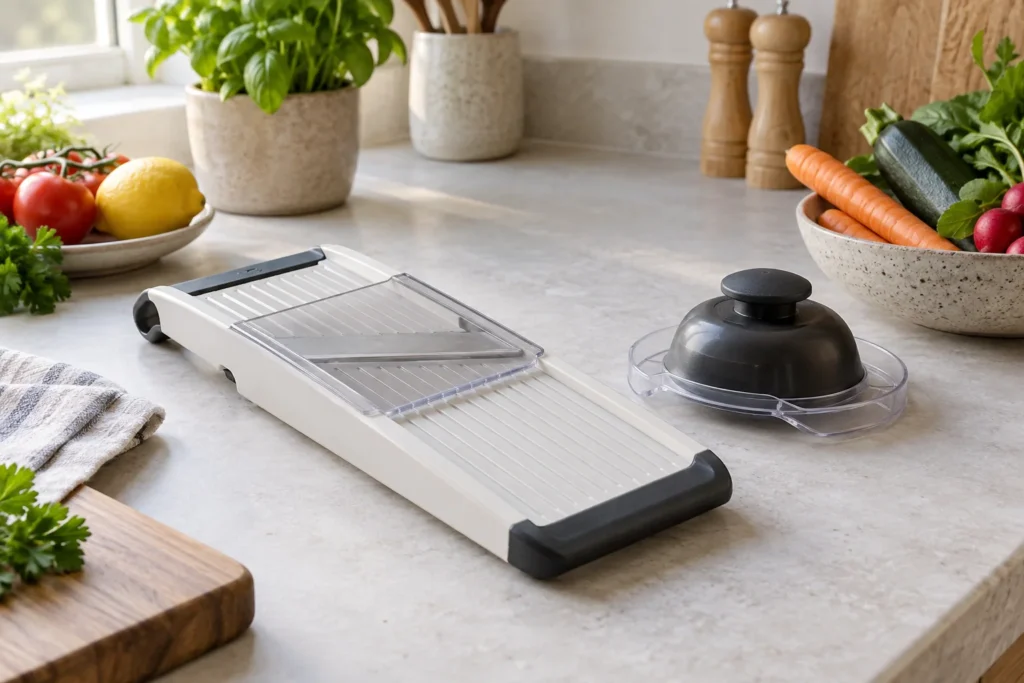
A mandoline slicer’s useful specification is more than the number of blades in the box. The thickness controls, food holder, working position and storage system need to suit the same preparation task. Compare the complete setup before choosing a model, and read its instructions before treating a feature list as an operating guide.
Image: AI-generated editorial illustration of generic equipment; not a photograph of a reviewed product. This guide uses published manufacturer information, not hands-on product testing.
Table of Contents
List the cuts you will use
Decide whether you need ordinary slices, julienne strips or another specifically supported shape. A large selection of blade inserts adds little if your cooking uses only one cut. Check the stated thickness settings and whether the controls identify actual measurements or simply numbered positions.
Do not assume a numbered setting means millimetres unless the maker says so. If a recipe requires a particular thickness, you need a clear way to interpret the setting for that model. The precision of a control label is also not a claim that we have measured the resulting slices.
If your main goal is vegetable strands rather than slices, compare our julienne-peeler versus spiralizer guide before deciding which tool fits the job.
Assess the food holder as part of the purchase
Read how the supplied holder accommodates food, how it travels and which produce dimensions are supported. A holder should not be an afterthought or an optional accessory in your comparison. If a replacement is needed later, establish the exact compatible part rather than substituting a similar-looking design.
Think about the vegetables you normally buy. Their width, length and shape must fit the model’s intended preparation and holding method. Do not buy a slicer on the assumption that you can bypass the holder when a particular piece does not fit.
Measure the working and stored shapes
OXO’s V-Blade Mandoline combines four blades, a height adjuster and a food holder, with folding feet and a storage lock. The maker lists separate folded and standing dimensions. That distinction is useful when comparing a drawer position with the space needed during use.
Make a paper footprint for the open device and add the collecting area described in its instructions. Check the working height and the space around the controls. A device that fits in the cupboard may still crowd the preparation surface when fully assembled.
Compare blade access and cleaning
Find out which components detach, how they are handled and which wash method each permits. A general dishwasher symbol on a product page may not describe every blade or assembly. The detailed instructions should resolve this before purchase.
Count the parts that need to be washed and dried after your usual task. More cutting options can mean more storage and care responsibilities, even when only one blade is used at a time. Choose the functions you will maintain as well as the ones you might enjoy using.
| Feature | Buying question |
|---|---|
| Cut and thickness settings | Are the required outputs clearly specified? |
| Food holder | Does it fit the intended produce and have documented use? |
| Working dimensions | Is there room for setup and collection? |
| Blade storage | Are all sharp parts protected and identifiable? |
| Care instructions | Can each component be cleaned and dried as required? |
Count changes of setting, not only available settings
Imagine preparing two ingredients that require different documented settings. Check where the first batch will go, how the slicer is made safe for adjustment and where a removed blade or insert rests. A device with many available cuts can still be inconvenient if changing between them does not suit the kitchen’s working space. Conversely, a simpler model may cover the same regular tasks with fewer setup steps. This is a workflow comparison, not a claim that fewer components are inherently safer. Use the exact instructions to establish the permitted changeover sequence before judging its convenience.
Choose the system you can use consistently
Before ordering, read the manual from beginning to end, including preparation, stopping, cleaning and storage. If the instructions or holder arrangement are unclear, ask the maker or seek a suitable demonstration. A mandoline should not rely on guessing where fingers belong or how a loose insert locks in place.
Our kitchen-gadget guide provides wider preparation context. For a mandoline, a clear holder system, relevant settings and manageable care are better reasons to buy than a large blade count alone.