
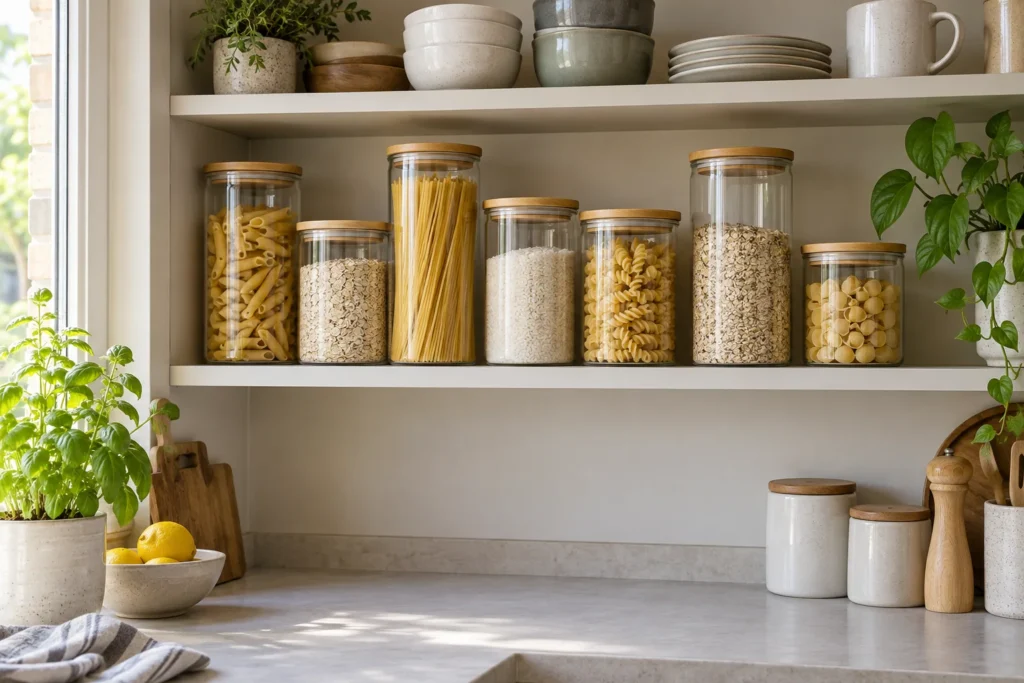
A useful food cupboard lets you answer three questions quickly: what is here, what will I use next, and where should the shopping go? Start with those questions instead of buying baskets for an arrangement you have not yet tested. The layout should support the food you actually keep and the way your household cooks.
Image: AI-generated editorial illustration of generic equipment; not a photograph of a reviewed product.
Table of Contents
Work on one cupboard at a time
Choose a cupboard you can empty and restore within the time available. Put its contents on a clear surface where labels remain visible. Group similar foods, identify duplicates and read the storage instructions before deciding where anything belongs. This is also an opportunity to notice products that have migrated into an unsuitable location.
Make a short list of the cupboard’s regular contents rather than documenting every packet in elaborate detail. You need enough information to plan space and recognise excess stock. If the same item appears in three places, decide where the working supply and any unopened backup should live.
Build zones around real tasks
Breakfast, baking and weekday meal ingredients are possible zones, but use only categories that make sense in your kitchen. A household that rarely bakes does not need prime shelf space dedicated to baking equipment and flour. Likewise, a “snack zone” may be useful for one household and unnecessary for another.
Choose names people can understand without explanation. Place a temporary label on the shelf while trialling the arrangement. A simple location such as “rice and pasta” is more useful than a decorative label that leaves everybody guessing where an ingredient belongs.
Use height to improve access, not just density
A shelf insert can create another level for appropriate items. IKEA’s VARIERA insert, for example, is listed at 32 × 28 × 16 cm. Those outer dimensions are a starting point for fit, rather than a promise that it will double the usable storage in every cupboard.
Measure the space above and below a proposed insert, including the room needed to remove an item. Check its assembly instructions and any load guidance before use. A shelf that adds another layer but requires you to dismantle the front row every evening has not solved the access problem.
Give backup stock a defined boundary
Choose a specific area for unopened extras, then make it visible enough to check before shopping. That might be one shelf section or one suitable basket. The boundary helps you notice when buying habits exceed the space available.
Keep the working supply near the preparation task. If you decant food, retain its identity and relevant label information. Do not mix several anonymous remnants into a container merely to make the cupboard look tidier. Organisation should make the food’s history easier to follow, not harder.
Test a meal against the arrangement
| Test | What to observe |
|---|---|
| Prepare a normal breakfast | Are the needed items grouped usefully? |
| Put away a routine shop | Does each item have an obvious destination? |
| Check ingredients before cooking | Can you see the back row and identify duplicates? |
| Replace one finished packet | Is backup stock easy to find and date information visible? |
If a zone fails the test, move it before adding more accessories. Sometimes the most helpful change is simply moving a tall packet to a shelf where it can stand upright and be read. Another may be reducing the number of containers used for the same ingredient.
Consider the shelf holding pasta, tins and stock cubes for weekday dinners. If the stock cubes disappear behind large packets, a small visible section may help more than a full cupboard makeover. Keep the frequently used ingredients within the same understandable zone, but let their physical shapes determine the precise positions.
Keep the reset easy to maintain
Leave a little flexibility for a different packet size or an occasional extra ingredient. A layout that only works with one exact shopping list becomes frustrating as soon as the household changes its meals. Our kitchen storage guide offers broader options; use this cupboard plan to decide which, if any, products would remove a specific obstacle.