
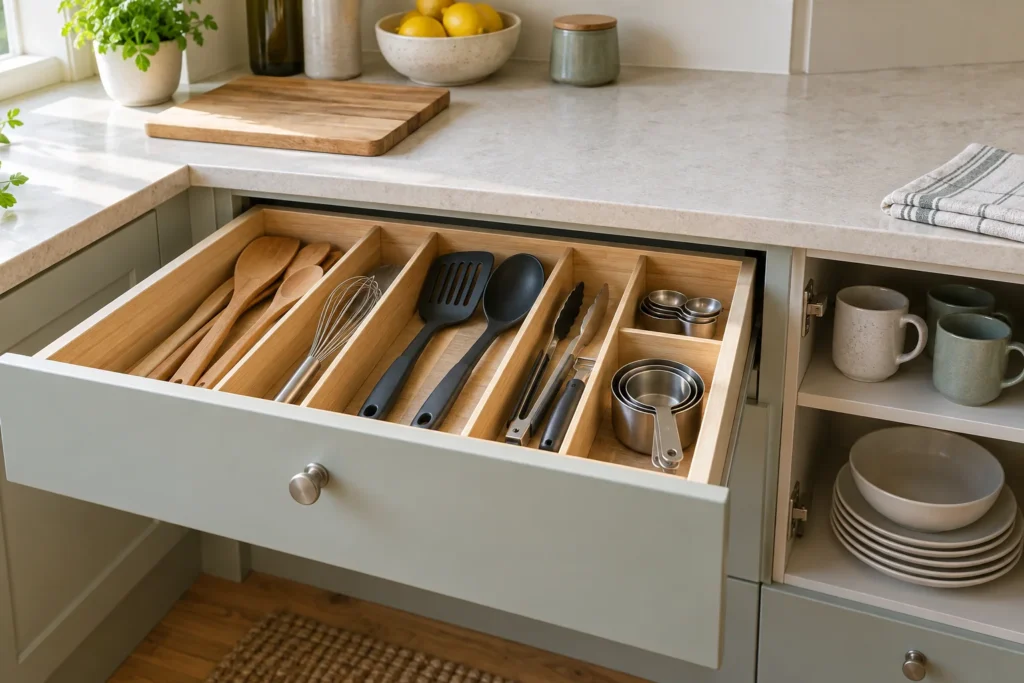
Mug storage becomes awkward when a cupboard is planned around cup bodies while ignoring handles. The useful footprint includes the part you grip and the space needed to lift the mug clear. Start with the mugs used every day, then decide how much accessible space the occasional collection needs.
Image: AI-generated editorial illustration of generic equipment; not a photograph of a reviewed product.
Table of Contents
Count the everyday mugs first
Separate daily cups from occasional serving pieces and mugs kept primarily for sentimental reasons. This is a storage distinction, not a reason to discard something you value. It helps assign the easiest shelf positions to the items repeatedly taken out and put away.
Count how many mugs are usually in use or being washed at once. An arrangement that seems spacious when half the collection is in the dishwasher may become crowded when everything returns. Plan for that complete clean collection, then give the daily group a clear boundary within it.
Measure body, handle and lifting room
Record the widest dimension including the handle, the height and any unusual shape at the rim or base. Compare the mugs together because their handles may project in different directions. Do not assume identical nominal capacities mean identical cupboard footprints.
Place the mugs on a paper shelf outline and test a few orientations. Handles turned towards the opening may be easier to grasp, while other arrangements may fit your particular shelf better. The important test is whether you can remove one mug without knocking or lifting several neighbours.
Use shelf inserts for a specific access problem
IKEA’s VARIERA shelf insert is an example of a freestanding second level, with published external dimensions. For any insert, measure the space above and below it with your actual mugs present, including the room needed to lift them.
Check the organiser’s instructions and any load guidance. Its outer width does not necessarily equal the usable platform between legs or raised edges. Avoid balancing handles across unsupported gaps merely to reach an advertised capacity.
Do not infer stackability from appearance
Some cups are designed to stack; others have shapes that only appear to fit together. Check the mug maker’s guidance before relying on a stacked arrangement. A wide rim, decorative handle or uneven base can change the contact points.
If stacking is not documented or does not suit the mugs, use a single layer or an appropriate shelf arrangement. Hanging storage also needs the correct support and installation instructions. A handle that accepts a hook is not by itself evidence that the complete rack and fixing are suitable for the load.
Compare daily retrieval rather than maximum capacity
| Arrangement | Question to test |
|---|---|
| Single shelf layer | Can each handle be reached independently? |
| Shelf insert | Is there lifting room above both levels? |
| Maker-supported stack | Can the desired mug be removed without an awkward tower? |
| Hanging rack | Are the rack, fixings and mugs compatible? |
As a practical example, a cupboard may need room for several everyday mugs near the front and a smaller occasional group on another shelf. Mixing the two groups into one dense row can make every morning more awkward simply to keep the full collection together. A deliberate split often makes the purpose of each shelf easier to understand.
Build a layout around the awkward handle
Try a paper layout with the largest everyday mug first. Mark its body footprint and the extra area occupied by the handle, then leave a clear direction for lifting it out. Add the remaining mugs without hiding one handle behind another. If the arrangement only works when handles are precisely alternated, consider whether everyone will return the mugs that way. A slightly less dense layout may be easier to maintain. Use occasional guest mugs in a separate accessible position rather than rearranging the everyday group after every wash.
Keep the return movement easy
After washing, each mug should have an obvious place that does not depend on perfect handle alignment. If the arrangement falls apart whenever dishes are put away, simplify it. Our kitchen storage guide covers wider cupboard options. Choose a mug layout that protects comfortable access to the daily collection and gives the remaining pieces a stable, identifiable home.