
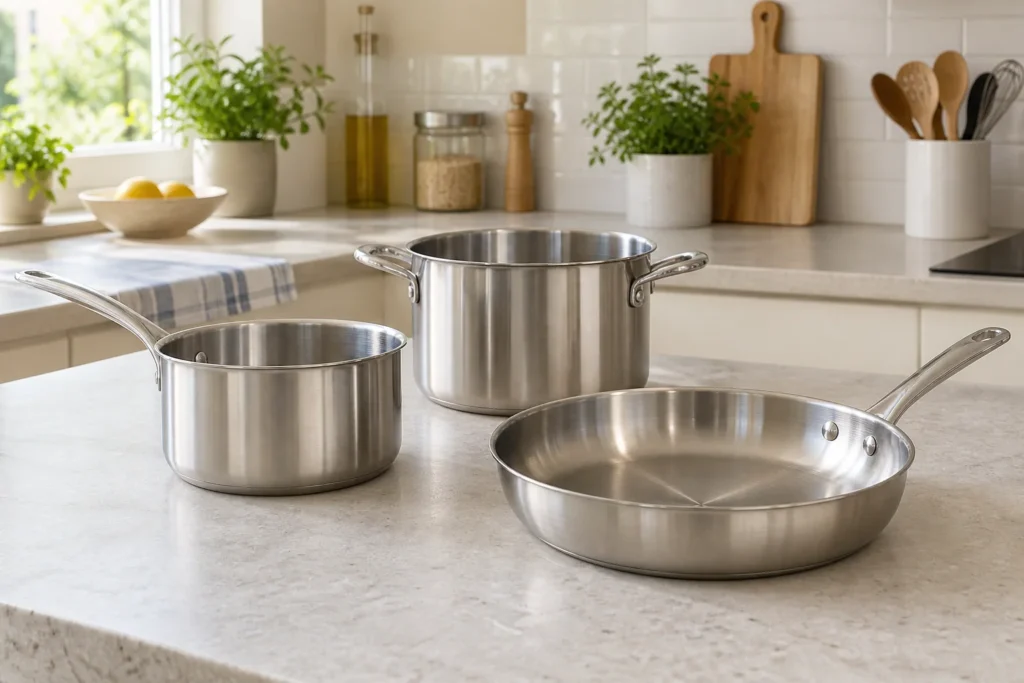
Easier-to-lift cookware depends on the complete task: the pan's weight, its contents, the grip available and the distance you move it. A lightweight label is only a starting point. Compare how a vessel is filled, carried, poured from and washed before choosing a replacement for a pan that has become awkward.
Image: AI-generated editorial illustration of generic equipment; not a photograph of a reviewed product.
Table of Contents
Identify the hardest movement
Write down where the difficulty occurs. Lifting an empty casserole from a low cupboard is different from moving a full one out of an oven. Holding a saucepan while pouring asks for a different grip from carrying a two-handled pot to a nearby resting surface.
Start with that specific movement rather than replacing every pan. A smaller batch, a more accessible storage position or a different serving arrangement may be worth considering alongside a new vessel. Keep any changes compatible with the recipe and equipment instructions.
Compare weight on the same basis
Check whether the listed weight includes the lid and any detachable handle. Ask the maker if the specification is unclear. A heavy lid can change the total substantially, while packaging weight is not a useful substitute for the empty cookware weight.
| Component | Illustrative weight |
|---|---|
| Empty pan | 1.2 kg |
| Lid | 0.4 kg |
| Contents | 1.5 kg |
| Combined load | 3.1 kg |
These are invented arithmetic values for planning, not a product specification or a suggested lifting limit. They show why comparing the empty pan alone can miss much of the load. Choose a manageable arrangement for your own circumstances rather than treating the example as a target.
Examine handle position and grip
Two side handles, a long handle and a helper handle offer different ways of supporting a pan. Check the space inside a loop and whether the grip remains usable with the heat protection required for the task. An attractive handle can be awkward if fingers or an oven glove barely fit.
With a cool display item, assess picking up and putting down the empty pan. Do not add a challenging load to test your limits. If lifting difficulties relate to an individual health or mobility need, an occupational therapist can help assess the complete activity and appropriate equipment.
Look beyond one material family
Tefal Air construction and component notes identifies cast-aluminium construction in its Air range, illustrating that casserole-shaped cookware is not always cast iron. That does not make every aluminium pan easy for everyone to lift. Compare actual size, weight and handles rather than assuming the material label decides comfort.
A smaller vessel in a familiar material may suit you better than a larger pan advertised as light. Conversely, a different construction can be worth considering if it supports the recipe and has a manageable care routine. Check the interior coating and compatible heat sources separately.
Plan pouring and serving
If pouring is the difficult part, look at the spout or rim, handle balance and the receiving vessel's position. A lid described as suitable for straining still needs its exact locking or holding instructions; do not assume it removes the need for a controlled grip.
Consider whether the recipe can be served with an appropriate ladle while the pot remains in a stable permitted position. That is a different task from lifting and tipping the whole vessel. Choose equipment and a layout that support the actual serving method you will use.
Include storage and washing
A pan that is manageable on the hob may still be difficult to retrieve from a deep cupboard or lift out of a sink. Give frequently used cookware an accessible home and check the complete dimensions against the washing space. Read the lid's care instructions separately when they differ from the body.
Measure the landing area beside the oven and the route to it. Keep the movement short and clear, with a suitable resting surface ready. These practical details can matter as much as a modest reduction in empty weight.
Choose by a successful task fit
Write a replacement specification based on the difficulty you identified: manageable empty weight, useful capacity, comfortable two-handed grip or a suitable pouring arrangement. Compare candidates against that note before considering colour or a matching collection.
The useful outcome is a pan and setup that make your normal cooking more manageable. There is no universal weight that defines accessible cookware, and no material guarantees it. A deliberate comparison of the whole movement gives you a better basis for choosing.