
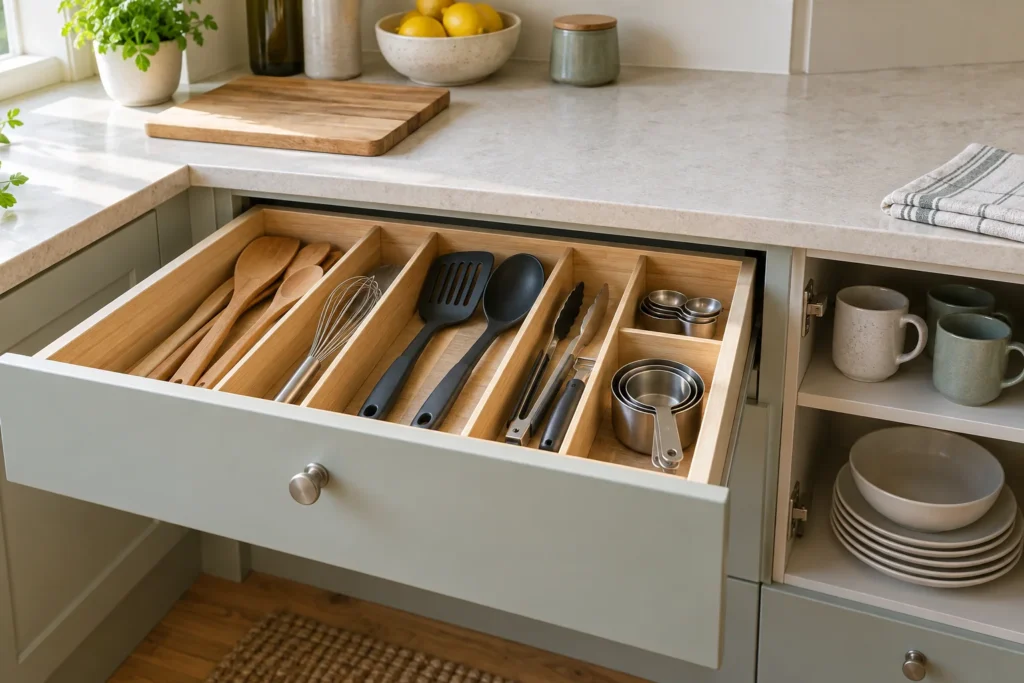
A kitchen cupboard shelf riser creates another level, but it only adds useful storage when the objects on both levels remain accessible. Before buying, decide which stack or crowded shelf you want to improve. Then measure the items, the cupboard opening and the space needed to lift them out.
Image: AI-generated editorial illustration of generic equipment; not a photograph of a reviewed product.
Table of Contents
Identify the access problem
Common problems include small plates buried beneath larger ones, bowls stacked too deeply, or cups hidden behind taller pieces. Name the particular movement that is inconvenient. An insert should reduce that difficulty rather than simply fit another layer into the cupboard.
Bring the relevant clean items together and group them by shape and frequency of use. Keep the everyday group easy to retrieve. Occasional serving pieces can occupy a different position without forcing every daily plate to be lifted past them.
Distinguish outer dimensions from usable platform
An organiser’s listed width and depth usually describe its overall size. Legs, raised edges or joining pieces may reduce the area available for a plate or bowl. Look at the specification and assembly drawings, and ask for missing measurements if the fit is close.
The IKEA VARIERA insert is listed at 32 cm wide, 28 cm deep and 16 cm high. Those dimensions help shortlist it, but they do not prove that every plate smaller than the outer rectangle will sit as intended between its supports.
Measure access above and below
Place a paper outline of the proposed insert on the shelf. Use the actual plate stack or a careful height measurement to assess the lower space. Repeat for the items intended above it. Include the movement of your hand and the lift needed to clear any rim.
For an illustrative calculation, a 36 cm-high cupboard with a 16 cm-high insert does not simply provide two equally useful levels. The platform thickness, item height and retrieval movement all affect what can go where. Use the calculation as a starting sketch, then assess each level separately.
Check loads and how inserts connect
Read the manufacturer’s load and assembly guidance, together with the cupboard shelf’s own limits. Do not infer a load rating from a product’s metal appearance or from a photograph of crockery. If the intended contents are heavy and the information is missing, seek clarification before filling the insert.
Some products allow specific joining or stacking arrangements. Follow the exact instructions rather than balancing independent risers on one another. An adjustable unit must remain within its supported range, with the intended contact points resting securely on the shelf.
Test the route through the cupboard door
| Measurement | Why it matters |
|---|---|
| Door opening | The insert and crockery must pass hinges and posts |
| Usable platform | Plates need the intended support area |
| Lower clearance | Items must be grasped and removed below the insert |
| Upper clearance | The top group needs lifting room too |
Check whether the whole arrangement can be removed for cleaning without an awkward sequence. A product that improves daily access but makes the cupboard impossible to inspect may need a different position or a smaller load.
Use a two-level retrieval trial
A shelf riser creates a second level, but both levels need to be usable. Imagine placing a stack of side plates below and bowls above. Check that the bottom plates slide out without touching the riser’s legs and that the bowls can be lifted clear without tilting into the cupboard roof. Include the full stack you normally store, while remaining within the product’s stated limits. If you must empty one level to reach the other, the riser has changed the shape of the obstruction rather than resolving it. Compare that layout with simply moving the less-used items to another shelf.
Keep the layout adaptable
Trial one insert before buying several. Use it through an ordinary washing-up cycle and notice whether plates return naturally to their places. Our kitchen storage guide provides wider organisation ideas. A useful shelf riser gives specific items their own accessible level while respecting the cupboard and organiser instructions.