
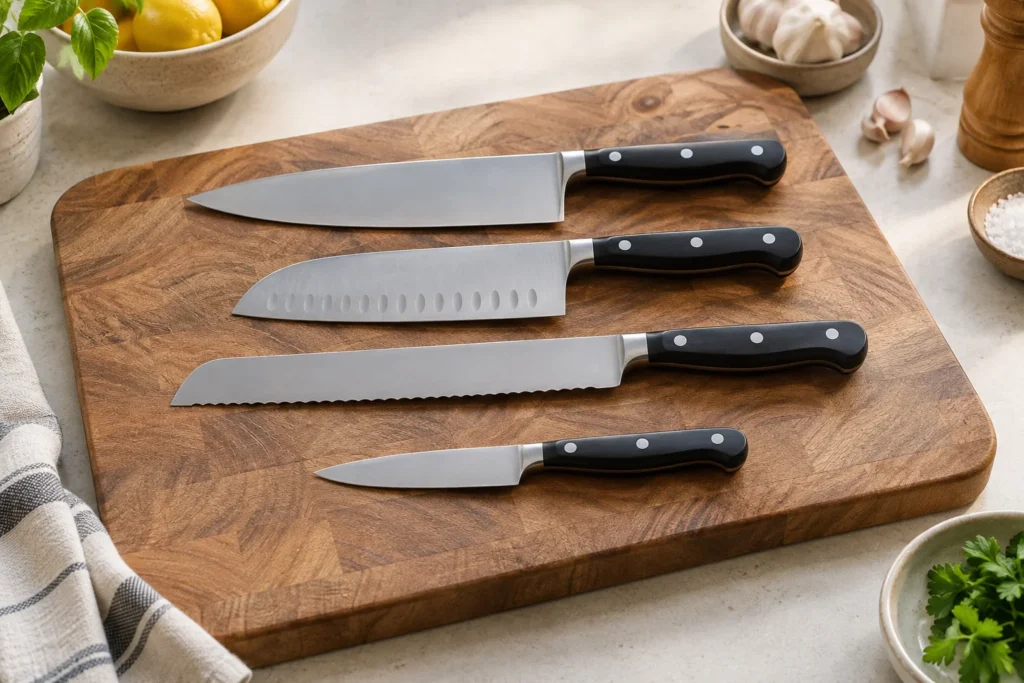
A chef’s knife and a santoku can both be considered for general kitchen preparation, but their shape and handling need to suit the person using them. The useful comparison is between actual models. A style name does not establish one standard length, edge profile or sharpening angle across every manufacturer.
Image: AI-generated editorial illustration of generic equipment; not a photograph of a reviewed product.
Table of Contents
Compare the blade profile
Look at the cutting edge from heel to tip and the shape of the spine. Note where the blade curves and how much of its length appears relatively straight. These observations help explain why two knives may feel different, but they are not a substitute for the maker’s intended handling instructions.
WÜSTHOF’s santoku introduction describes its santoku as a slimmer, lighter general-purpose shape with a comparatively straight edge. That is a useful description of the maker’s design, not proof that every santoku weighs less than every chef’s knife. Compare published dimensions and weights for the exact pair.
Check length and knuckle clearance
Blade length is only one part of fit. Look at blade height near the handle and the relationship between the handle and cutting edge. Consider whether the model provides the clearance and grip you prefer on your usual board, following the maker’s intended use.
Do not assume a shorter blade automatically needs less working space. The food, your hands and the movement involved also occupy the board. Use a paper outline for storage and layout planning, then seek an appropriate controlled retail demonstration if handling is important to the decision.
Match the knife to regular preparation
List the foods you prepare most often and the tasks that currently feel poorly served. Both categories contain general-purpose designs, so there may be substantial overlap. Buying one of each is not essential simply because the names differ.
Keep specialised tasks outside the comparison where neither exact model is intended for them. A broad blade does not establish permission for bones, frozen foods or other excluded uses. Choose any specialist tool through its own manufacturer guidance rather than asking a general-purpose knife to cover every job.
Handle comfort needs an actual comparison
Compare handle length, thickness and shape, including any directional design. Consider whether the grip position you use is supported by the maker. Another cook’s favourite knife can be an awkward match for a different hand or worktop arrangement.
If you cannot handle the knives before ordering, gather the dimensions and read the seller’s current return conditions. Do not treat descriptive words such as balanced or ergonomic as measurements. They can explain a design aim, but they do not establish how it will feel to you.
| Feature | What to compare on both knives |
|---|---|
| Edge profile | Curvature, straight section and intended handling |
| Blade dimensions | Length and height near the handle |
| Handle | Shape, size and any handedness information |
| Material and bevel | Specific care and sharpening requirements |
| Storage | Fit in a suitable guard, block or drawer insert |
Compare the same preparation movement
A fair handling comparison uses the same intended task and working position for both knife shapes. Look at the blade’s profile on the board, the space below the handle and the direction in which the tip moves during the maker’s permitted technique. Changing the board, ingredient and grip at the same time makes it harder to identify what you prefer about the knife itself. Where a shop allows only an unloaded inspection, be honest about that limit: handle comfort can be assessed, but it does not establish cutting performance. Treat the trial as one part of the specification comparison.
Include maintenance in the final decision
Read the washing and sharpening instructions for both models. Do not transfer an angle, honing method or dishwasher permission between them merely because they are from the same country or look similar. A familiar maintenance routine can be a practical advantage when comparing otherwise suitable choices.
Our knife-set guide covers the broader collection. For this choice, decide which actual blade and handle fit your recurring preparation jobs. If your existing general-purpose knife already does that well, another style should answer a specific need before it earns drawer space.