
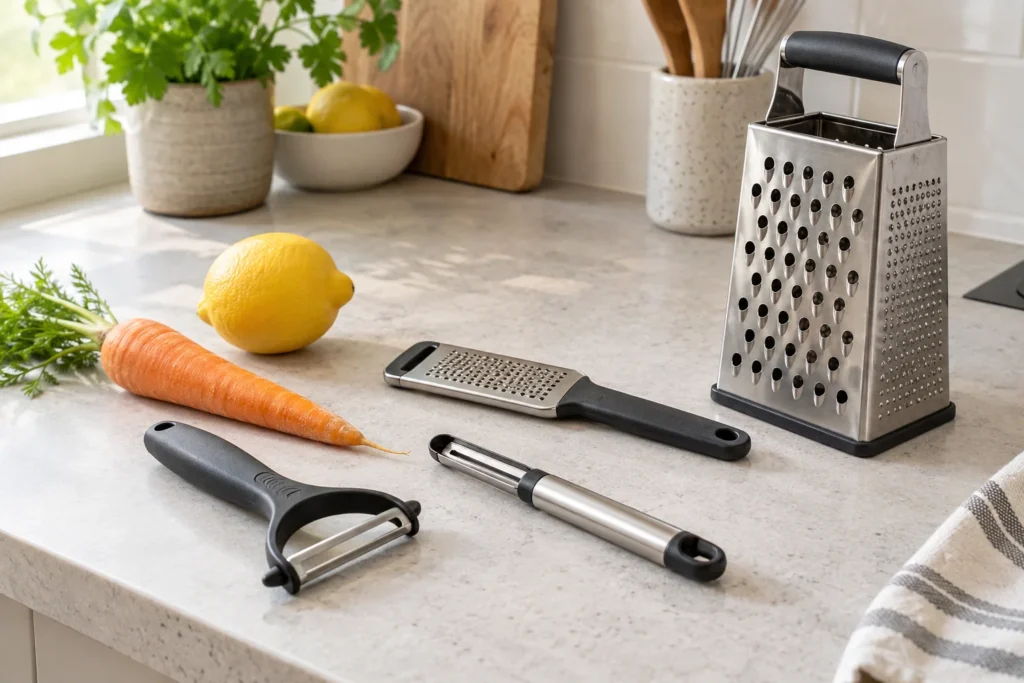
A Y-peeler and a straight swivel peeler arrange the blade differently in relation to your hand. That changes the shape of the tool and the movement it is designed around, but it does not make one format universally better. Compare the actual grip and the produce you prepare most often.
Image: AI-generated editorial illustration of generic equipment; not a photograph of a reviewed product.
Table of Contents
Understand the shape labels
On a Y-shaped peeler, the blade spans the two arms at the top of the handle. On a straight peeler, the blade sits along an extension of the handle. Swivel describes the blade’s ability to move within its mounting, so it is not a complete description of the handle shape by itself.
Blade type is another separate detail. A Y-shaped handle can carry a straight, serrated or julienne blade. Before comparing two products, check that both are intended for the same peeling task; otherwise you may be comparing output as well as grip.
Start with your regular produce
List two or three foods you peel frequently and the quantity you usually prepare. The useful tool for occasional apples may be different from your preference for a larger batch of vegetables. Identify what currently feels awkward: the handle, blade access, control or simply a worn existing peeler.
OXO’s Swivel Peeler and UK Y Peeler are both described by the maker for tougher-skinned produce, with handles intended for left- or right-handed use. This establishes overlapping intended tasks within those models, not a head-to-head performance result.
Compare the handle in your hand
Look at handle length, thickness and the space between the grip and blade. Consider whether the shape lets you follow the manufacturer’s intended movement comfortably. A soft coating or large handle is a design feature, not proof that it will suit every person.
If possible, examine a suitable sample in a controlled shop setting. Without cutting food, compare the grip and whether the tool feels easy to orient. For a remote purchase, find dimensions and handedness information rather than guessing scale from an isolated photograph.
Check blade access and additional features
A broad blade may appeal for large produce, but check the exact intended uses and instructions. A potato-eye remover, scraping edge or other additional feature can add a different sharp area to the tool. Know where those features are before storing it in a crowded utensil drawer.
Do not choose solely by the number of functions. If you use one regular peeling action, a straightforward design may answer the need. A more elaborate tool is useful only when its extra functions fit tasks you actually perform and remain easy to clean.
| Comparison | Useful question |
|---|---|
| Blade position | Which orientation suits the intended movement? |
| Blade type | Are both tools designed for the same output? |
| Handle | Are dimensions and handedness suitable? |
| Care | What cleaning and storage does the maker specify? |
| Existing tool | Would another shape solve a real problem? |
Separate blade choice from the handle trial
When comparing a Y-peeler and a straight-handled peeler, first check whether their blades are intended for the same produce and task. If one has a serrated blade and the other a plain blade, any difference is not solely a consequence of the handle shape. Write down blade type and handle layout separately. Then compare the movements needed to position, peel and set each tool down. This makes the comparison more useful than choosing from the outline alone and helps you identify whether an existing peeler needs a different blade role or simply a more manageable grip arrangement.
Make the washing and storage routine work
Read the care instructions for the exact model, including any blade cover or replacement cartridge. Check where the peeler will dry and how it can be retrieved without reaching among exposed sharp parts. A compact tool is convenient only if it has an identifiable place.
Our kitchen-gadget guide provides wider preparation context. For everyday peelers, match the blade task first and the handle preference second. If your current tool works comfortably and cleans properly, a different silhouette needs a clear reason to join it.