
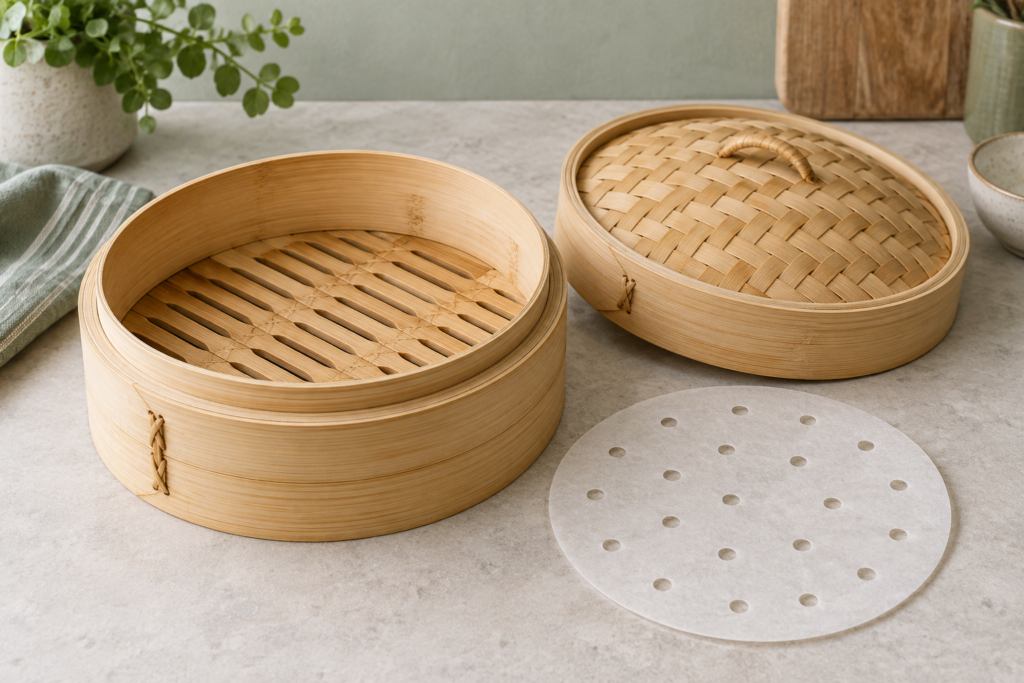
A bamboo food steamer is a basket that holds food above simmering water. Before buying one, check how it will sit in your pan, how much usable space is inside each tier, and where you will leave it to dry. Those details matter more than simply choosing the largest diameter.
This guide covers basket fit, liners and care. For an overview of electric appliances and metal inserts, see our food steamer buying guide.
Image: AI-generated editorial illustration of a generic bamboo basket, lid and perforated liner. It does not show a reviewed product. This guide is based on manufacturer instructions; we have not carried out a hands-on product test.
Table of Contents
Measure the basket and the pan together
Start with the pan you already own. Compare its shape and usable opening with the steamer manufacturer’s fitting instructions. A quoted basket diameter does not, by itself, tell you where the basket will sit in a curved wok or whether the food platform will stay above the water.
For example, School of Wok lists its two-tier basket at 26 cm across and gives compatibility information for its own woks. Treat that as a matching claim for that range, rather than a promise that every similarly sized basket fits every pan.
Check three measurements before ordering: the outer diameter for pan fit, the inner diameter for your food or heat-safe plate, and the height available beneath the lid. A broad, shallow basket may suit a single layer of dumplings; a taller food item needs clearance above it. If the listing only gives overall dimensions, ask the seller for the missing internal measurement.
Choose a liner that leaves a route for steam
A liner separates sticky food from the basket. Perforated steaming paper and reusable mats made specifically for steamers are options to compare. Check their intended cooking use and dimensions; a sheet that folds up around the food or covers the available steam passages is a poor fit.
School of Wok’s reusable silicone mat, for example, is specified as 25 cm across and designed for its 10-inch steamer. This illustrates why the liner’s stated compatibility is more useful than choosing by material alone. Follow the care instructions for the liner separately from those for the bamboo basket.
If the recipe uses a heat-safe plate or bowl, check that it leaves space around its sides. The Joyce Chen steamer manual specifies about 2.5 cm of clearance around a dish for its baskets and says the lid should not touch the food. Use your own model’s instructions when the dimensions differ.
Set the water level using the maker’s instructions
There is no single water-depth measurement that suits every wok and basket combination. Joyce Chen instructs users to let the basket’s lower rim rest in water while keeping boiling water away from the food. Check the level during cooking, replenish as directed, and never let the pan boil dry. Keep the basket stable and follow the cooking instructions supplied with the food or recipe.
A visible cloud of steam does not establish that the centre of the food is cooked. The Food Standards Agency’s cooking guidance recommends following the relevant time and temperature instructions and checking the food thoroughly, with a food thermometer where appropriate. Frozen products should be cooked according to their packet instructions; do not substitute a generic dumpling time for the manufacturer’s directions.
For a first use, choose one food and one recipe so there are fewer timings to coordinate. Stacking two tiers adds space, but you still need to check each food rather than assuming everything finishes together.
Open, wash and dry the basket carefully
Joyce Chen advises switching off the heat and opening the lid away from your face and body because the escaping steam is hot. Let the parts cool before cleaning. Its care instructions call for warm water, gentle cleaning, air drying and ventilated storage; they also warn that scented soap can be absorbed by bamboo.
School of Wok explicitly marks its basket as unsuitable for a dishwasher. Read the instructions for your particular steamer before applying detergent, oil, prolonged soaking or a cleaning method recommended for another bamboo product.
Think about drying space before you buy. The basket and lid need somewhere to sit apart until dry, so a steamer that fits neatly in a cupboard may still be awkward in a kitchen with very little draining space. Do not stack damp parts tightly together just to clear the worktop.
A short checklist before you buy
- Pan fit: the seller explains how the basket is supported in a compatible pan.
- Usable space: the inner width and lid clearance suit the food or dish you intend to use.
- Liner fit: the paper or reusable mat is intended for steaming and fits the basket.
- Care: the washing and drying routine is practical in your kitchen.
- Instructions: you can find the actual product’s use-and-care guidance before purchase.
If a listing leaves the fit unclear, resolve that measurement first. Buying a basket and then discovering that it needs another pan can turn a small accessory purchase into a larger one.