
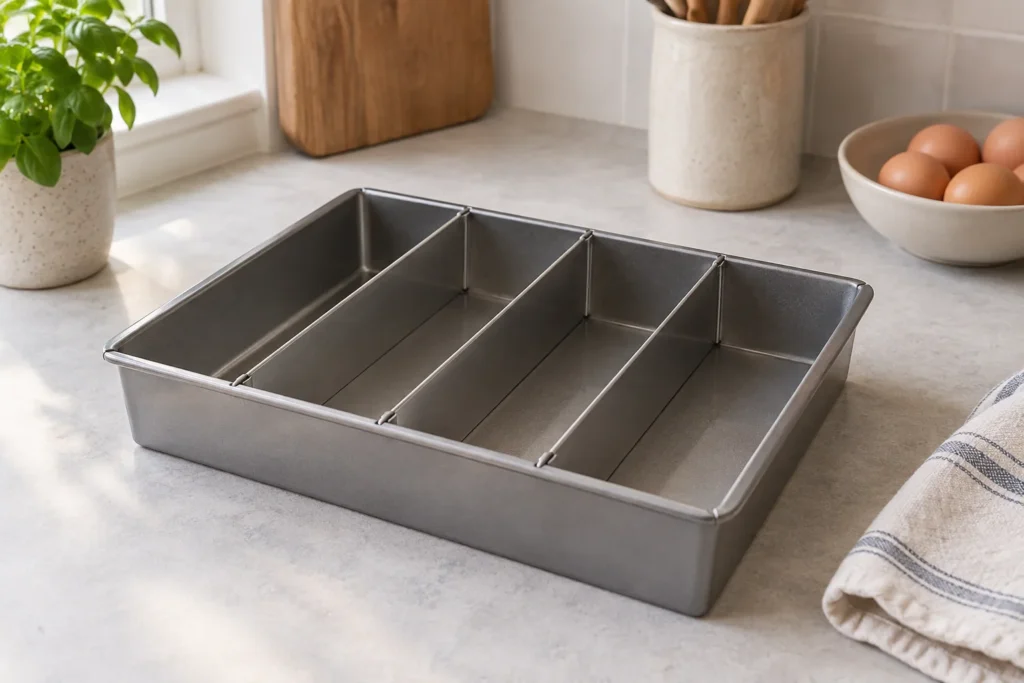
A Battenberg cake tin is useful when you want to bake separate strips that can be assembled into a chequered cake. Choose it by the channel arrangement and the recipe it supports. The important question is how the baked strips will fit together, rather than whether the tin simply carries the right cake name.
Image: AI-generated editorial illustration of generic equipment; not a photograph of a reviewed product.
Table of Contents
Start with the finished cross-section
Sketch the intended cake from the end. A simple two-by-two chequerboard needs four strips arranged in two rows. Write the colour or flavour in each square, then connect that sketch to the tin's channels and your recipe. This makes it easier to see whether you need one batch, repeated batches or a different arrangement.
The sketch is a planning aid, not a new recipe. Use a reliable Battenberg recipe for mixture, baking, filling and covering. If it was developed for a conventional divided tin, do not assume a much deeper or differently proportioned product will give interchangeable strips.
Inspect the dividers and their assembly
Look at how the dividers meet the base and sides. Are they removable? Do they fit in only one orientation? Can each piece be installed without forcing it? A dedicated manufacturer example is the Silverwood 8 × 6 inch Battenberg tin, which uses anodised aluminium. Its construction and care details are useful reference points, not evidence about UK stock or a recommendation based on testing.
Assemble an empty tin before preparing the mixture. Check that every divider is in its intended position and that you understand the release sequence. Keep the pieces laid out in order the first time you take it apart. A quick reference photograph of your own empty assembly can be more helpful later than trying to remember which edge faced upwards.
| Planning step | What to record |
|---|---|
| Final pattern | Number of strips and their arrangement |
| Channel dimensions | Internal width, length and depth |
| Recipe allocation | Which mixture goes in each channel |
| Release sequence | Order in which the maker says pieces are removed |
| Serving plan | Finished cake length and the number of slices wanted |
Keep strip dimensions and portions separate
The width of a channel helps define the strip that will form the cake's cross-section. The length of the assembled cake relates to how many slices you can cut, but portion thickness remains your serving choice. Do not interpret a retailer's serving claim as an exact promise for your gathering.
For an illustrative planning exercise, a finished cake 20cm long divided into ten equal slices gives a nominal 2cm per slice before allowing for any trimming. That is simple arithmetic, not a tested yield from a particular tin. Record the actual finished length after your own bake if you want to repeat the same portion plan.
Prepare channels deliberately
Follow the recipe and tin maker for greasing or lining each component. The preparation needs to account for the dividers as well as the outer wall. Work methodically around the assembled or separated pieces as the instructions specify, then check the final assembly again before adding mixture.
Assign the mixtures to channels in your sketch rather than relying on memory while filling. Keep the written recipe available for its quantity and fill guidance. Do not use an extra-large batch to fill remaining space simply because the tin appears to have room; the intended strip dimensions and recipe method should determine the plan.
Make cleaning part of the choice
Count the pieces that will need washing and drying. Dividers are easy to put in a different drawer from the tin body, so provide a storage place that keeps the complete set together. The cited Silverwood tin specifies hand washing; that instruction belongs to its anodised construction and should not be replaced with a generic bakeware dishwasher assumption.
Before buying, compare the work involved with the frequency you expect to use the tin. If Battenberg is a regular bake, dedicated channels may suit your routine. If it is an occasional project, first find a reliable recipe whose specified equipment matches what you own. Either way, planning the final pattern, channel allocation and release sequence is more useful than relying on the product name alone.