
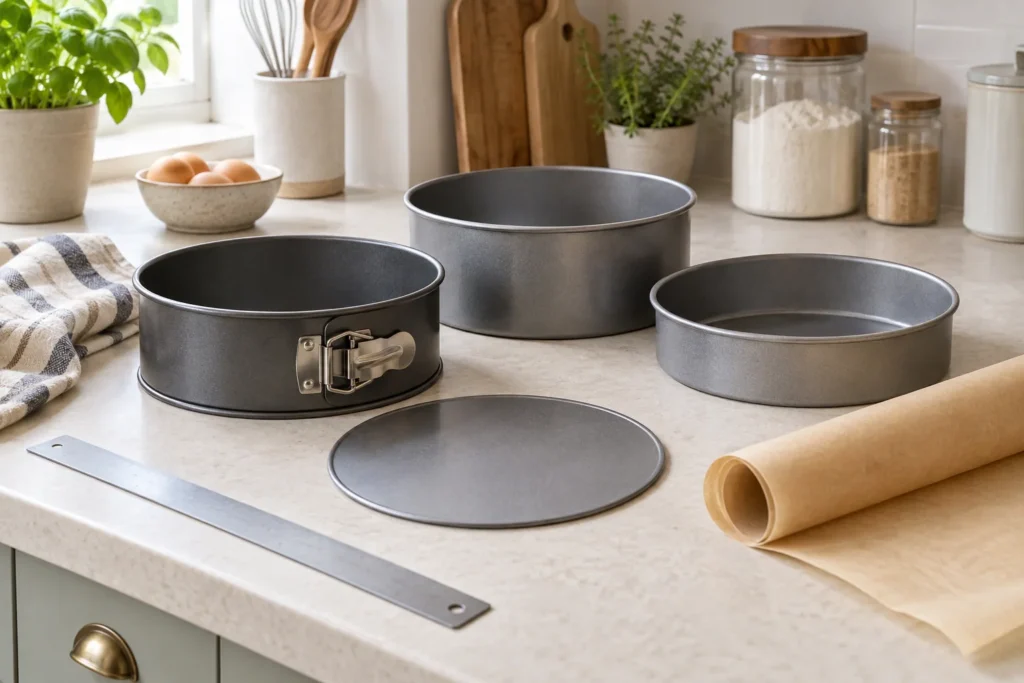
A useful cake tin is one that matches the recipes you actually bake, fits your oven and lets you remove the finished cake in the way the recipe expects. Start with those three jobs. A decorative shape or an impressive set of sizes is secondary if the tin you need every fortnight is missing.
Image: AI-generated editorial illustration of generic equipment; not a photograph of a reviewed product.
Table of Contents
Read the recipe specification first
Write down the shape, internal dimensions, depth and number of tins. Include any instruction about a removable base or an ungreased surface. A recipe asking for two shallow round tins has specified a different arrangement from one deep tin, even when all three have the same diameter. The importance of the original dimensions is explained in King Arthur Baking: why baking pan size matters.
Treat a missing measurement as something to resolve before buying. Check the publisher's equipment notes or ask the manufacturer how its dimensions are taken. An overall width that includes handles tells you whether a tin will fit the shelf; it does not tell you how wide the cake will be. Keep both measurements on your shopping note.
Separate the body from the surface
The material description should tell you what forms the tin and what touches the mixture. Steel with a non-stick finish, uncoated aluminium and silicone are different constructions. The word aluminium does not, by itself, identify the surface. For example, Silverwood: bakeware construction describes an uncoated anodised construction. That is a useful reminder to read beyond the first material label.
Avoid choosing from colour alone. A dark finish does not reveal its exact coating, and a shiny surface does not establish dishwasher permission. Look for a named range and its care instructions. If you share a kitchen, a clear cleaning routine may be more valuable than owning several tins that each need different treatment.
Decide how the cake will leave the tin
| Base design | How it opens | A useful question before buying |
|---|---|---|
| Fixed base | The cake must be lifted or turned out using the recipe's method | Does the recipe allow inversion or a lifting liner? |
| Loose base | The base separates from the surrounding wall | Can you support the cake while removing the ring? |
| Springform | A clip opens the side wall around the base | Is this release arrangement suitable for the finished cake? |
The release mechanism is a handling choice, not proof of a watertight seal. A separate base creates a join. If a recipe involves very fluid mixture or a water bath, check the exact tin's instructions and the recipe's specified equipment. Do not assume parchment converts an unsuitable join into a reliable seal.
Try the mechanism when the tin is empty and cool. Check that you can identify the correct base orientation, engage the clip or seat the base without forcing it, and find a clear place to put the released ring. This simple rehearsal often reveals awkward features that are difficult to judge from a product photograph.
Check the whole baking route
Measure the oven shelf, cupboard and cooling area as well as the tin. Include projecting clips and handles. Plan a route from the oven to a stable heat-resistant surface without needing to move other equipment while carrying the bake. A tin that fits only at an awkward angle is an inconvenient everyday choice.
Think about washing too. Can the tin be cleaned in your sink without balancing it on its edge? Are there removable pieces that could be lost in a busy washing-up bowl? Store a loose base with its own ring so similar sizes do not become mixed. Keep the product instructions or photograph the relevant label while it is still legible.
Build a small collection around repeated recipes
List your three most frequently baked cakes and count the equipment requirements they share. If two use the same pair of sandwich tins, that pair is a stronger starting point than a large assortment of specialist moulds. Add a Bundt, chiffon or miniature tin when you have a specific recipe and a practical storage place for it.
Before ordering, finish one sentence: this tin is for this recipe, in this oven, with this release method. If that sentence still contains guesses, resolve them first. Buying a clearly specified tin once is more useful than collecting several almost-right shapes and trying to redesign every recipe around them.