
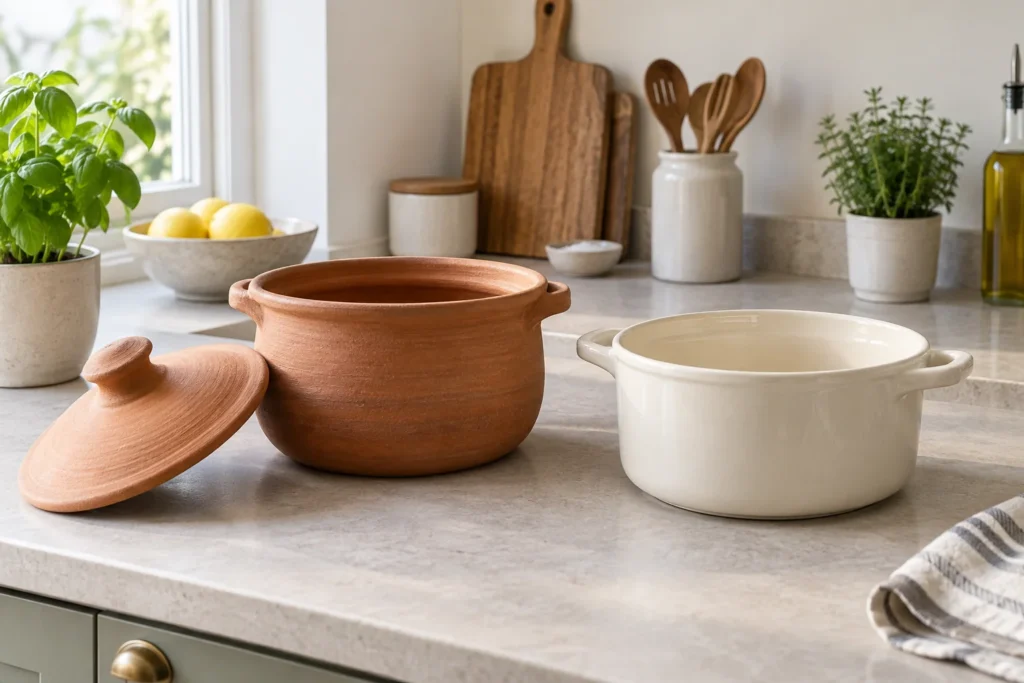
Choose a clay cooking pot by its intended use and exact first-use instructions. A clay oven roaster, a hob-approved donabe and a decorative ceramic vessel are not interchangeable. The material, glaze and construction can change the preparation and care routine, so identify the product before applying a general clay-pot method.
Image: AI-generated editorial illustration of generic equipment; not a photograph of a reviewed product.
Table of Contents
Establish the cooking purpose
Look for a manufacturer, model and explicit description of the permitted cooking method. “Traditional clay” or “handmade” does not establish hob, oven or grill suitability. If a vessel is sold for serving or display, do not infer cooking permission from its resemblance to a familiar pot.
Choose the recipe or cooking method you want to use before shopping. A shallow covered roaster and a deeper pot may fit different tasks even when their advertised capacities match. Check whether the recipe requires a particular vessel and whether it offers an alternative.
Read the glaze description
A pot can have a glazed lower section and an unglazed lid, or another combination. Römertopf model-dependent preparation guidance distinguishes components and models when discussing preparation. That is why a single instruction to soak “the pot” is not sufficiently precise for every product.
| Product detail | Question to answer |
|---|---|
| Lower vessel | Glazed or unglazed, and intended for which use? |
| Lid | Same material treatment or a different one? |
| First use | What exact preparation does this model require? |
| Repeated use | Is preparation repeated before each cooking session? |
| Heat source | Which appliance and starting conditions are permitted? |
Do not treat a broad care article as a substitute for the leaflet supplied with your exact model. If the two disagree, ask the manufacturer to resolve the difference before cooking.
Plan the first-use process
Read the full sequence before beginning. Note whether the maker specifies washing, soaking, seasoning or another preparation, and which component each step concerns. Prepare the required space and equipment without replacing the documented process with advice for metal cookware.
“Seasoning” can mean different things in different cookware contexts. An oil-based process for carbon steel is not automatically appropriate for clay. Likewise, a preparation method for one clay recipe vessel should not be copied into another whose glaze and intended heat source differ.
Check heating and temperature changes
Find the instructions for starting in a cold or preheated oven, adding ingredients or liquid, and removing the pot after cooking. Follow the model's restrictions rather than using the highest temperature you have seen attached to the material category.
Prepare a suitable resting surface and heat protection in advance. Consider how you will grip the lid and body, including the space around handles inside the oven. A pot that fits on the shelf but is difficult to withdraw is not a practical match for the kitchen.
Assess size and handling
Compare internal dimensions with the recipe's requirements and external dimensions with the oven and sink. Include lid height and side handles. Ask whether capacity means filling to the rim or the working volume for the manufacturer's intended method.
Think about the empty weight and the food you normally prepare. If possible, assess a cool display item without adding a challenging load. An attractive large pot may be less useful than a smaller one that is easy to store, lift and wash after an ordinary meal.
Keep condition and care separate
Inspect a new or inherited pot for visible damage and ask the maker about an uncertain mark. Do not assume every line is harmless glaze character or that every defect can be repaired by repeating preparation. Avoid home repairs to a cooking vessel unless the manufacturer supplies an appropriate approved route.
Read the ordinary washing and drying instructions, including any difference between glazed and unglazed components. Store as directed so the item can dry properly. Keep its identity and leaflet together; this is particularly helpful for a pot used only occasionally.
A clay pot is a considered purchase when its purpose, preparation and handling fit your routine. Choose the complete documented vessel, then follow its own method. That gives you a sound basis for using it without inventing a universal rule for every form of clay cookware.