
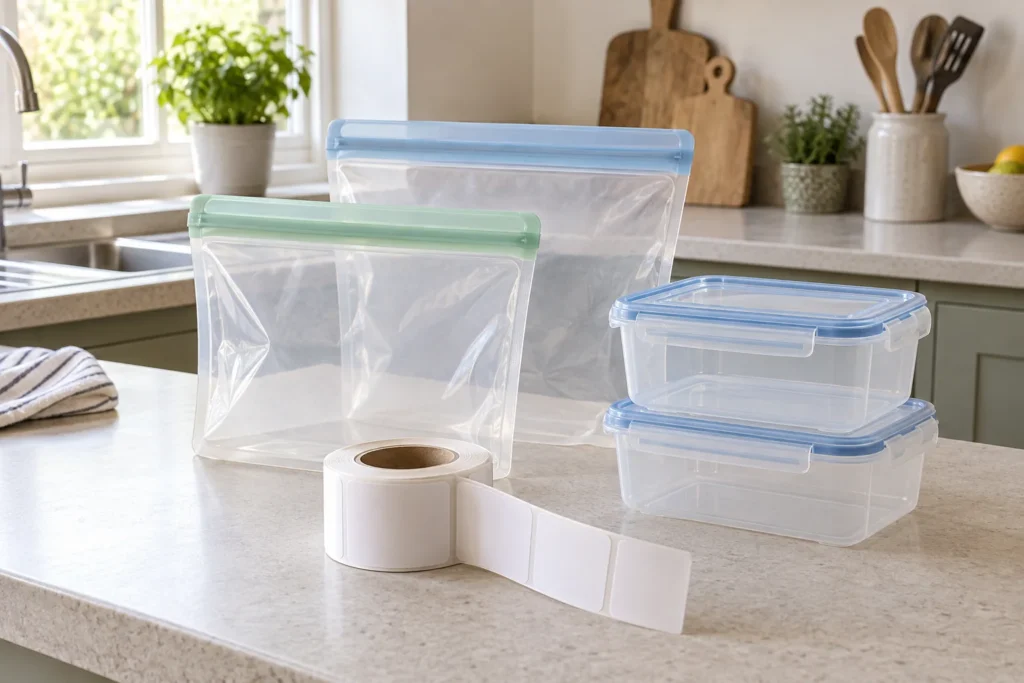
Containers for freezing food need a documented freezer use and a shape that works when the food is frozen. The easiest box to fill is not always the easiest portion to retrieve later. Start with the meal you expect to use, then choose a suitable container and a clear labelling method around it.
Image: AI-generated editorial illustration of generic equipment; not a photograph of a reviewed product.
Table of Contents
Verify freezer use for the complete product
Check the exact manufacturer’s instructions for the body, lid, seal and any insert. A material name does not establish every component’s permission. Keep the model reference and care information so the decision remains clear after the packaging is discarded.
For example, the IKEA 365+ steel container with bamboo lid distinguishes its freezer-suitable body from a lid that is not intended for the freezer. The assembly you choose must suit the actual task, not just contain one compatible component.
Plan portions around later use
Think about how many people normally need a portion at the same time. A single large container may suit one shared meal; separate portions can suit lunches or differing schedules. Do not choose the largest box merely because it reduces the number of lids.
Food Standards Scotland’s chilling guidance advises following the food’s freezing and defrosting instructions and notes the usefulness of smaller portions. Apply those instructions when planning the food itself; container selection cannot supply a universal storage duration or defrosting timetable.
Measure drawer fit with the lid attached
Record the freezer drawer’s usable dimensions and any obstruction at its opening. Include projecting clips and handles in the container measurements. A container that fits the drawer footprint may still catch when the drawer slides into the appliance.
Compare the arrangement with the freezer manual’s loading and airflow instructions. Use an empty-container planning exercise rather than leaving the freezer open while experimenting with food. Mark the planned layout on paper and check whether the most frequently used portions will remain accessible.
Leave filling limits to the correct instructions
Look for the container maker’s filling guidance and the food’s relevant directions. Do not invent one headspace amount for every food and every container. A printed fill line, where present, should be understood according to the product’s instructions rather than treated as a decorative mark.
If you cannot establish whether a container is suitable, choose one whose instructions answer the question. Avoid adapting an unidentified glass jar or a lid from another range simply because it appears to fit. Compatibility is a purchasing criterion, not something to infer from the absence of an immediate problem.
Label for identification before freezing
Write the actual food name and freezing date, and retain the instructions needed for later use. A frozen portion may no longer resemble the meal you remember preparing. Labels should be visible from the direction you normally look into the freezer, whether that means the lid or the front face.
| Decision | Useful information |
|---|---|
| Container permission | Exact body and lid freezer instructions |
| Portion shape | How much will be used together later? |
| Drawer layout | Complete external dimensions and retrieval path |
| Food identity | Name, freezing date and retained instructions |
| Reuse | Care and condition checks after the container is emptied |
Consider whether the intended portion will be used alone or combined with another frozen component. Two clearly identified small boxes can support separate choices, while one larger box may be appropriate when its contents are always used together. Plan that later decision before filling, rather than trying to divide an inconvenient frozen shape after the fact.
Choose a manageable working set
Count how many portions you actually keep in rotation and leave room for foods that arrive in their own suitable packaging. A large matching set is unnecessary if most boxes remain empty in a cupboard. Our kitchen storage guide can help with that wider space plan. Prioritise documented freezer compatibility and portions you can identify and retrieve without searching through the entire drawer.