
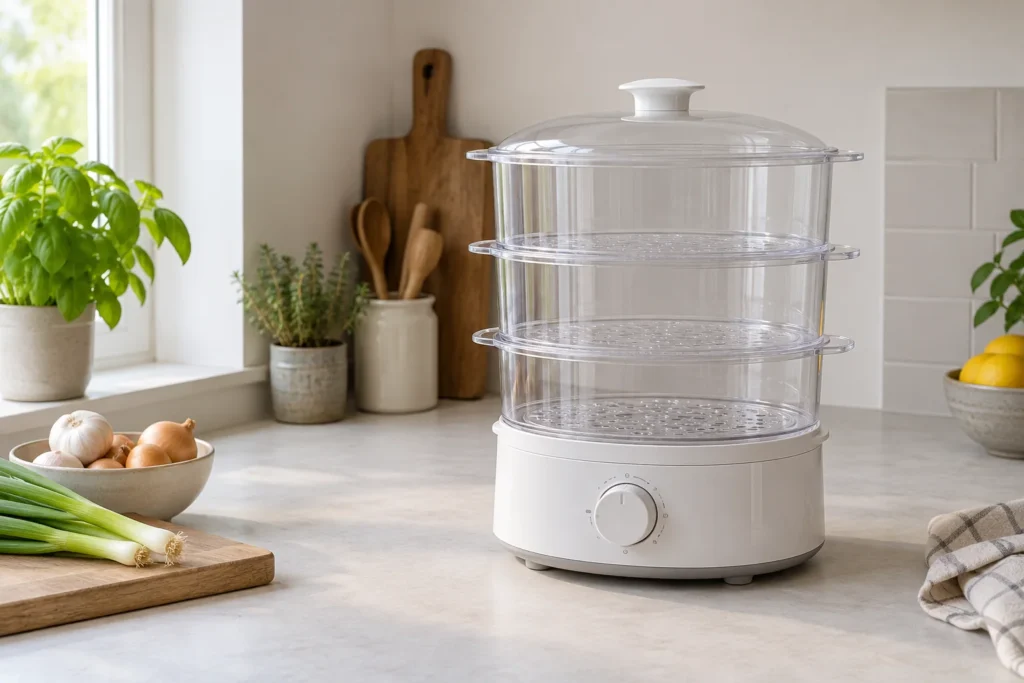
To cook rice in a food steamer, first confirm that the model supports rice and identify the bowl and method its manufacturer specifies. Do not pour dry grains straight into a perforated basket or borrow a ratio from an unrelated appliance. The useful starting point is a matched set of instructions: the steamer model, the rice type and the intended quantity.
Image: AI-generated editorial illustration of generic equipment; not a photograph of a reviewed product.
Table of Contents
Find the rice method for your model
Use the appliance model number to locate the manufacturer's manual. Check its date or revision as well as the number on the cover. Product names can remain familiar while the supplied accessories or instructions change, so a search result containing the right brand is not enough.
As one specific example, the Russell Hobbs 21140 instructions, August 2018 manual puts rice and water into the supplied rice bowl, directs readers to the rice packet for the water amount, and places that bowl in the bottom basket. That is an instruction for the covered model and manual revision, not a rule for every tiered steamer.
Read the entire rice section before measuring anything. Look for the quantity, type of rice, position of the bowl, filling instructions and how the manufacturer says to check progress. If an accessory is missing, ask for the approved replacement rather than assuming an ordinary bowl of similar diameter is suitable.
Separate the two water questions
There are two distinct entries to identify in a rice-steaming method: water associated with the rice and water used by the appliance to generate steam. Write them on separate lines in your preparation notes. This prevents an instruction about one container being mistakenly applied to the other.
For the Russell Hobbs example, the rice packet informs the water quantity in the rice bowl. The steamer's own filling instructions govern its reservoir. Neither entry should be inferred from how much room appears to remain in the other container.
| Note to record | Where to find it |
|---|---|
| Appliance and manual revision | Model label and manufacturer document |
| Rice variety and amount | Chosen method and rice packet |
| Bowl and basket position | Steamer rice instructions |
| Water associated with the rice | The source specified by that method |
| Reservoir filling and monitoring | Appliance operating instructions |
Use consistent units when copying the information. If one source uses grams and another describes a supplied cup, establish what the method requires rather than treating every cup as interchangeable. Keep the packet available for the first batch so that you can check its wording again.
Check fit before the cooking stage
Assemble the empty approved rice bowl in its stated position while everything is cold. Confirm that the basket and lid fit as the manufacturer describes. The space occupied by a bowl is different from the basket's advertised overall capacity, which may be intended to describe several kinds of food.
Plan the removal and serving arrangement using the appliance instructions. A deep bowl inside a tall basket can create a different handling task from lifting the basket itself. Have the intended resting place ready and make sure the serving utensil suits the bowl's material and shape.
Do not add other dishes merely because an unused tier is available. First check whether the manual describes that combination and whether the recipe accounts for it. A straightforward first batch gives you fewer instructions to coordinate and a clearer record of what you actually followed.
Start with a supported quantity
Choose a quantity explicitly covered by the method and within the bowl's permitted capacity. The largest theoretical amount that fits before cooking is not a useful substitute for a stated recipe quantity. If you need a substantially different amount, find a supported method for it rather than scaling the timing by arithmetic.
Follow the source's progress and finishing instructions. Keep separate notes on any practical difficulty: an unclear measuring unit, an awkward bowl or a rice packet whose method does not match the steamer's reference. These are specific questions for the manufacturer, not reasons to invent a universal rice-to-water ratio.
Save a repeatable setup
Keep the rice packet details, appliance model, bowl and quantity with the recipe link. After using the supported method, note whether the serving size suited your meal and whether the equipment was convenient to handle. That record helps you repeat a known setup or ask a precise question before changing it. Follow official guidance for any storage or reheating; this equipment guide does not establish a leftovers method.