
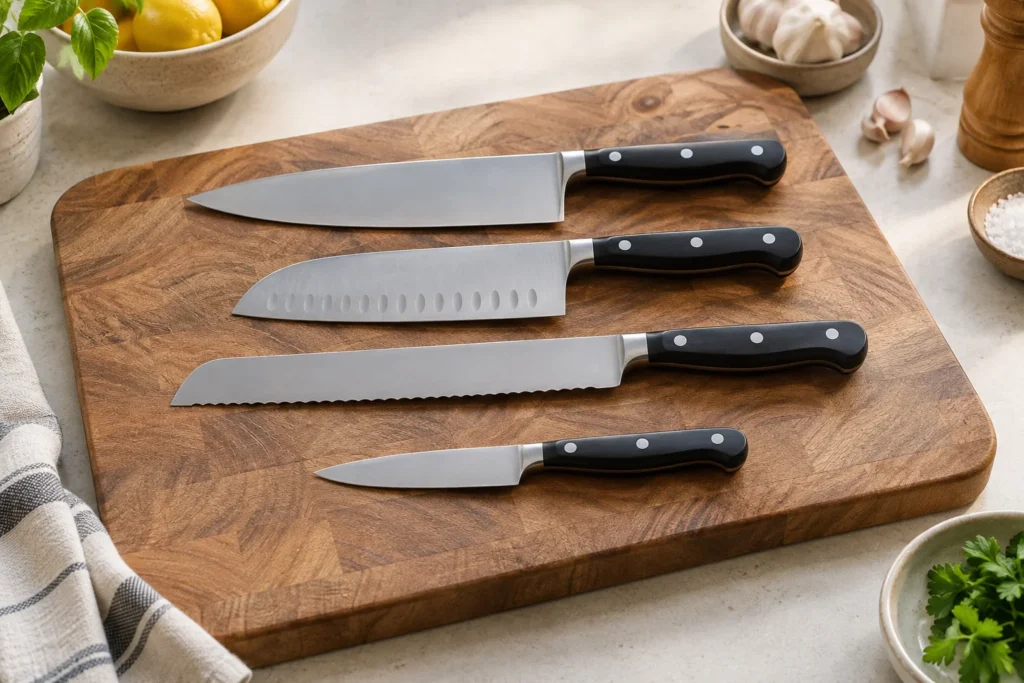
Damascus kitchen knives attract attention because of their visible patterns, but appearance is only one part of the purchase. To compare them usefully, identify what the manufacturer says about the construction, the cutting core, the edge and the intended care. A striking photograph cannot answer those questions by itself.
Image: AI-generated editorial illustration of generic equipment; not a photograph of a reviewed product.
Table of Contents
Ask what the Damascus description refers to
KAI’s materials guide describes modern Damascus construction as visible layers combined with a core steel. That distinction helps separate the patterned surrounding material from the specification of the steel at the cutting edge.
Look for the exact maker’s description rather than assuming every patterned blade uses the same construction. If the listing does not explain what the layers or pattern represent, ask for clarification. Avoid diagnosing authenticity from a small online image alone.
Read the core steel separately
Record the named core material where supplied. Then note any stated cladding or outer layers. Keep those fields distinct in a comparison so a large layer count does not substitute for missing information about the working edge.
Do not convert a steel name into a complete performance ranking without evidence. Heat treatment, geometry and the intended use also belong to the product specification. If a maker provides a hardness range, record it as a stated range, not a first-hand measurement or proof that the knife will suit every task.
Compare geometry and the actual food task
Choose the blade shape and length from your regular preparation needs. A patterned chef’s knife, santoku and long slicer can have very different jobs. The decorative treatment does not make them interchangeable.
Check the bevel, any handedness restriction and the manufacturer’s exclusions. Do not assume a broad blade is intended for bones or frozen food, or that a thin edge should be maintained with the same tool as another knife in the drawer. The specific instructions remain the relevant guide.
Treat layer count as a description
More layers do not, by themselves, provide a complete measure of usefulness. Ask what the number includes and whether the maker explains the construction clearly. Two manufacturers may present their specifications differently, so compare the underlying description rather than arranging products by the largest figure.
Keep aesthetic preference honest. It is reasonable to enjoy a particular pattern or handle finish without claiming that it demonstrates sharper cutting or greater durability. A visual preference becomes a purchasing choice after the practical requirements are satisfied.
Compare a complete specification card
| Field | What to record |
|---|---|
| Construction | Maker’s explanation of core and patterned layers |
| Blade geometry | Shape, length, bevel and intended tasks |
| Material data | Named steels and stated hardness where supplied |
| Handle | Actual construction and care instructions |
| Maintenance | Supported sharpening, washing and storage method |
For a practical comparison, choose two knives intended for the same task and of a manageable size. If one supplies clear core and care information while the other offers mainly pattern photographs, the missing information is a reason to investigate further. It is not a basis for inventing either a favourable or unfavourable performance result.
Separate appearance from missing information
A useful comparison can be made without deciding which pattern looks more impressive. Put two candidate knives in adjacent columns and list core material, blade length, bevel information, handle construction and the documented sharpening route. Put unknown beside any missing entry. Then assess the pattern as an appearance preference in its own row. This prevents a richly described finish from distracting from a missing functional specification. If one seller supplies only a layer count while another explains the cutting core and care, ask the first seller for equivalent information. Do not assign a performance advantage to the more detailed pattern simply to complete the comparison.
Choose the knife beyond the pattern
Consider handling, storage and the maintenance route before purchase. If a specialist sharpening service is required or preferred, establish that it can work with the exact blade. Our knife-set guide offers wider collection context. Choose a Damascus knife whose construction and intended use are documented, then let appearance decide between suitable options.