
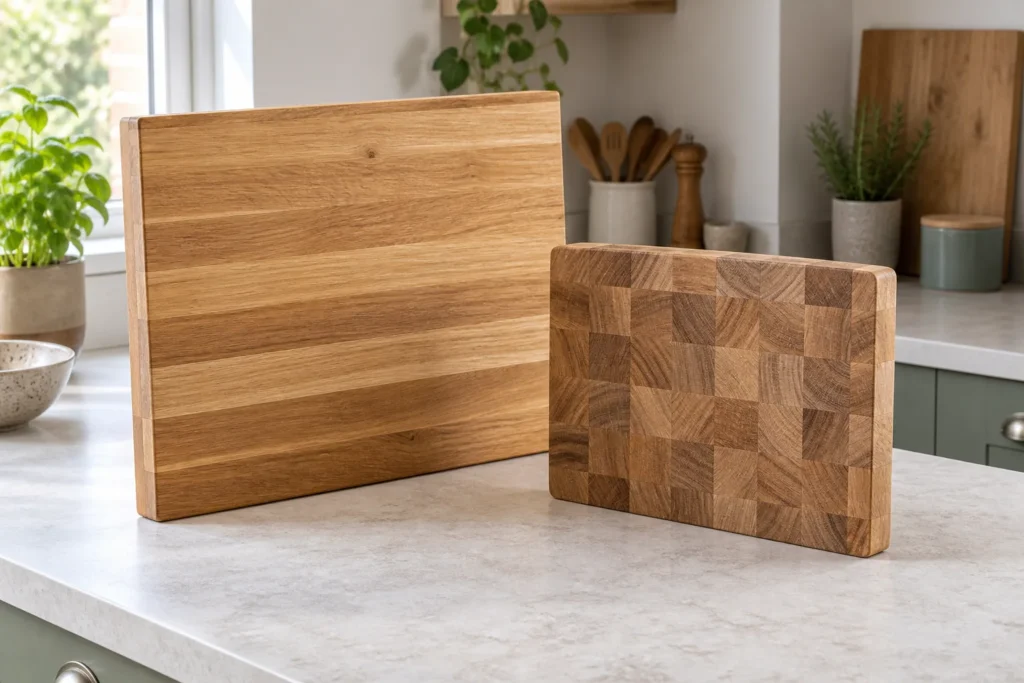
End-grain and edge-grain chopping boards describe how wood is arranged at the working surface. The pattern can help you recognise the construction, but it does not provide a complete assessment of the board’s quality or suitability. Compare the actual product, including dimensions, joints, weight and care instructions.
Image: AI-generated editorial illustration of generic equipment; not a photograph of a reviewed product.
Table of Contents
Understand what the names describe
John Boos’s board FAQ describes its end-grain boards as assembled from the end pieces of wood rails, creating a block-like pattern, and its edge-grain boards as using longer rails along the board. This explains the construction distinction without proving that any board with a similar pattern performs identically.
Look for the maker’s stated construction rather than relying only on a styled photograph. Decorative patterns, mixed woods and surface treatments can make visual identification less straightforward. If the material arrangement matters to the purchase, obtain a clear specification.
Compare boards of a useful size
Choose the footprint from your usual preparation tasks and worktop space. Then compare end-grain and edge-grain candidates within that useful range. A very large, thick example of one construction and a small, thin example of the other do not isolate construction as the reason they feel different.
Record external dimensions, usable cutting area and any grooves or handle cut-outs. Check whether both sides are intended for cutting and how feet or other fittings affect use. A reversible surface can be convenient, but it should be established for the actual board rather than inferred from its shape.
Include lifting and washing
Check the published weight and consider the board’s journey from storage to worktop, washing area and drying position. A board that stays on the counter still needs an appropriate care routine. Do not choose solely for the impression of solidity if lifting it is awkward for the intended user.
Measure the sink area and storage slot. A thick board may not fit a rack intended for thinner boards, and handles may project beyond the listed cutting area. The complete product needs to work through the whole kitchen routine.
Read performance claims carefully
Manufacturers may make claims about blade friendliness, marking or durability. Keep those claims attributed to the exact product and distinguish them from independent testing. A patterned surface is not evidence of measured edge retention, and a higher price does not supply missing performance data.
If comparing claimed benefits, look for how the maker supports them and whether the comparison involves similar boards and use conditions. Avoid turning a general construction explanation into a guarantee that the board will not mark, warp or need maintenance.
Check joints, finish and care information
| Specification | Practical question |
|---|---|
| Construction | What wood arrangement does the maker actually describe? |
| Dimensions and weight | Can it be used, washed and stored comfortably? |
| Finish | Which cleaning and maintenance products are permitted? |
| Joints and condition | What inspection and repair guidance is provided? |
Keep the oiling or finish-care instructions with the product reference. Do not assume a maintenance method suitable for one board is appropriate for another coating or wood assembly. If joints separate or the surface changes, seek the maker’s condition advice rather than treating oil as a structural repair.
Compare equal working tasks
Suppose you are comparing a thick end-grain board with a thinner edge-grain board. Put their actual footprint, weight and storage height on the same sheet before judging the construction label. If the larger board cannot be lifted and washed conveniently in your sink, its extra work area may not be useful to you. Conversely, a smaller board that stores easily may require more frequent clearing during a large preparation task. These are differences between the particular boards, not proof that all boards of either construction behave alike. Separate each dimensional trade-off from the grain description when making the final choice.
Choose the board you can maintain
As a practical comparison, shortlist one manageable board of each construction and record their actual care and storage requirements. The easier fit for your household may depend on weight or dimensions more than the visible grain pattern. Our main chopping-board guide covers the broader material decision; use construction as one part of a complete product assessment.