
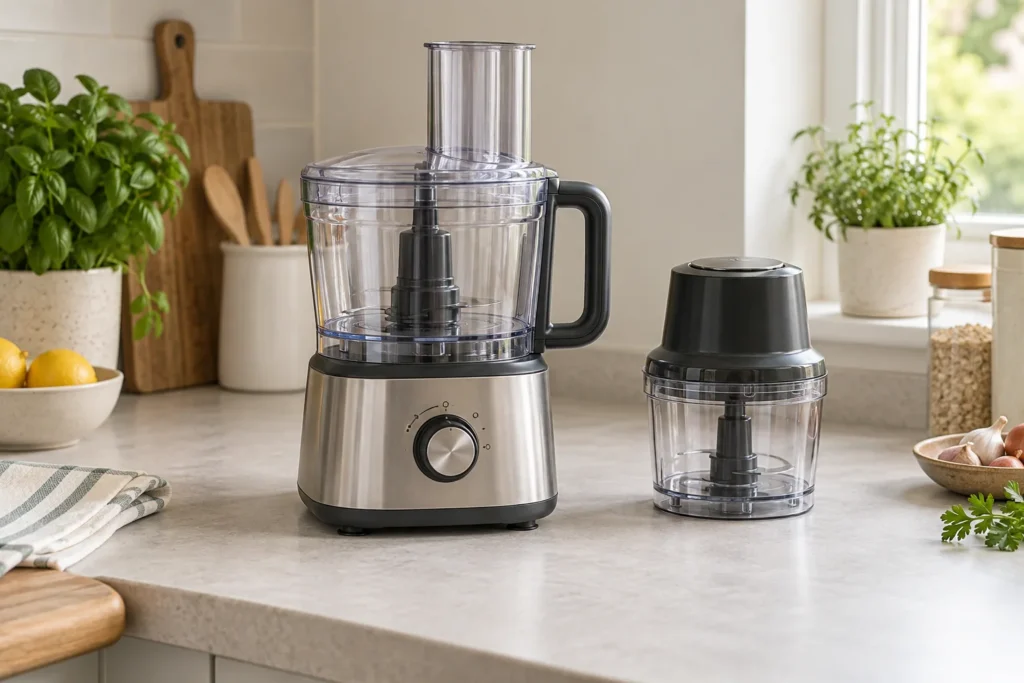
A food processor’s chopping blade does not produce the same cutting action as a dedicated dicing system. If your recipes need recognisable cubes, look for an actual compatible dicing kit and its instructions. The grid, slicing component, feed arrangement and cleaning tool all matter to whether the accessory is useful.
Image: AI-generated editorial illustration of generic equipment; not a photograph of a reviewed product.
Table of Contents
Confirm that it is a dicing system
Read the parts list rather than relying on the word dice in a broad description. A processor may be described as chopping vegetables for a diced-style recipe without including a dedicated grid. Ask what component establishes the cube dimensions and how it works with the rest of the appliance.
The KitchenAid UK 5KFP1319 listing explicitly includes a dicing kit and cleaning tool, separately from its multipurpose blade and slicing disc. That is a useful example of the distinction. It does not imply that the kit fits another KitchenAid processor or a stand-mixer attachment.
Match the exact machine and accessory codes
Record the processor model and the dicing kit reference. Confirm the approved pairing in the manufacturer’s information, including any required adapter or lid. Similar bowl capacity or the same brand logo does not establish that the cutting system will seat and operate correctly.
For a used kit, compare the contents against the official diagram. A missing cleaning tool may look unimportant until food is lodged in the grid. A missing support or lid is more than an inconvenience. Do not operate an incomplete arrangement or substitute a household object for a specified component.
| Specification | Why you need it | How to assess it |
|---|---|---|
| Cube dimensions | Determines whether the cut suits the recipe. | Use a published measurement; leave it unknown if absent. |
| Supported ingredients | Not every food behaves suitably in a grid. | Read the exact preparation guide. |
| Feed dimensions | Determines any required trimming before processing. | Compare with the vegetables you normally buy. |
| Cleaning tool and method | The grid needs safe access after use. | Check that the required tool is included. |
Compare the cut with your actual recipes
Think about where uniform cubes matter to you. A chopped sauce base may not need a grid, while a salad or a dish with visibly separate pieces may benefit from a particular size. If the manufacturer does not state that size, do not estimate it from a photograph and present the estimate as a specification.
A larger feed tube can reduce some preparation, but it does not remove the ingredient instructions. Foods may need trimming, peeling or another preparation stage before loading. Include that work when deciding whether the attachment saves enough effort for your usual quantity.
Follow the approved loading arrangement
Fit the kit exactly as the manual describes and use its supplied pusher. If the food does not move through as expected, stop through the approved procedure and investigate the supported ingredient size and assembly. Extra force is not a substitute for a correct fit.
Keep fingers and improvised tools away from the grid and feed path. A dicing system has several cutting surfaces, and some may be less obvious than the main knife blade. Treat disassembly as part of the operating method rather than an afterthought.
Make cleaning part of the purchase decision
Read how the cleaning tool is used and which parts may be washed. A grid full of vegetable fragments can make an otherwise quick preparation task inconvenient if the cleaning process does not suit you. Assess the whole job, including drying and storage.
Store the kit so that its cutting surfaces and supports are protected. Do not pile heavy pans onto a grid or leave the cleaning tool separated from it. Keeping the complete set together makes it easier to identify missing or damaged parts before the next use.
Choose a dicer for a recurring need
If you regularly prepare a supported ingredient in the stated cube size, a compatible kit may address a real task. If you mostly need rough chopping, a standard blade or a knife may already be sufficient.
A dicing label is not a guarantee of identical cubes with every vegetable. This guide compares documented components and practical requirements, without claiming measured cut quality. Use the exact manual and the meals you repeat to decide whether the attachment earns its storage space.