
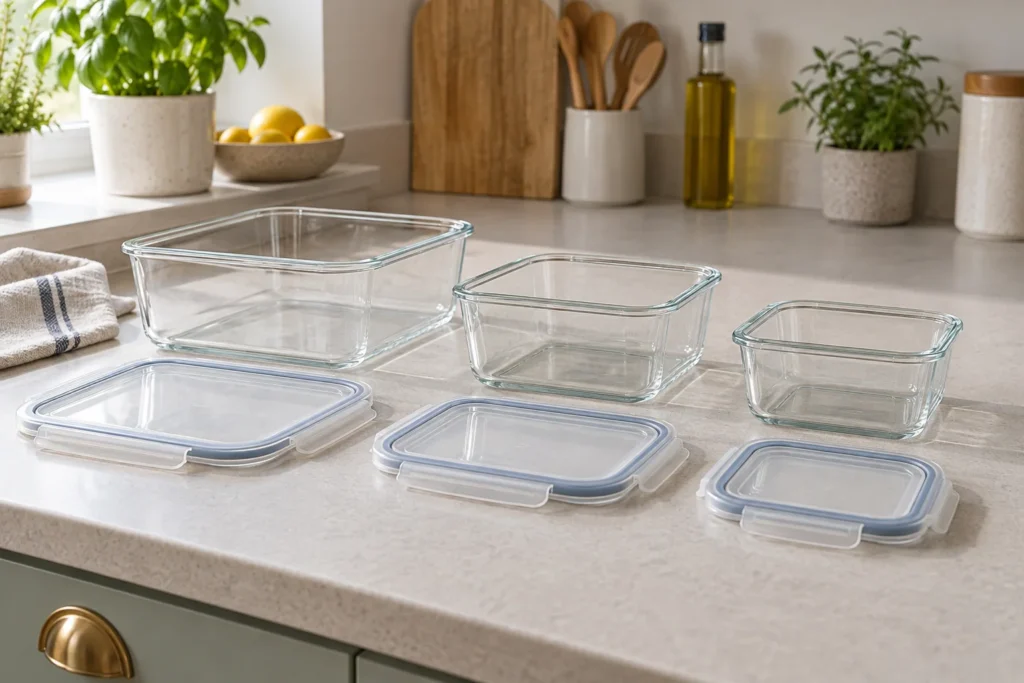
The most useful food storage containers are the ones that match what you put in them and where they have to fit. A large mixed set can leave you with plenty of tiny pots but too few boxes for ordinary leftovers. Before comparing materials, spend a few days noticing which containers you reach for, borrow or wish you had.
Image: AI-generated editorial illustration of generic equipment; not a photograph of a reviewed product.
Table of Contents
List the jobs your set must cover
Separate storing food at home from carrying it outside the house. A box that works well on a fridge shelf might be too bulky for a lunch bag. A deep tub can suit loose ingredients but be inconvenient when you want to eat directly from it. Write down three or four regular jobs and the approximate portions involved.
Use the containers you already own as references. If your usual lunch fits comfortably in one, record its stated capacity and external measurements. If it is always too deep, the next purchase needs a different shape, not necessarily a larger volume. A shortlist based on actual meals is more useful than an imagined weekly meal-prep routine you do not follow.
Count usable containers, not just pieces
Read exactly what the advertised piece count includes. The number may include lids, inserts or accessories as well as boxes. Make a simple inventory of complete container-and-lid pairs in each size. Then compare that with the jobs on your list.
For example, a household might need two lunch boxes in use and two more being washed or filled. That is an illustrative rotation, not a recommended number for everyone. A person who packs lunch only occasionally will have a different requirement. The practical calculation is how many complete pairs you need at the same time.
Compare materials as complete assemblies
The body, lid, seal and clips may have different materials and care instructions. IKEA’s 750 ml round IKEA 365+ container, for example, lists polypropylene for the body and lid and silicone rubber for the seal. That illustrates why “plastic container” is not a complete description of every component.
| Question | What to look for |
|---|---|
| Will I carry it? | Filled weight, grip and the maker’s closure claims |
| Will I reheat food in it? | Specific permission and instructions for the body and lid |
| Will it be frozen? | Freezer instructions for the complete product |
| Will I wash it by hand? | Access to corners, seal channels and clips |
| Will I use a dishwasher? | Component-by-component dishwasher instructions |
There is no need to choose one material for the whole kitchen. You might prefer one format for food that stays at home and another for a bag carried on public transport. Compare those jobs separately rather than expecting a single set to win every category.
Make the lid system earn its cupboard space
Check whether multiple sizes genuinely share lids. Similar-looking rims do not establish compatibility. Look for a model or range reference you can keep with the instructions, particularly if you intend to buy matching pieces later. Ask whether the manufacturer supplies replacement lids or seals; do not assume it does.
Consider opening effort as well as closing confidence. Can everyone who uses the container operate the clips and remove the lid? A closure that feels straightforward on an empty box may be less convenient when the container is full and the surrounding shelf is crowded. Where possible, handle a sample before committing to a large set.
Measure the route through your kitchen
Check the fridge shelf, lunch bag, drawer and washing area rather than measuring only the cupboard. Include handles and projecting clips in external dimensions. For empty storage, decide whether you prefer nested boxes or complete pairs with lids attached; both use space differently.
Our kitchen storage guide can help place the set within the wider cupboard layout. Keep the most frequently used sizes easiest to retrieve. If obtaining one lunch box requires dismantling an entire stack, reconsider the arrangement before buying another matching set.
Buy a small working combination first
Choose the missing sizes that solve current problems, then use them through an ordinary household week. Record what remains inconvenient: lid sorting, carrying, portions or washing. Expand only where that experience identifies a real gap. This makes the purchase decision specific and leaves room for containers that you will actually use.