
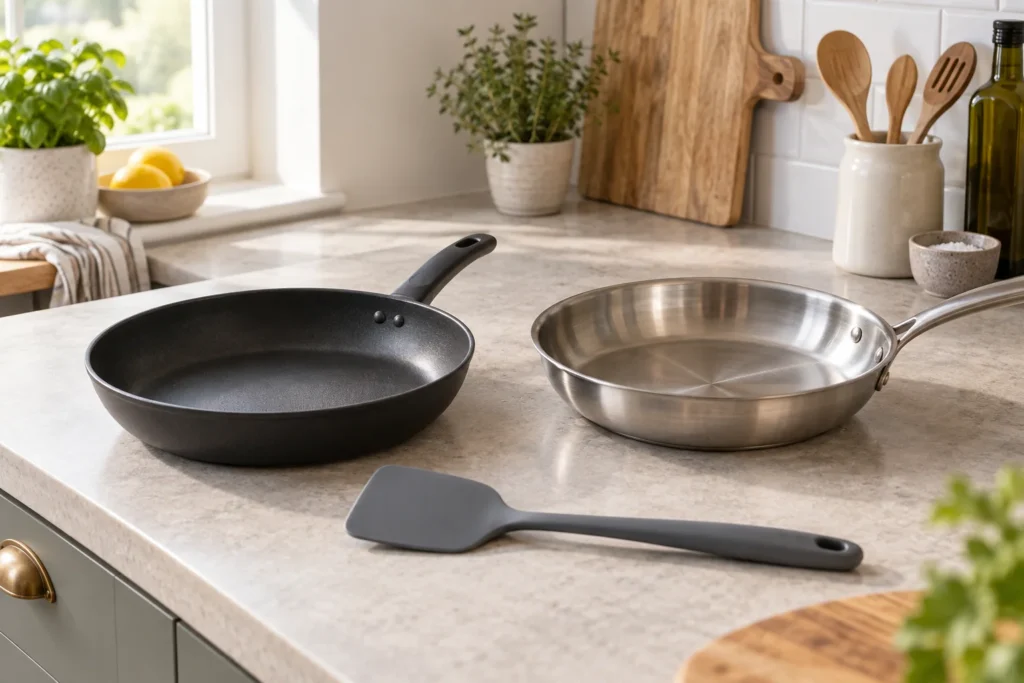
Compare “granite” and “ceramic” cookware by finding the actual cooking-surface specification. A stone-inspired name or speckled finish does not identify every material in the pan. Record the coating, underlying body and base separately before comparing care instructions, hob suitability or the way you intend to cook.
Image: AI-generated editorial illustration of generic equipment; not a photograph of a reviewed product.
Table of Contents
Treat the name as a starting point
A manufacturer may use a distinctive coating name to identify its own range. That name is useful for finding the right instructions, but it is not a complete technical description. Look for a separate field labelled internal coating, materials or construction, especially when several promotional names appear in the title.
For example, BALLARINI Bologna Granitium 28 cm wok specification lists Granitium as a coating name and PTFE as the internal coating for that particular model. This does not establish that every product described as granite contains PTFE. It demonstrates why a surface's appearance or stone-related name cannot answer the question on its own.
Identify what “ceramic” describes
Ceramic cookware can also be an ambiguous shopping category. In a ceramic-coated metal pan, the term refers to the cooking surface rather than an all-ceramic body. GreenPan ceramic-coated range comparison describes metal constructions separately within its ceramic non-stick ranges. Check which meaning applies to the candidate in front of you.
Do not assume a white interior proves a ceramic coating or a dark interior rules one out. Colour is a design choice, not a substitute for the maker's materials statement. If the specification is missing, ask for it before drawing conclusions about the coating.
| Comparison field | Candidate A | Candidate B |
|---|---|---|
| Named coating and stated type | Copy the exact specification | Copy the exact specification |
| Pan body | Record the documented material | Record the documented material |
| Hob suitability | Check your actual hob | Check your actual hob |
| Complete oven permission | Include handle and lid | Include handle and lid |
| Cleaning and utensils | Read the range instructions | Read the range instructions |
Leave unanswered fields blank until the maker supplies the information. Filling them from a photograph creates a misleading comparison.
Compare the pans in the same size and shape
A coating comparison can become confused by differences in pan depth, cooking area or handle design. Choose candidates intended for the same task. Check the flat interior area as well as the rim diameter, and record empty weight on the same basis, including or excluding lids consistently.
Think about ordinary handling: lifting from a cupboard, placing on the hob, moving to a resting surface and washing. A surface label cannot tell you whether a heavy lid or wide handle fits your routine. Those details can be more decisive than the coating name.
Read the use limits without blending them
Follow each maker's heat, preheating and utensil guidance. Do not combine the highest temperature from one range with the cleaning permission from another to create an imaginary best-of-both routine. A coating may be part of a complete system whose handle or lid sets a lower limit for a particular use.
If a page has inconsistent specifications, ask the manufacturer which applies to the exact product code. Keep the answer with the care leaflet. A contradiction is a reason to clarify the product, not to select whichever figure is most convenient.
Avoid unsupported health and lifespan rankings
This guide does not rank coatings by health benefit or claim a fixed number of years of use. “Natural”, “stone”, “green” and similar words do not provide a measured answer to either question. Look for specific statements relevant to the product and the intended task rather than relying on broad promotional reassurance.
Choose a pan with clear construction information, suitable dimensions and a care routine you can follow. If two candidates meet those needs, comfort, storage and the current delivered cost may decide the purchase. The useful comparison is between documented complete pans, not between attractive names applied to their surfaces.