
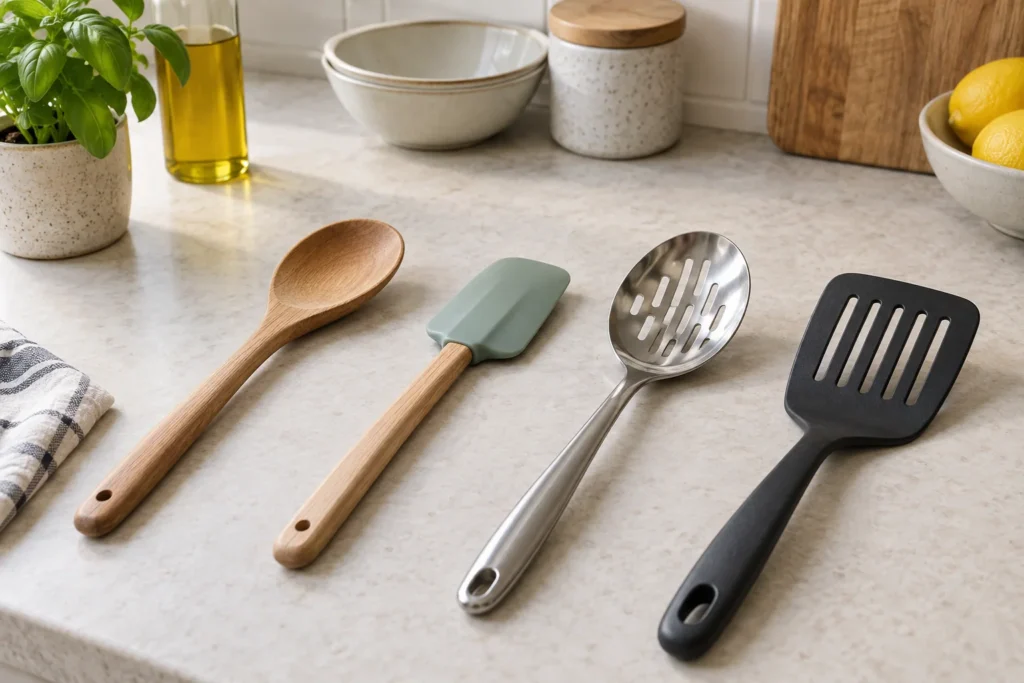
Clean a stainless steel kitchen utensil according to the complete item, including its handle and joints. A steel head does not automatically make a wooden grip, bonded insert or detachable component suitable for the same treatment. Identify the tool before reaching for a strong cleaner or putting an unfamiliar piece through the dishwasher.
Image: AI-generated editorial illustration of generic equipment; not a photograph of a reviewed product.
Table of Contents
Establish the normal washing method
Look up the maker and model, or read the supplied care leaflet. OXO UK stainless-steel utensil care states that OXO's stainless-steel cooking utensils can be washed in a dishwasher. That is useful permission for the manufacturer's relevant tools; it should not be inferred from the appearance of another utensil.
If you cannot identify an item, start by asking the seller or manufacturer for its care information. This is particularly worthwhile for inherited utensils with mixed materials or a loose connection. Avoid experimenting with a treatment merely because a different steel object tolerated it.
Inspect before choosing a cleaner
Let a used tool cool as appropriate, then examine it in good light. Separate food residue from a change in the metal's appearance and from physical damage. A deposit trapped around a rivet presents a different problem from a cracked handle. Cleaning can address residue; it does not secure a failing joint.
| Observation | Useful next check |
|---|---|
| Food caught in slots | Can the cleaning tool reach both sides? |
| Residue at a handle connection | Does the maker describe disassembly? |
| Spots remaining after ordinary washing | What deposit-removal method is approved? |
| Rough edge or loose part | Is the utensil damaged rather than dirty? |
Photograph a persistent mark after the normal wash if you need to ask the manufacturer. Include a whole-tool view as well as the close-up. A support team can identify construction more easily when it can see the head, handle and any product marking.
Clean openings and joins deliberately
For a tool whose instructions permit hand washing, use the recommended method and a cleaning implement suited to its openings. Work around slots, the underside of a spoon bowl and the neck where food can collect. Do not force a brush or pointed object into a sealed joint.
Only detach parts that the maker intends to be removed. Taking apart a riveted or bonded utensil can create a problem that ordinary washing would not solve. If a removable head or grip is part of the design, follow the reassembly instructions and check that it is seated correctly before reuse.
Use the dishwasher permission precisely
Read any rack-position or cycle restrictions as well as the headline permission. Arrange utensils according to the dishwasher's loading guidance so water can reach the working surfaces and long handles do not obstruct moving parts. A bundle of nested spoons is not the same arrangement as separate exposed surfaces.
After washing, inspect the contact areas instead of assuming the cycle resolved every deposit. Allow the tool to dry before enclosed storage and deal with retained residue using the approved method. If a decorative finish or handle changes, stop and check the relevant care information rather than repeatedly trying a hotter cycle.
Treat stubborn marks as a separate question
Do not apply a cookware cleaning recipe to a utensil without checking its compatibility. A treatment suitable for an uncoated saucepan may be inappropriate around a handle material or bonded connection. Ask which product, concentration and contact time the maker permits when ordinary cleaning leaves a persistent mark.
Avoid combining cleaners or improvising increasingly abrasive methods. The aim is to remove the identified deposit while preserving the tool's working surface. If the manufacturer recommends a specialist cleaner, read that cleaner's instructions too; the utensil and cleaning-product guidance need to agree.
Make the next wash easier
Give utensils enough storage space that you can see their condition and identify them. Keep a brief care note for unusual pieces, especially those that differ from the rest of a set. A simple “hand wash: wooden handle” reminder is more useful than a general assumption that everything silver belongs in the dishwasher.
Review a troublesome tool after several normal uses. If the same inaccessible joint repeatedly traps residue, that is a useful design consideration when replacing it. Choose a new utensil with cleanable construction and clear instructions, rather than relying on a stronger cleaner to compensate for a shape that does not suit your routine.