
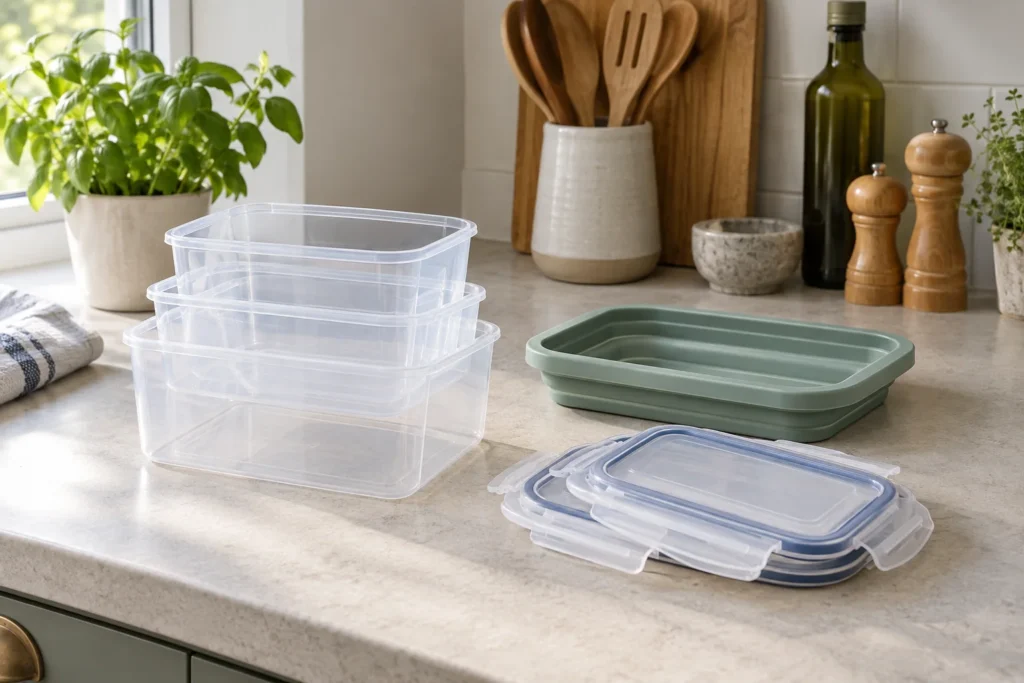
An overflowing container drawer often contains fewer useful boxes than it appears to. Some bodies have no lid, some lids belong to another range, and several tiny pots may never be used. Start by counting complete, usable pairs before deciding that you need a larger organiser or another set.
Image: AI-generated editorial illustration of generic equipment; not a photograph of a reviewed product.
Table of Contents
Match the collection on a clear surface
Bring clean, dry containers and lids together in one place. Group obvious matching ranges, then confirm uncertain pairs against their product markings or manufacturer information. Do not force a lid onto a similar-looking rim merely to clear the unmatched pile.
Keep a temporary “identify” group for parts that need further checking. This prevents an uncertain lid from repeatedly returning to the drawer as if it were a known match. Photograph model references that are difficult to read so you have a record when looking for instructions or replacements.
Count by household job
Make three or four useful categories based on actual use: lunch portions, larger leftovers, small ingredient pots and anything genuinely task-specific. Record how many complete pairs you have in each group. This is more informative than a total number of pieces.
Notice whether the collection is unbalanced. If the daily problem is a missing lunch box, a drawer full of miniature dressing pots does not solve it. Equally, a large box may be worth keeping if it has a regular role even though it occupies more space than several small ones.
Remove uncertainty about care
Check the exact instructions for any container you intend to heat, freeze or put in a dishwasher. For example, IKEA’s round 750 ml 365+ container has a specified range and use instructions. That type of identifiable reference is more useful than a general assumption about all plastic tubs.
Follow the maker’s condition and replacement guidance for damaged components. If the lid or body is no longer suitable, check whether a verified replacement exists. When disposing of something, follow the local route for its actual material rather than assuming every kitchen plastic belongs in the same recycling collection.
Choose between pairs and separate lids
Storing complete pairs makes the next container easy to find but can use more height. Nesting compatible bodies and storing lids separately may reduce the footprint, although it adds a matching step. Choose according to the space and the frequency with which you use each size.
You do not need one method for everything. Frequently used lunch boxes can remain paired while occasional large containers are nested nearby. The best arrangement reduces the movements required for everyday tasks instead of forcing every item into the same visual pattern.
Measure the drawer with its obstructions
| Dimension | What to include |
|---|---|
| Usable width | Space inside the drawer sides, not the front panel |
| Usable depth | Rear fittings and the part you can comfortably reach |
| Clear height | Lids or handles projecting above containers |
| Opening path | Whether a tall piece catches when the drawer moves |
Use paper strips or temporary dividers to trial groups before buying an insert. Give each group enough room to remove and return a piece. A tightly packed arrangement can look efficient while making the drawer difficult to maintain after washing-up.
Set a simple return rule
Make the storage location obvious to everyone who puts dishes away. Label the section by size or use if that helps, and keep uncertain parts out of the working groups until they are identified. When a new container enters the kitchen, assign it a place and record its compatible lid immediately.
Our kitchen storage guide offers wider cupboard options. For the container drawer, the most useful result is modest: every regularly used body has an identifiable lid, and retrieving one complete pair does not require emptying the drawer.