
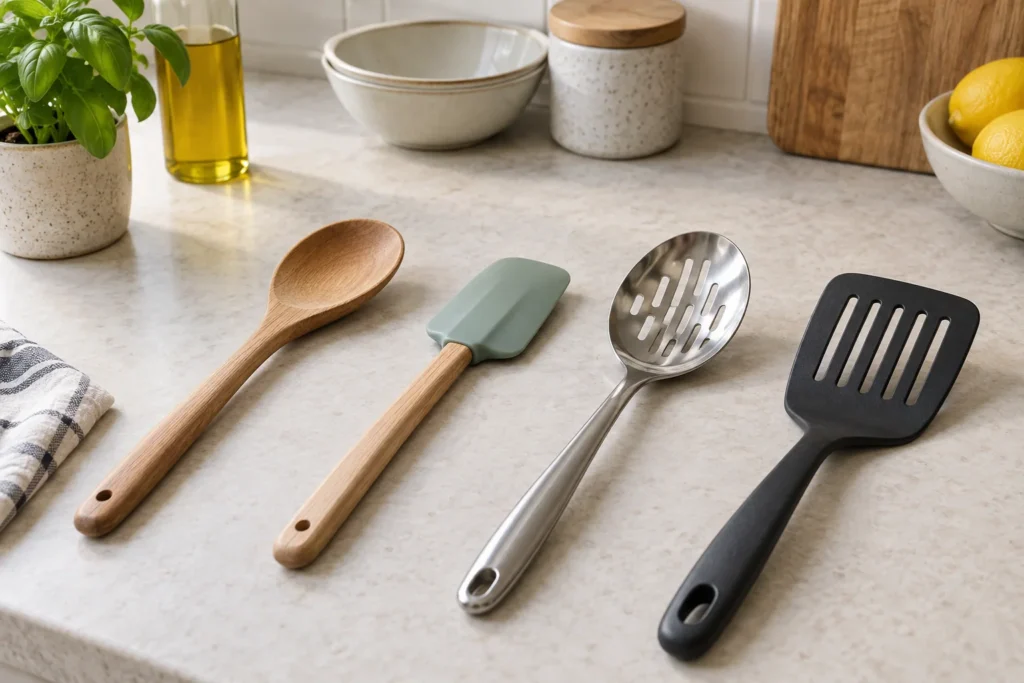
Kitchen utensil names are easiest to understand when you connect the head's shape to its job. A spoon holds or moves food; holes let liquid pass through; a broad flat head supports food from underneath. Start with those clues and unfamiliar recipe instructions become easier to translate into the tools in your drawer.
Image: AI-generated editorial illustration of generic equipment; not a photograph of a reviewed product.
Table of Contents
Stirring and serving tools
A cooking spoon usually has a shallower bowl than a ladle. It is useful for moving a mixture around a vessel, although its exact shape varies. A ladle has a deeper bowl arranged to scoop and transfer liquid. Choose its size around the saucepan and the serving bowl, rather than expecting every ladle to deliver the same portion.
A slotted or perforated spoon lets some liquid drain as food is lifted. A skimmer has a relatively broad, shallow head, often with small holes or mesh. The names can overlap in shops, so examine the working surface. Rösle cooking and serving tools separates several of these forms in its cooking and serving range; the head design is the useful distinction for the home cook.
| Name you may see | Recognising feature | Typical reason to reach for it |
|---|---|---|
| Cooking spoon | Solid, fairly shallow bowl | Stirring and mixing |
| Ladle | Deep bowl | Transferring soup or sauce |
| Slotted spoon | Bowl with holes or slots | Lifting food while leaving some liquid behind |
| Skimmer | Broad, shallow perforated or mesh head | Collecting material near a liquid's surface |
| Pasta server | Pronged head | Lifting and portioning suitable pasta shapes |
None of these names establishes a heat limit or permission to use the tool with a particular coating. Those details come from the product and cookware instructions.
Turner, spatula and scraper
“Spatula” is especially ambiguous. A recipe may mean a turner for getting underneath food, a flexible scraper for clearing a bowl, or a palette knife for spreading icing. Look at the verb in the instruction. “Turn” suggests support underneath; “scrape down” suggests a flexible edge; “spread evenly” suggests a flat spreading surface.
A turner typically has a broad, relatively flat head and a handle angled away from the working surface. Slots are optional. A bowl scraper often has a flexible edge and may have no long handle at all. A spoon-shaped spatula combines a shallow scoop with a scraping edge. These hybrids can be useful, but they do not eliminate the need to check shape against the task.
Whisks, tongs and brushes
A whisk consists of wires or loops designed to move through a mixture. Balloon whisks have a rounded cage; flat whisks spread their wires into a flatter form; smaller whisks suit smaller vessels. The name tells you the broad shape, not how much effort you will need with a particular mixture.
Tongs bring two gripping ends together. Check whether they have a spring, a lock and tips suited to the food and cookware. A pastry or basting brush carries a coating onto a surface. Bristle material, head size and cleaning instructions matter more than whether a shop calls it a cooking brush or pastry brush.
Translate a recipe into an actual tool
Imagine an instruction to “lift the dumplings with a slotted spoon”. The useful requirements are support underneath, drainage and a head that fits the saucepan. You can compare those requirements with the utensils you own. A narrow pasta server or tiny tea strainer is not equivalent merely because it also has openings.
For “fold with a spatula”, look for a tool that can travel around the bowl and underneath the mixture. A rigid metal turner sold under the same broad name may be awkward for that movement. Read the surrounding recipe instructions before deciding that an unfamiliar name means you must buy something new.
Label your drawer by purpose
Sort your collection into stirring, lifting, scraping and serving. Keep the most-used items easy to reach and identify any genuine gap after cooking a few ordinary meals. There is no need for one object for every name in a catalogue. Understanding the vocabulary helps you choose a useful substitute, ask a shop a precise question and avoid buying three versions of a tool you already have.