
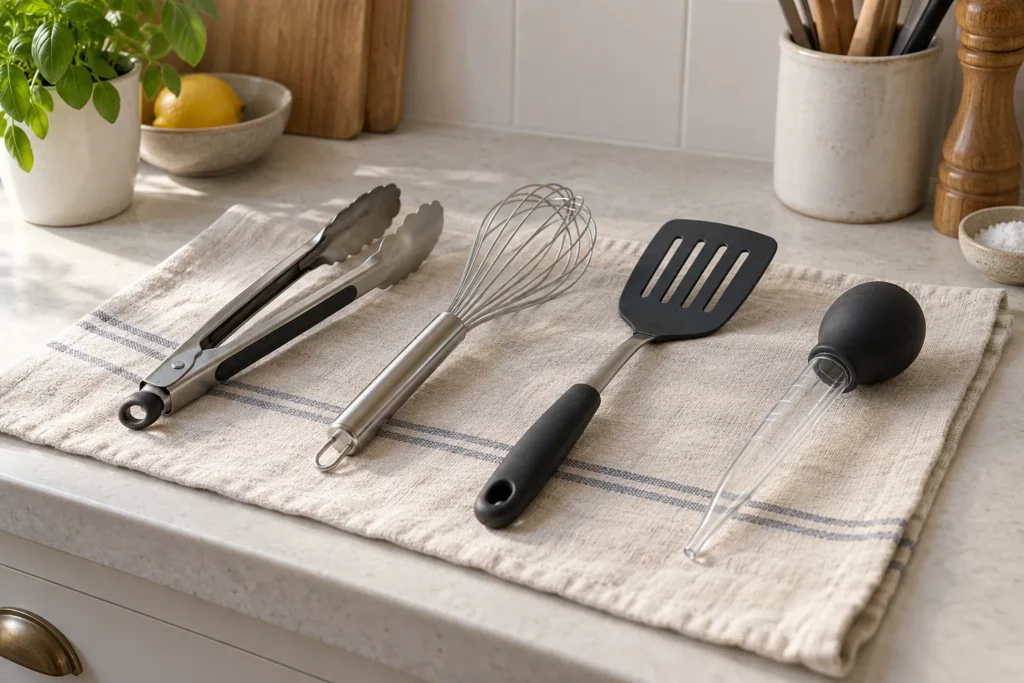
Choose a kitchen whisk by the vessel and movement the recipe needs. A balloon whisk has a rounded cage of wires, a flat whisk spreads its wires into a flatter form, and a small whisk scales the working head down for modest quantities. The best fit is the one you can move effectively in your actual bowl or pan.
Image: AI-generated editorial illustration of generic equipment; not a photograph of a reviewed product.
Table of Contents
Start with the bowl or saucepan
Look at its depth, width and lower corners. A large whisk can be awkward in a narrow jug even when the handle reaches the bottom. A tiny whisk may fit a large bowl but require a lot of movement to reach different areas. Match the working head to the quantity and container rather than choosing by total handle length alone.
Try a clean display whisk in a suitable empty vessel where permitted. Check whether the wires reach the part of the bowl you need to work and whether your hand clears the rim. This is a useful fit assessment without making claims about how quickly a particular whisk will combine or aerate a recipe.
Understand the main shapes
| Whisk shape | What to examine | Likely reason to consider it |
|---|---|---|
| Balloon | Rounded cage, width and wire spacing | Mixing in a suitably sized bowl |
| Flat | Flatter wire arrangement | Working across a compatible pan base |
| Small | Compact head and manageable handle | Small bowls, dressings or modest quantities |
| Coated-wire design | Coating condition and instructions | Tasks where the vessel requires a particular contact material |
OXO flat whisk specifications describes its flat form for sauces and pan-bottom work. That explains the intended geometry, not a promise that every sauce needs one. Compare the shape with your saucepan and check that the wire material is allowed by the cookware maker.
Read the recipe's intended action
Whisking can mean combining ingredients, removing lumps, incorporating air or keeping a mixture moving during a particular stage. Those are not interchangeable goals. Follow the recipe's method and equipment guidance rather than assuming vigorous movement is always desirable.
A hand whisk is also different from an electric mixer attachment. If a recipe specifies one, check whether it offers an alternative before substituting. This guide compares manual tool shapes; it does not provide a universal conversion between hand and machine mixing times.
Assess wires and handle together
Examine the wire spacing, the joint where the wires enter the handle and the overall balance. Widely spaced and tightly arranged wires can feel different in a mixture, but a product photograph cannot measure effort for you. If comfort matters, hold the tool in the grip you normally use and imagine the full range of movement.
Look for a handle that is easy to pick up and release, with no awkward pressure point. A very long handle can provide reach but may also knock the rim of a small bowl. The head and grip need to suit one another; a comfortable handle does not compensate for a cage that cannot reach the mixture.
Check coating and care requirements
For a coated-wire whisk, inspect the covering before use and follow the maker's instructions if it becomes damaged. A coated appearance alone does not establish the permitted temperature or suitability for every non-stick pan. Read both the utensil and vessel guidance.
Cleaning access matters around the wire-to-handle connection. Check dishwasher permission for the complete item and avoid pulling wires out to clean a sealed joint. Store the whisk where heavier tools will not force the cage out of shape or make it difficult to remove without snagging.
Choose a small collection with clear roles
For many home kitchens, one whisk matched to the usual mixing bowl is a reasonable starting point. Add a smaller version if you often work in a little bowl, or a flat shape if pan-based tasks make it useful. There is no need to buy every named form before you know which movement is missing from your routine.
When replacing a whisk, note the specific problem: too wide for the jug, uncomfortable grip, difficult cleaning or poor access to the pan's corners. That gives you a practical specification for the next purchase and makes a shape comparison more useful than choosing a tool simply because it is described as professional.