
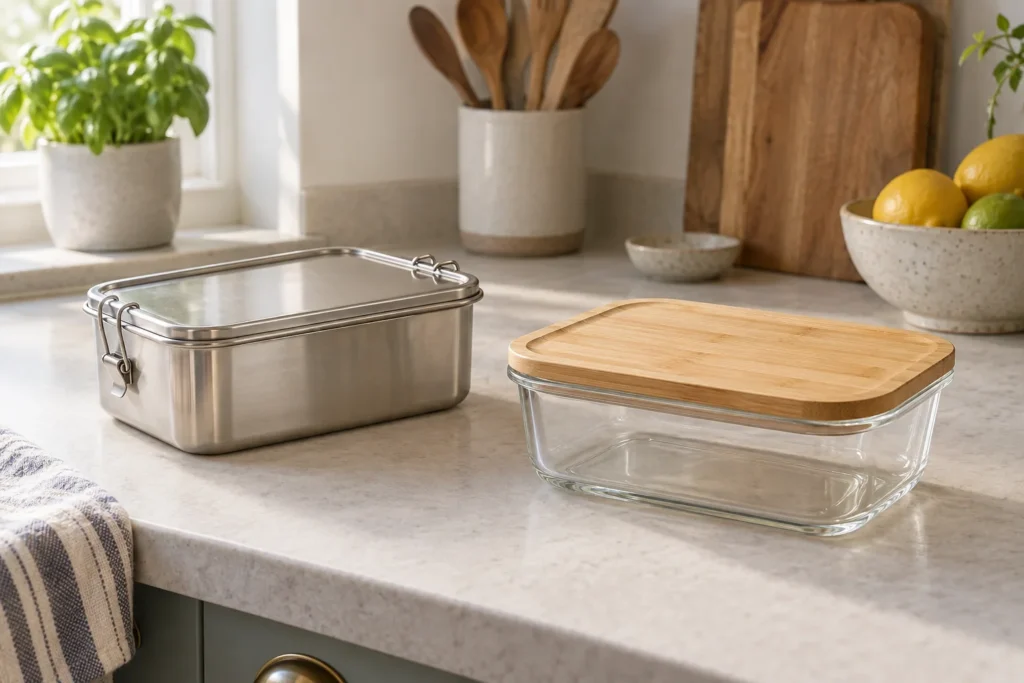
Metal food storage containers can look remarkably similar while having different lids, interior finishes and permitted uses. Start with the exact product specification. A photograph of a silver-coloured box is not enough to identify its construction, and a material description alone does not establish whether the complete item can be heated, frozen or put in a dishwasher.
Image: AI-generated editorial illustration of generic equipment; not a photograph of a reviewed product.
Table of Contents
Identify the body and its interior
Look for the named metal and any coating or lining described by the manufacturer. Check whether the food contacts bare metal, a lining or a separate insert. If the information is absent, ask before buying for a use where that distinction matters to you.
Do not use marketing terms such as “natural”, “premium” or “non-toxic” as substitutes for a material specification. Compare the actual components and instructions instead. You can prefer a particular construction without claiming that every other material is unsafe or inferior.
Read appliance permissions for the exact assembly
IKEA’s 3 litre IKEA 365+ steel container with bamboo lid illustrates the need to separate components: the steel body is listed as oven, freezer and dishwasher suitable, while the bamboo lid has different restrictions. The product is marked as unsuitable for microwave use.
That is a specific example, not a rule inferred from the colour or feel of another container. Keep the precise product reference with its instructions. If you intend to reheat food, choose a documented method for that model and its relevant components rather than assuming a metal box behaves like a saucepan or another branded storage system.
Compare shape with the meal you pack
A shallow rectangle, a deep round pot and a divided lunch box offer different access to food even at similar stated capacities. Think about whether you will eat from the container, serve from it or transfer its contents elsewhere. A shape that works for stacked sandwiches may be inconvenient for a meal you want to stir.
Measure the outside with clips and handles included. Check the lunch bag, fridge shelf and storage drawer. If weight is important, compare the maker’s empty weight and consider the complete carrying task, including food, lid and any outer bag. Avoid assuming that every metal container is lighter than every glass alternative without comparing actual products.
Inspect rims, clips and seals
Look at the rim where the lid meets the body. Establish how the closure operates and what the manufacturer claims it is designed to contain. A tight-fitting lid for cupboard storage is not automatically a verified liquid carrier.
Check whether the seal detaches for cleaning and whether replacements are supplied. Record the compatibility reference before discarding the packaging. Similar-looking clips can belong to different sizes or ranges, so do not improvise a part swap merely because it appears to fit.
Make cleaning access a purchase criterion
| Feature | Question to resolve |
|---|---|
| Folded rim | Can its cleaning instructions be followed easily? |
| Interior finish | Which utensils and cleaners are permitted? |
| Dividers | Are they fixed or removable, and how are they cleaned? |
| Lid and seal | Do they have separate washing and drying requirements? |
If a product develops visible damage, follow its maker’s condition and replacement guidance. Do not assume that a dent, chipped lining or distorted rim is harmless simply because the body remains usable as a shape. The relevant question is whether the original intended use and closure still apply.
For a useful shortlist, compare two complete products against the same meal and care routine. One may have a suitable body but a lid you would need to wash separately; another may fit the bag better but offer less convenient access to the food. Record those practical differences instead of giving the material itself an overall score.
Choose for one clear household role
Identify the regular job that makes this container worth storing. A particular format may suit lunches while another is better for food kept at home. Our kitchen storage guide helps with the cupboard arrangement. Choose the metal container on its documented construction and useful dimensions, then check that its care routine fits the way your kitchen operates.