
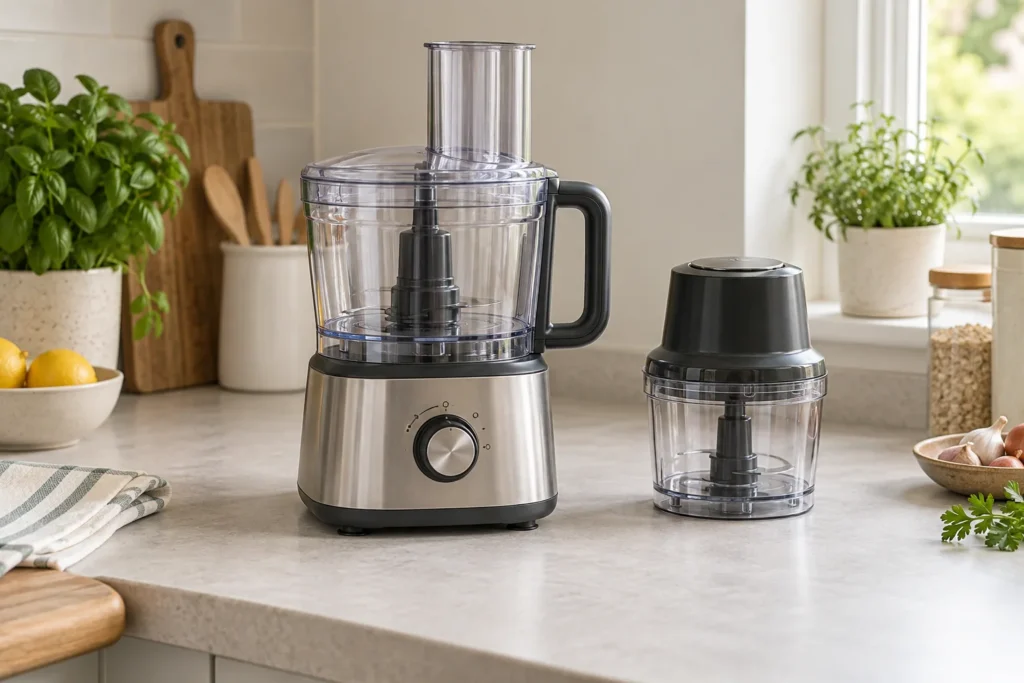
Mini food processors and choppers are worth considering when your regular jobs are small: a little chopped onion, a modest dip or herbs for one meal. Their usefulness depends on the working quantity and supported ingredients. A compact bowl is not automatically a miniature version of every full-size processor attachment.
Image: AI-generated editorial illustration of generic equipment; not a photograph of a reviewed product.
Table of Contents
Name the smallest job you want it to handle
Write down three examples with real quantities rather than broad labels such as meal prep. A small amount of chopped herbs is a different task from a bowl of hummus, and neither establishes that the machine can process a drink. Check the ingredient guide for the task you actually need.
Consider whether you want a rough chop or a smooth mixture. Chopping controls and access to inspect the result can matter more than a large speed count. A machine that is convenient for small solid ingredients may still be unsuitable for a recipe with substantial free liquid.
Compare working volume on the same basis
The Russell Hobbs 27131 has a one-litre glass bowl but specifies 500ml working capacity. The Kenwood CHP61 manual also marks a 500ml maximum level, while separately prohibiting operation with a bowl full of liquid and processing hot ingredients. Those limits show why the litre figure alone is insufficient.
These are documented design examples, not a test of which chops more evenly. For each candidate, find the quantity guidance for your ingredient and keep it separate from the total bowl size. A lower limit for a demanding food can override the general volume marking.
| Small-batch task | Useful feature to inspect | Question that matters |
|---|---|---|
| Herbs or a little onion | Bowl shape and controllable start-stop action. | Can you inspect texture without awkward disassembly? |
| A modest dip | Permitted ingredients and working quantity. | Does the recipe fit the specified use? |
| Dry crumbs or nuts | Exact ingredient limits and blade instructions. | Is this food explicitly supported? |
| Liquid dressing | Liquid permission and lid arrangement. | Is the chopper suitable, or is another vessel needed? |
Look at the blade and lid arrangement
Inspect how the cutting assembly is removed and where you can safely hold it. Some designs put a motor unit on top of the bowl; others use a separate base. This changes the order of assembly and the parts you need to move when checking or emptying the mixture.
Do not choose on the assumption that more blade tips guarantee a particular texture. Useful evidence would be a controlled test with the food you care about. In a specification comparison, focus on whether the documented blade system supports the task and whether you can handle and clean it confidently.
Count the washing-up for one small job
A chopper may save knife work but still create a bowl, lid and cutting assembly to clean. Consider a normal week: would you use it once for several compatible ingredients, or assemble and wash it repeatedly for very small quantities? A manual knife or grater may remain convenient for occasional tasks.
Read component-level cleaning instructions. A dishwasher-safe bowl does not make the motor washable. Check whether the blade separates, how it should be stored and whether the supplied covers are for storage or only packaging. Keep sharp loose parts out of an ordinary utensil drawer.
Make the choice around frequency and access
Measure the storage space for the assembled appliance and the parts you will keep separately. If it is buried behind heavy cookware, a compact machine may still be inconvenient to retrieve. The useful size is one that fits both your normal batch and a place you can reach easily.
Choose a mini processor when a supported small-batch task recurs often enough to justify setup and cleaning. Move to a larger processor when the genuine need is discs, larger dough quantities or other documented functions. Small size is a practical category, not a promise that every kitchen job has been compressed into one bowl.
If the jobs on your list require slicing discs or a larger supported batch, compare the equipment covered in our food-processor buying guide.