
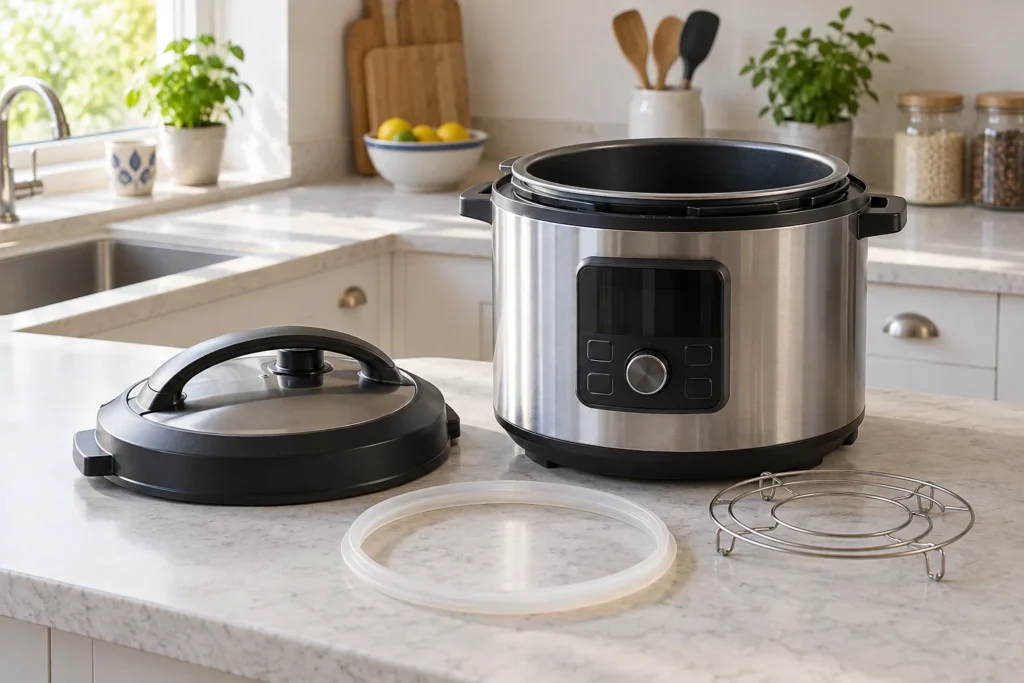
A pressure cooker sealing ring is a safety component, so replace it according to the exact model’s instructions and compatibility list. Diameter alone is not enough. The ring’s profile, material and lid arrangement must match the cooker, and some designs do not allow the ring to be removed separately.
Image: AI-generated editorial illustration of generic equipment; not a photograph of a reviewed product.
Table of Contents
Identify your lid design first
Instant Pot’s official FAQs distinguish removable-ring models from the Duo Crisp with Ultimate Lid, whose sealing ring is permanently attached to its pressure-cooking cover. This is why advice to pull out and replace any ring is unsafe as a universal instruction.
Read the model label and the lid’s diagram before touching the seal. A combined air-fryer and pressure-cooker lid may have more components than a conventional pressure lid. If you own more than one cooker, keep their seals and covers clearly separated. Similar colour is not evidence of interchangeability.
Inspect condition with the cooker cold
Disconnect the appliance where applicable and inspect only the parts the manual permits you to access. Look for cuts, distortion, stretching or other damage, and check that the ring sits in the documented position. Do not pull hard to test its elasticity or stretch it over an unrelated pot as a size check.
An old ring that still appears to seal is not automatically within its recommended service life. Follow the manufacturer’s replacement interval and replace earlier if condition requires it. Conversely, an odour alone does not tell you the ring’s mechanical condition. Keep those two questions separate when deciding what to do.
Buy against explicit compatibility
The Instant Pot UK 8L ring listing describes a two-pack for that size family, including separate sweet and savoury use. Check the complete current listing and your manual for the exact cooker before ordering; a size headline is a starting point, not the entire compatibility check.
Record the part number, supported models and whether the pack contains the large sealing ring or a small float-valve cap. Those components do different jobs. If the supplier cannot confirm the match, ask the appliance manufacturer with photographs of the model label and old component.
| What you notice | Appropriate next step |
|---|---|
| Cut, stretched or distorted ring | Stop pressure use and obtain the authorised replacement. |
| Ring will not sit correctly | Check the model and installation diagram; do not force or trim it. |
| Food odour remains after cleaning | Use the maker’s approved cleaning/storage advice; inspect condition separately. |
| A small silicone part is missing | Identify it from the parts diagram before buying a large ring. |
| Seal appears integral to the lid | Confirm whether the complete cover must be replaced. |
Clean without changing the material
Use the approved washing method, temperature and drying routine. Do not bake a ring, boil it in an improvised solution or apply oil to improve the seal unless the exact manufacturer instructions require that treatment. Internet deodorising methods can be unrelated to the material or design you own.
If removable, refit the clean ring carefully and check the full circumference rather than only the section nearest you. Keep food residue away from the sealing surfaces. A ring trapped under a lid incorrectly should not be pushed into place while the cooker is operating or hot.
Keep spare rings easy to identify
A spare can be useful when the manufacturer approves switching between sweet and savoury dishes. Label its storage container with the cooker model and record when it first entered use. Store it without heavy objects pressing it out of shape, following the manufacturer’s guidance.
Do not present a separate ring as an allergen-control guarantee. Food can remain on other lid and pot surfaces, and cleaning requirements extend beyond one silicone component. Use appropriate food-safety advice for the people you are cooking for.
Check the system after replacement
Complete any manufacturer-required inspection or test before returning to food cooking. A new ring cannot correct a warped rim, damaged lid or blocked pressure component. If steam escapes abnormally, stop and follow the cooker’s fault instructions rather than repeatedly tightening or reseating the lid while it is hot. Keep the replacement packaging and part details so support can verify exactly what was fitted.