
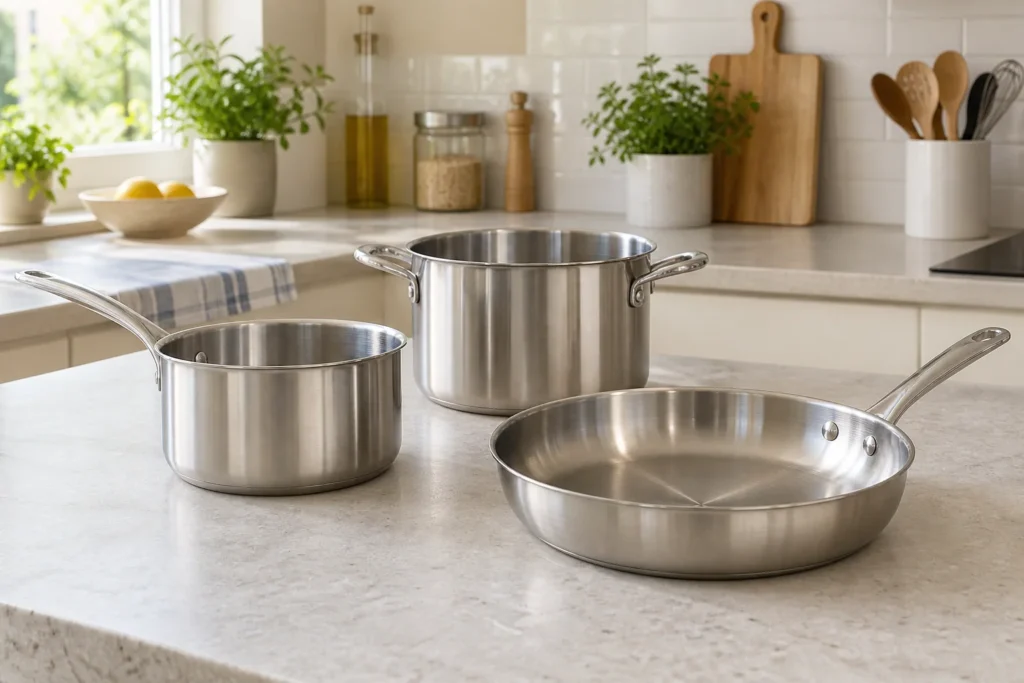
A sauté pan usually has straighter, higher sides, while a frying pan commonly has lower, sloping sides. Compare the actual shapes, because product names overlap. The useful choice depends on how you reach the food, whether the recipe contains liquid and how much flat cooking area fits on your hob.
Image: AI-generated editorial illustration of generic equipment; not a photograph of a reviewed product.
Table of Contents
Look beyond the rim diameter
Two pans sold with the same nominal diameter may have different flat interior areas. Sloping sides take up some of the opening's width, while a straighter wall can leave more of that width near the base. Ask for usable cooking dimensions rather than assuming the headline diameter describes the entire food-contact surface.
All-Clad: the sauté-pan shape describes the higher-sided sauté form and its use with dishes containing sauce. That explains one design role; it does not prove that every sauté pan is preferable for every recipe with liquid or that a frying pan cannot perform overlapping tasks.
Match side shape to access
Lower, sloping sides can make it easier to position a turner under food or slide food towards a serving dish. A deeper straight-sided vessel changes that access and may suit a recipe that needs more containment. Assess the movement with a cool empty pan and the utensil you normally use.
| Feature | Frying-pan question | Sauté-pan question |
|---|---|---|
| Side shape | Does the slope give useful access? | Does the depth suit the recipe? |
| Flat interior | Is there enough area for the usual amount? | Is the extra area actually documented? |
| Lid | Is a compatible lid available if needed? | Is it included and manageable to lift? |
| Handling | Is the long handle comfortable? | Would a helper handle be useful? |
A pan's shape does not provide a safe maximum oil depth or a deep-frying method. Follow the recipe and cookware instructions for any technique involving a substantial quantity of hot liquid or fat.
Decide whether a lid is part of the task
Read the recipe's covered and uncovered stages. A sauté pan often comes with a lid, but verify the contents and complete dimensions. If your existing frying pan already has a suitable lid and enough depth, it may cover the intended recipe without another purchase.
Check the lid separately for oven or grill use. Its knob, glass and rim may have different restrictions from the pan body. Include lid weight and the place where you will rest it during cooking in your handling assessment.
Compare depth with capacity
A litre figure can help describe a deeper pan, but it does not replace the flat cooking-area measurement. A tall narrow vessel and a broad shallow one can hold similar volumes while arranging food differently. Choose according to the recipe's intended depth and distribution.
Think about your normal quantity rather than a rare large occasion. A very broad sauté pan can occupy a large share of the hob and cupboard even when you cook small meals most days. Conversely, repeatedly cooking in several batches may be a reason to consider a larger suitable surface.
Check the complete kitchen fit
Measure the base against the hob's guidance, then include handles in the overall footprint. Check neighbouring cooking positions and access to controls. For an oven stage, measure the route into the cavity and the clearance for heat protection, not just the shelf width.
Consider washing and storage too. A lid and helper handle can make a pan more capable while also increasing the space it needs. Confirm that those features solve a real problem rather than adding bulk to an already crowded kitchen.
Keep surface choice separate
Either shape can come in different materials and with coated or uncoated cooking surfaces. Compare shape first, then read the relevant care and utensil instructions. A favourite surface in the wrong shape may still be inconvenient for your intended meal.
Choose a sauté pan when its documented depth, lid and usable area fill a distinct role. Choose a frying pan when access and the usual frying tasks are your priority. Keep a sound existing pan if it already meets the recipe's needs; overlapping functions do not require owning both forms immediately.