
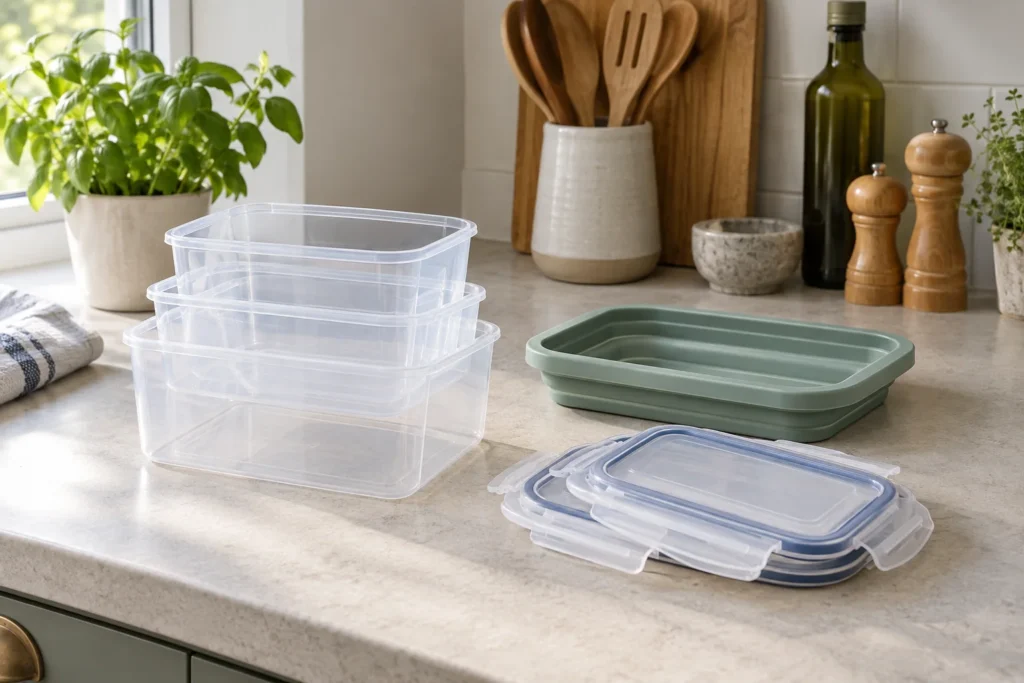
Stackable food storage containers and nestable containers solve different problems. Stacking usually describes complete containers placed above one another; nesting describes empty bodies fitting inside each other. A set may support both, but its useful storage footprint depends on which state it spends most of its time in.
Image: AI-generated editorial illustration of generic equipment; not a photograph of a reviewed product.
Table of Contents
Decide where the space problem occurs
Identify whether the crowded area is the fridge when containers are full or the cupboard when they are empty. If both are difficult, compare them separately. A tall collection of nested bodies may save cupboard width while leaving a large pile of unmatched lids nearby.
Record the number of containers normally in each state. For example, if most are used for lunches during the week, the full-container arrangement may matter more than the weekend cupboard photograph. If you use them occasionally for leftovers, easy empty storage may take priority.
Check what the manufacturer actually supports
The round 750 ml IKEA 365+ container is described as nesting when empty. That is a specific storage feature, not evidence that any lid from the same brand can support any filled container above it.
For a proposed filled stack, examine the stated compatibility and the shape of the base and lid. A shallow recess may help identify the intended position, but use the maker’s instructions rather than constructing a tall tower simply because the pieces appear to balance.
Measure the complete stack
Measure or obtain the height with lids attached, including raised clips and handles. If the design nests, ask for the nested height or use a sample to check it. Adding the height of individual empty bodies will not necessarily describe either configuration accurately.
Make an illustrative shelf calculation using your actual measurements. If the clear shelf height is 28 cm and a complete stack is 26 cm, only 2 cm remains above it. Whether that is enough depends on the retrieval movement, not merely whether the stack fits. This example is arithmetic for planning, not a recommended universal clearance.
Count the movements needed to reach one box
Imagine retrieving the bottom container while preparing lunch. How many pieces must be removed, and where will you put them? A stack can occupy little space while requiring considerable rearrangement. Keep frequently used sizes where they can be taken out without dismantling the whole collection.
For nested sets, consider grouping only a manageable number of bodies together. A second smaller group may be easier to use than one deep stack. The right arrangement depends on the shelf and the people using it, so evaluate access rather than maximising the count in a single pile.
Give lids an explicit home
| Storage method | Benefit to check | Likely planning question |
|---|---|---|
| Complete pairs | Matching lid is immediately available | Does the combined height fit? |
| Nested bodies | Reduced empty-body footprint | Where do the lids go? |
| Several small groups | Less dismantling for daily access | Is enough shelf width available? |
Sort lids by confirmed compatibility, not only by apparent size. If two ranges look similar, retain their product references so replacements and matching bodies can be identified. A neat lid rack is useful only if it helps you find the right lid rather than displaying every orphaned component.
A household using four lunch boxes might keep the two needed tomorrow as complete pairs and nest the spare bodies nearby. This is an illustrative arrangement, not a required number. The point is to give the next task priority while using compact storage for pieces that are not immediately needed. If the household routine changes, the grouping can change with it.
Trial the arrangement before expanding
Use a small group through a normal cycle of filling, washing, drying and storage. Note whether the inconvenience occurs in the fridge, at the sink or in the cupboard. Our kitchen storage guide covers wider layouts; for stackable containers, choose a configuration that saves usable space without making a daily box difficult to reach.