
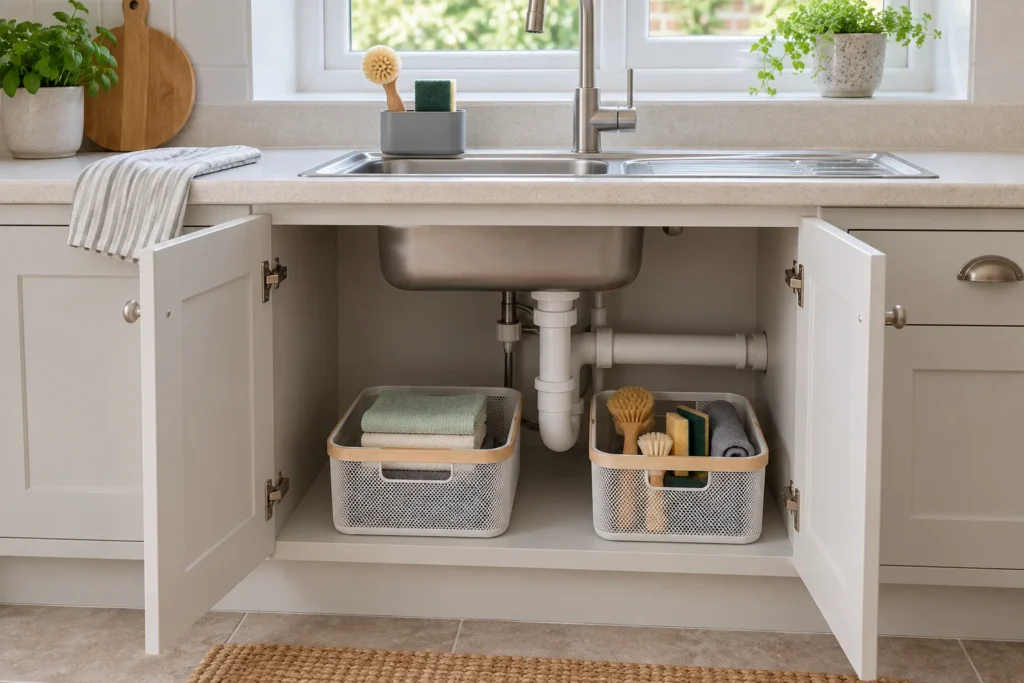
Kitchen cleaning-product storage should make the correct product easy to identify without making harmful substances accessible to people who should not handle them. Begin with the labels and the household’s access needs. A decorative bottle or a neat basket is only useful if it preserves the information and storage conditions the product requires.
Image: AI-generated editorial illustration of generic equipment; not a photograph of a reviewed product.
Table of Contents
Keep the original containers
The NHS poisoning-prevention guidance advises keeping liquid cleaning products and chemicals in their original containers so they are not mistaken for drinks. It also recommends keeping chemicals out of children’s reach, ideally in a locked cupboard, and using safety catches where appropriate.
Do not decant products into food or drink containers to make the cupboard look uniform. Keep the cap, label and any safety mechanism with the product. If the label is unreadable or the contents are uncertain, resolve that through the appropriate product or local disposal advice instead of inventing a replacement description.
Read storage instructions before grouping
Check each product’s label for storage conditions and restrictions. Grouping by cleaning task can be convenient, but it must not override those instructions. Avoid assuming every bottle used in the kitchen can share any available cupboard simply because it belongs to the same shopping aisle.
Keep food and food-related storage separate from cleaning products. The FSA’s household guidance includes storing food away from cleaning products. Use that distinction when deciding what belongs in an under-sink area or a nearby food cupboard.
Make the labels visible from the opening
Arrange working supplies so the product name and relevant instructions can be read without lifting several bottles. If a caddy hides the lower label, choose a shallower position or another grouping. Do not cover original warnings with decorative category labels.
Keep backup supplies in a clearly defined area rather than behind unrelated bottles. Before buying another product, check whether an unopened replacement is already there. This reduces clutter without requiring you to transfer products into anonymous larger containers.
Plan access for the whole household
Choose the storage location and any lock or catch around the actual household, including visiting children where relevant. Follow the fitting instructions for safety devices. A high shelf is not automatically inaccessible if nearby furniture or stored items create another route to it.
Keep the working routine consistent: take out the product needed, use it according to its label and return it to the designated storage. Do not leave a caddy of harmful substances on a low surface simply because it is convenient to carry around.
Measure bottles and the retrieval route
| Feature | Storage question |
|---|---|
| Trigger bottle | Does the nozzle clear the shelf and neighbours? |
| Tall container | Can it be removed upright as instructed? |
| Caddy handle | Is the filled group manageable? |
| Door catch or lock | Does it operate without obstruction? |
For an under-sink location, leave plumbing and valves accessible. A tidy arrangement should not conceal a leak or require moving a heavy collection before a shut-off control can be reached. Choose smaller removable groups where they improve access.
Check the largest bottle with its label facing out
Place an empty-paper template of the tallest product in the proposed organiser and mark where its handle or trigger projects. Then check whether you can lift it out without knocking adjacent containers or turning the label away. A divider that makes the shelf look tidy can still trap a trigger handle against a pipe. Keep products identifiable during this measurement exercise; do not decant them into matching containers to make the layout work. If the existing packaging does not fit, change the storage arrangement or the purchase size rather than removing the information needed for correct use.
Review the collection without improvising disposal
Check for products no longer used, damaged packaging or instructions you cannot recover. Follow manufacturer and local waste guidance for disposal rather than pouring unwanted chemicals together or into an assumed route. Our kitchen storage guide helps with the wider layout. The priority here is an identifiable, appropriately controlled collection that remains easy for the intended user to manage.