
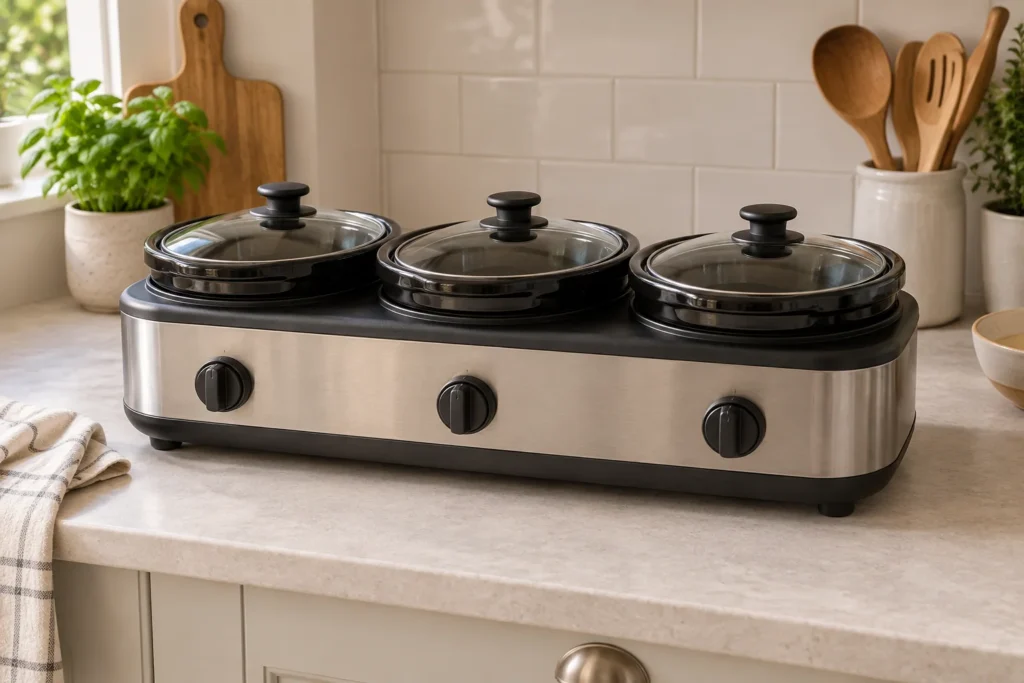
A triple slow cooker is most useful when you regularly need several small dishes kept separate. It is a different proposition from one large cooker: three pots create three recipe quantities, three control decisions and three items to wash. Work backwards from the meal you want to serve before deciding that the extra compartments are worthwhile.
Image: AI-generated editorial illustration of generic equipment; not a photograph of a reviewed product.
Table of Contents
Decide whether you need cooking or serving functions
Similar-looking appliances can be sold as slow cookers, servers or warmers. Check which functions are permitted for the exact model and each pot. Do not infer that an appliance can cook raw ingredients merely because it can keep prepared food warm.
The Bella cook-and-serve manual supplied by Lakeland describes three independently operated stations, with one, two or three available for use. It warns against lifting the base with three filled pots and against sudden temperature changes to the ceramic vessels. These points illustrate why the complete appliance needs its own handling plan.
Build the menu around the individual pots
Write one dish beside each compartment. Add the starting quantity, supported programme and expected finishing point. Three equal-sized pots do not require three identical recipes, but every dish still needs to fit its vessel and cooking instructions. A large main course may be better suited to one conventional cooker while the smaller compartments handle accompanying dishes.
Consider whether the dishes actually benefit from separation. Two sauces and a topping can make sense; dividing a single stew into three containers adds control and cleaning work without necessarily improving dinner. The appliance earns its space when the menu has a clear reason for separate vessels.
| Menu arrangement | Potential advantage | Question to resolve |
|---|---|---|
| Three different dishes | Separate flavours and serving utensils. | Can each dish use a suitable permitted programme? |
| One main dish plus two sides | Keeps the components distinct at serving. | Do their cooking and finishing times align? |
| Only one compartment needed | A model may permit partial use. | What does this exact appliance require for unused stations? |
| Buffet-style serving | Several choices can sit together. | What food-specific holding plan and supervision are appropriate? |
Check the serving space as carefully as the storage space
Measure the appliance’s complete width, including handles, then consider how people will reach the pots. The useful surface needs room for utensils, safe lid placement and dishes without forcing anyone to reach over a hot compartment. A cooker that fits neatly on a shelf may still crowd the serving area.
Map the cable route and use the supply arrangement specified by the manufacturer. Avoid planning a buffet around a trailing cable where guests pass plates. Keep the appliance on its approved stable surface and arrange serving access before heating begins.
Keep controls and utensils unambiguous
Use a simple written menu or labels beside the appliance so that each control corresponds clearly to its dish. Distinguish ingredient information from temperature or time instructions; a label saying vegetarian does not tell someone which setting to select.
Provide a separate serving utensil for each dish when separation matters. This helps with ordinary flavour management, but it is not a guarantee against allergen cross-contact. Ingredient preparation, shared utensils and the rest of the kitchen still need appropriate consideration.
Plan the end of the meal
Think through how food will leave the pots and where each cooled component will be washed and dried. A long appliance with several filled vessels should not become a tray carried across the kitchen. Follow the model’s guidance for moving components and handling hot lids.
If you would use three pots only once or twice a year, compare the storage burden with the equipment you already own. If you often serve several suitable dishes together, independent controls and manageable vessel sizes can be more useful than a larger single bowl. Choose the layout that simplifies a recurring meal, with a separate safe plan for every compartment.