
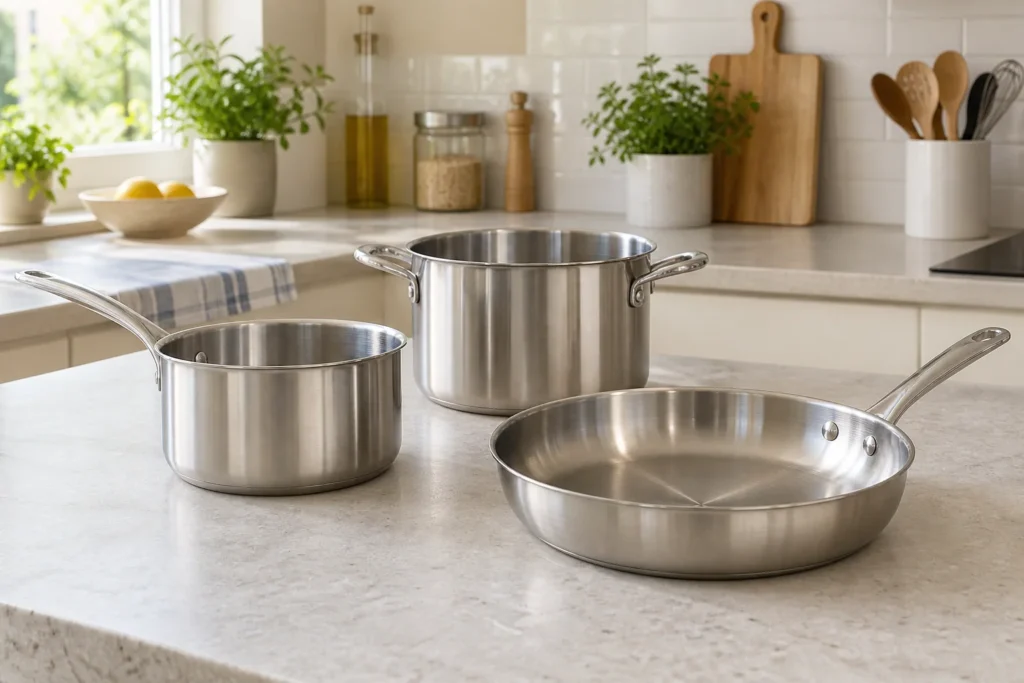
Stainless steel cookware labels describe composition or a steel grade; they do not describe the whole pan's cooking performance. The useful first question is which part of the cookware carries that specification. The interior, outer layer, base and handle may use different materials, even when a single grade appears prominently in the product title.
Image: AI-generated editorial illustration of generic equipment; not a photograph of a reviewed product.
Table of Contents
Understand the two styles of label
Numbers such as 18/10 and 18/0 are shorthand connected with chromium and nickel content. Grade designations such as 304 and 316 identify a more specific material family. They are not a sequence of quality scores in which the largest number always makes the best saucepan.
The technical note in worldstainless: stainless-steel designation note explains that 1.4301 steel is commonly described as 18/8 or 18/10 and gives composition ranges. The practical point is that shorthand should not be read as a laboratory certificate for an individual pan. Ask for the formal material specification when an exact composition matters to your purchase.
Recognise the main distinctions
Outokumpu stainless-steel grade compositions identifies 304 as a chromium-nickel austenitic steel, 316 as a molybdenum-alloyed grade and 430 as ferritic steel. These are basic material distinctions. Industrial corrosion-resistance descriptions do not by themselves prove that one finished cookware product will cook a home meal better than another.
| Label | Useful interpretation | What it does not settle |
|---|---|---|
| 18/10 | Chromium-nickel shorthand used in kitchenware | Complete composition of every pan component |
| 18/0 | Shorthand indicating no intentional nickel component in that label | Full-pan construction or an allergy guarantee |
| 304 | A recognised stainless-steel grade designation | Base thickness, handle comfort or coating status |
| 316 | A grade with molybdenum as part of its alloying | A universal cooking-performance advantage |
Read the maker's own documentation alongside these definitions. A pan advertised as stainless steel may also contain an aluminium core or a non-stick cooking surface, neither of which is explained by the steel grade alone.
Ask which part is being described
Look for a cross-section or a written construction description. Does the named grade apply to the interior, both steel skins or only a particular component? Is the base a separate assembly? Are the handles included in the material claim? If the listing leaves this unclear, ask with the exact model number.
This matters when comparing two products. One may prominently describe its inner steel while another describes the complete layered body. Those statements are not automatically inconsistent, but they are not directly comparable until the scope is clear.
Check induction compatibility separately
A small magnet can provide a clue about a particular area, but it is not a complete cookware approval or an alloy identification test. Use the pan maker's induction statement and the hob's pan-size requirements. The base may be deliberately different from the cooking surface.
Do not reject or approve a complete pan solely because a marketing label is associated with one magnetic behaviour. Construction, geometry and the hob's detection requirements still matter. Record the actual base diameter and the manufacturer's permitted uses rather than trying to infer everything from the side wall.
Keep health questions specific
This guide does not diagnose allergies or establish a personal exposure limit. If a material sensitivity affects your cookware choice, obtain the exact manufacturer's material information and discuss the relevant concern with an appropriate healthcare professional. An 18/0 label on one component is not evidence that the entire assembled product contains no nickel.
Avoid buying on broad “surgical”, “medical” or “premium” language without an identifiable grade and component description. Those words do not explain the pan's shape, finish, washing routine or suitability for the cooking method you intend.
Finish the comparison with ordinary pan checks
Once you understand the material statement, compare usable size, weight, handle design, lid fit and care instructions. Check whether the surface is coated, what utensils are permitted and whether the complete assembly has the oven rating you need.
Choose a clearly documented pan that fits those requirements. The grade is useful evidence about one part of the construction, but it should sit within a practical specification rather than replace it. A comfortable, correctly sized pan with clear instructions is a more meaningful purchase than an unexplained number chosen for its apparent prestige.