
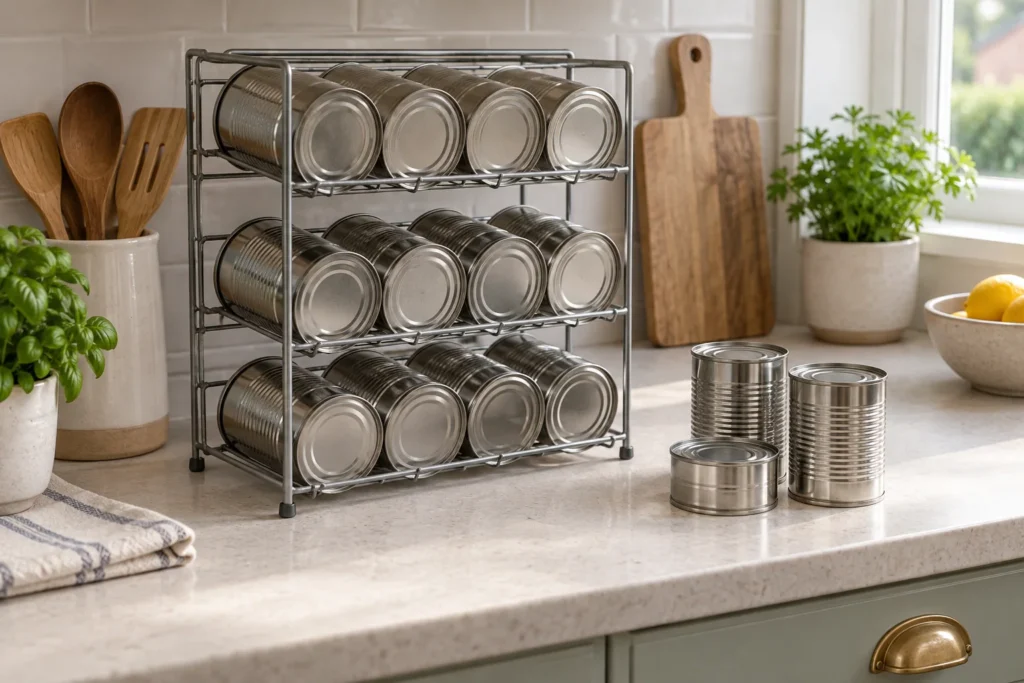
A canned-food storage rack should make tins easier to identify and remove. It can also create a new obstacle if its channels fit only some tins or if loading requires space your cupboard does not provide. Begin with a few examples of the products you regularly buy rather than choosing by an advertised maximum can count.
Image: AI-generated editorial illustration of generic equipment; not a photograph of a reviewed product.
Table of Contents
Measure the actual tins
Record height and diameter for your usual formats, including unusually tall or wide products. Do not assume every tin described by the same food weight has the same external dimensions. Keep a sample or a photograph with measurements when comparing rack specifications.
Note whether your collection is mostly one repeated size or a mixture. A fixed-channel rolling organiser may be easier to assess for uniform tins; a stepped shelf can accommodate a different arrangement if its usable platform fits the products. The choice depends on what is stored, not on a universal preference for one rack style.
Compare how each design reveals the back row
Joseph Joseph describes CupboardStore organisers as options for tins, jars and other cupboard foods. That broad category includes different mechanisms, so inspect the exact design rather than expecting all cupboard organisers to provide the same access.
A stepped shelf raises the rear row, but you still need to see the label and reach the tin. A rolling rack changes how items move towards the front, but the loading route and permitted tin dimensions become central. A rotating organiser needs clear space around its movement. Compare those actions in your cupboard before buying.
Measure the opening as well as the shelf
Take the cupboard’s usable width, depth and height, then account for hinges, door catches and projecting shelf edges. Check whether the organiser can be inserted fully assembled according to its instructions. A rack might fit the internal space but be difficult to manoeuvre through the opening.
Allow room above and beside the rack for loading and removal. If tins are inserted from the top or rear, work out whether that area remains accessible after the rack is installed. A large stated capacity is not useful if restocking means unloading the entire cupboard.
Check load and assembly information
Read the manufacturer’s assembly and load instructions for the exact rack. Include the weight of its intended contents in that assessment rather than treating empty tins in a promotional picture as a practical load test. Follow the cupboard or shelf’s own limits as well.
Do not extend an adjustable rack beyond its stated range or stack separate organisers unless the maker supports that arrangement. If the instructions do not answer a load question relevant to your intended use, ask for clarification before filling the rack.
Keep date information visible
| Design question | Practical test on paper |
|---|---|
| Fixed channels | Do all normal tin diameters fit the stated range? |
| Stepped shelves | Can you see and grasp the rear row? |
| Rolling layout | Can you load it while preserving the intended order? |
| Rotating layout | Does the complete sweep clear doors and neighbours? |
Arrange products so you can read their identity and relevant dates. A rack does not automatically create the correct use order; that depends on how you load it and which products are present. Avoid hiding several different foods in one channel if that makes them difficult to identify.
Imagine a cupboard holding several tins of tomatoes, two wider tins and one tall tin. A capacity claim based on identical cans may not describe that mixed collection. Sketch the awkward sizes first, then add the repeated tins. If the rack excludes the items you most need to see, its nominal can count is the wrong measure of usefulness.
Compare against a simpler shelf arrangement
Before committing, try a clearly defined shelf section with fewer rows. It may solve the visibility problem without additional hardware. Our kitchen storage guide provides wider cupboard ideas. Choose a tin rack when its specific mechanism improves access to your actual collection and its dimensions work throughout loading, storage and retrieval.