
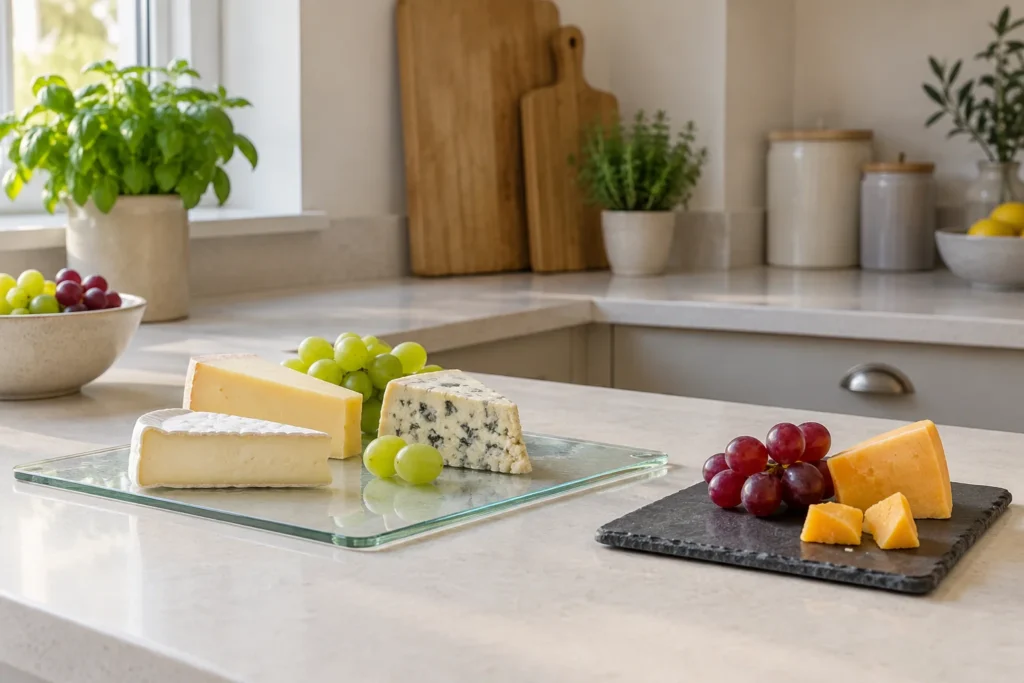
A glass chopping board can look perfectly at home beside a knife block without being the most suitable surface for your knives. Stone slabs create the same confusion: a photograph of cheese on marble tells you how a board has been styled, but does not establish every use its maker permits. Start by deciding the job you need, then check that both the surface and the equipment touching it are compatible.
Image: AI-generated editorial illustration of generic equipment; not a photograph of a reviewed product.
Table of Contents
Separate three different jobs
Cutting, serving and protecting a worktop place different demands on a surface. A cutting board has repeated contact with a blade. A serving board supports food and is carried or passed around. A worktop protector sits between the counter and another object, sometimes a warm dish if its instructions allow that use. A product may cover more than one job, but the name in an online listing is not enough to establish this.
Write your intended use in a complete sentence: “I want to slice bread every morning”, “I want a removable cheese display”, or “I need a place to stand this particular serving dish”. That short description makes an ambiguous product easier to assess. If a listing answers a different need, leave it off your shortlist even if its colour and dimensions are appealing.
Check the knife as well as the board
WÜSTHOF advises against glass, metal and stone as cutting surfaces because they can dull a knife edge quickly. That is useful knife-maker guidance, rather than a claim that every decorative slab has the same composition or finish.
For a purchase intended for regular chopping, check your knife manufacturer’s cutting-surface advice alongside the board description. Do not assume that a hard surface will be kinder to an edge because it resists visible marks. If you decide to reserve a glass or stone piece for presentation, provide a separate appropriate cutting board nearby instead of leaving guests to guess where to slice.
Our main chopping-board guide covers the broader choice of materials. The question here is narrower: what documented role can this particular piece safely and conveniently perform in your kitchen?
Read the material description closely
“Stone effect” describes an appearance, not a complete material specification. Likewise, a stone name alone does not tell you what sealant, backing, feet or adhesive is present. Look for the full product description, food-contact intended use and care instructions. Save those details with the order confirmation so they remain available after the packaging has gone.
| Proposed role | What to establish | What remains a separate question |
|---|---|---|
| Food presentation | Whether direct food contact is an intended use | Whether guests may cut on the surface |
| Everyday chopping | Board and knife-maker compatibility | How the board will be washed and dried |
| Worktop protection | Permitted object and temperature conditions | Whether the feet or backing suit your counter |
An oven-safe serving dish does not make the surface beneath it heat resistant. Similarly, a wipe-clean finish does not establish dishwasher suitability. Treat each permission as a separate line to verify rather than allowing one attractive claim to stand in for the rest.
Plan lifting, washing and storage
A display board should be manageable when it contains food, not just when you lift it empty in a shop. Check the published weight and handling features; if there are no handles, consider how you will get fingers beneath it without tipping the contents. The heaviest option may be awkward to carry from a low cupboard even if it sits comfortably on the table.
Measure the washing area and the intended storage space. Include feet, raised edges and handles in those measurements. A flat slab needs a stable home where it will not have to be pulled out from beneath a tower of other kitchenware. If you plan to stand it upright, use storage intended to support that size and weight.
Give the board an unambiguous home
Keep a serving piece with serving dishes and a cutting board beside the preparation tools. This is a practical household cue: equipment is more likely to be used for the intended task when the arrangement makes the distinction obvious. If the manufacturer information remains unclear, ask for clarification before using the product for that disputed purpose. Choose on the basis of a supported use, then let appearance decide between the suitable options.