
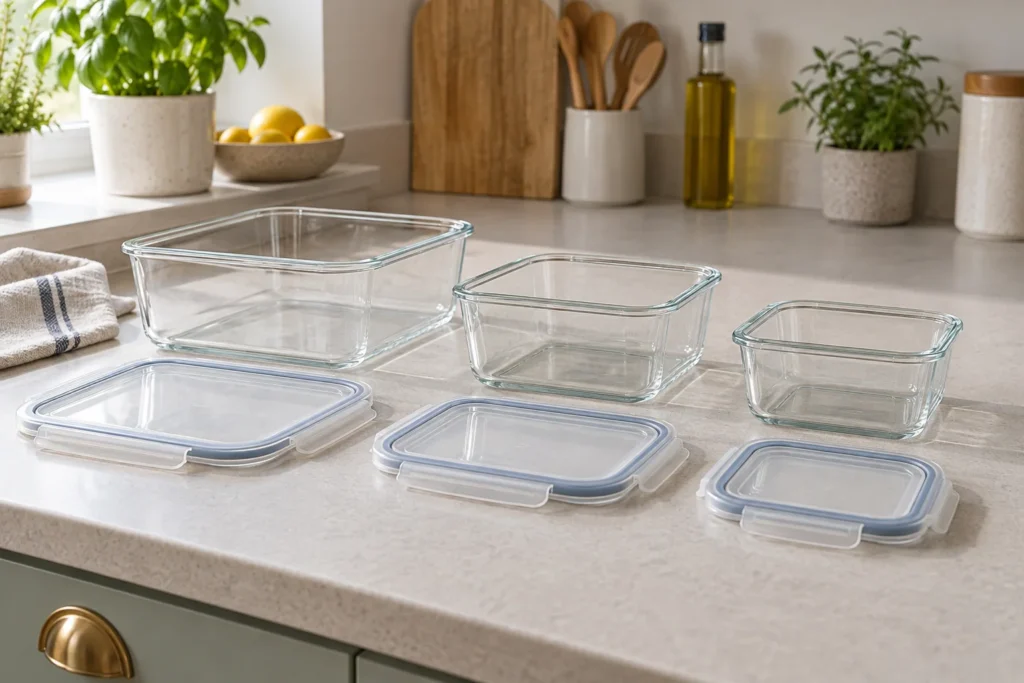
Glass food storage containers are often chosen because the contents are visible and the body feels substantial. Those features do not tell you whether a particular lid can be heated, whether the complete box fits a lunch bag, or how comfortably you can lift it from a fridge shelf. Evaluate the container as an assembly rather than treating the word “glass” as a complete specification.
Image: AI-generated editorial illustration of generic equipment; not a photograph of a reviewed product.
Table of Contents
Separate the body, lid and seal
Record what each part is made from. A glass body might have a plastic lid, silicone seal and separate clips; a lid described as glass may still include another material around its edge. If avoiding a particular material is your reason for buying, check every component rather than relying on the main product photograph.
Draw a quick three-column checklist: body, lid and seal. Under each, note the maker’s permitted uses and cleaning instructions. This makes conflicting or incomplete information easier to spot. Ask the manufacturer to clarify gaps before relying on a use that matters to you.
Considering a cooking appliance that uses its own glass containers? Our Ninja Crispi FN101UK versus drawer air fryer guide looks at that specific system. Its instructions do not establish compatibility for an ordinary glass storage box.
Read heating permissions one component at a time
Do not transfer an oven permission for the glass base to the lid. Pyrex’s Cook&Go set information, for example, distinguishes oven use of the glass from the lid, which must be removed. That is a product-specific distinction, not a universal temperature rule for all glass containers.
For any shortlisted container, obtain the exact instructions for oven, microwave and freezer use, including any restrictions on changes in temperature. Save the document against the model reference. If the product page and printed instructions appear inconsistent, seek clarification rather than choosing the more permissive statement. Glass type alone does not replace those instructions.
Compare usable shape as well as litres
A stated capacity is helpful, but two boxes with the same volume can hold a meal very differently. A shallow rectangle may suit food you want to arrange in one layer. A deeper shape may suit a different portion and occupy a smaller shelf footprint. These are layout choices, so begin with the food you routinely store rather than a standard “family size” label.
Measure the external width, depth and height, including the lid and clips. Then consider the usable interior. Rounded corners, thick walls and a broad rim can make the inside smaller than the outside suggests. If internal dimensions are absent, ask for them or compare a sample with a container whose fit you already know.
Think about the complete lifting task
Published empty weight is only the starting point. Your hand has to control the container when food is inside it and when you are reaching into its storage position. A large box may be comfortable on a worktop but awkward at the back of a crowded shelf.
| Household use | Handling question |
|---|---|
| Lunch carried outside | Does the complete box leave enough room and weight allowance in the bag? |
| Food stored on a low shelf | Can it be retrieved without an awkward grip? |
| Several portions together | Would two smaller containers be easier to move and portion? |
| Eating directly from the box | Does the depth make the food easy to reach? |
These questions do not produce a universal preferred size. They reveal whether the largest container in a set will have a regular job or spend most of its time taking up space.
Inspect the closure and cleaning access
Look closely at the seal channel, clips and corners. Establish whether the seal is designed to be removed, how it is refitted and whether replacements are available. Do not prise out a component just because it resembles a removable seal on another product. An accurate parts diagram is more useful here than a general “easy-clean” claim.
Keep lids with their corresponding range references. If different sizes share a lid, confirm that compatibility in the manufacturer’s information. A lid that seems to sit on the rim is not necessarily the correct closure.
Fit the set into your storage routine
Decide where clean, dry components will live before buying. Our kitchen storage guide provides wider cupboard ideas; for glass containers, focus on retrieval and manageable stacks. Choose the combination that gives your usual portions a useful shape and a clear set of instructions, with each body and lid easy to identify.