
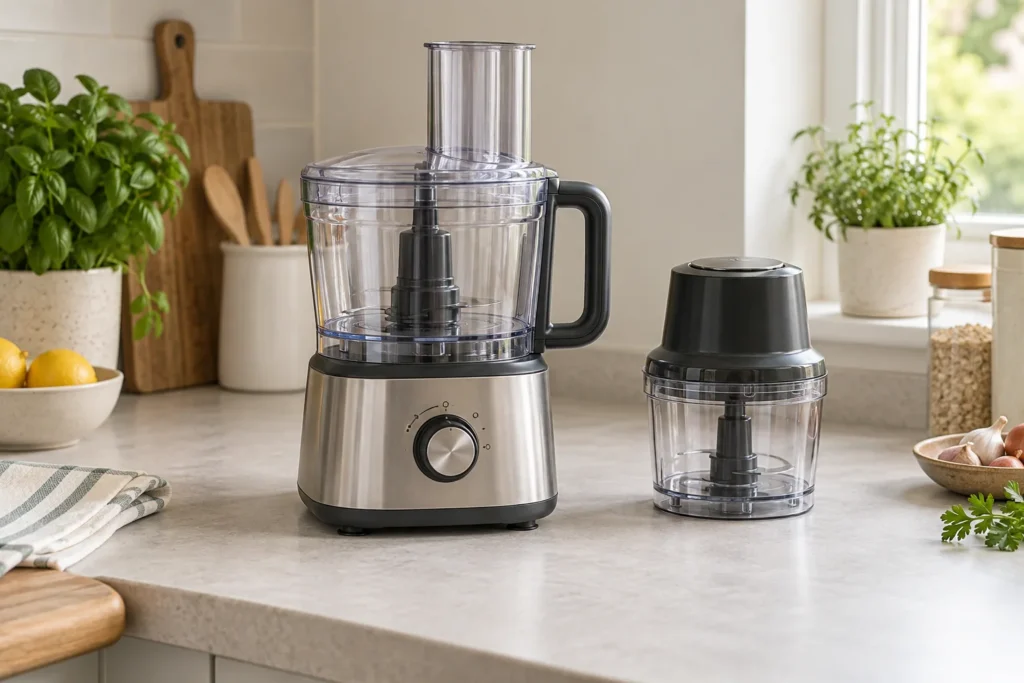
A large food processor is useful when it can handle your normal preparation quantity within its documented limits. Total bowl volume is only a starting point. Liquid, dough and solid-food processing may have different maximum loads, and slicing can involve a different collection arrangement again.
Image: AI-generated editorial illustration of generic equipment; not a photograph of a reviewed product.
Table of Contents
Break the batch into its actual tasks
Write down the jobs behind the phrase batch cooking. You might slice vegetables, chop onions, mix a dough and prepare a sauce. Record the ingredient quantity for each rather than assigning one combined meal weight to the processor. The bowl needs to support each operation separately.
Look for the manufacturer’s processing chart. A maximum expressed as flour mass is not the same as total dough mass. A liquid limit is not interchangeable with the volume of loose vegetables. Keep the units and ingredient category beside every figure you copy.
See how total and working capacity can differ
Braun’s MQ 9195XLI specification describes a 3.2-litre processor bowl with 2.0-litre working capacity. This is an international specification example, not a claim about current UK stock or permission for every mixture. It demonstrates why both figures should appear on a useful comparison sheet.
When a product page gives only headline litres, look in the manual before deciding that your batch fits. If the required figure is still missing, mark it unknown and ask the manufacturer. A photograph with a full bowl is not a substitute for a supported maximum.
| Operation | Useful capacity figure | Common comparison error |
|---|---|---|
| Chopping | Permitted quantity for that ingredient. | Using the whole meal’s weight. |
| Liquid mixtures | Working liquid limit for that vessel. | Filling to the rim because the bowl is large. |
| Dough | Specified flour or total dough mass, with units retained. | Treating flour mass and dough mass as equal. |
| Disc processing | Bowl collection limit or approved external-output arrangement. | Assuming the bowl never needs emptying. |
Account for the work between batches
A smaller permitted batch is not necessarily a problem if dividing the task is straightforward. Count the extra assembly, emptying and required motor-rest periods. That gives a more realistic comparison than assuming every task must be completed in one uninterrupted run.
For example, slicing a large quantity may be easy to divide into several collections, while repeatedly dividing a delicate mixture could be less convenient. Use the supported recipe and appliance instructions to decide whether splitting is sensible. Do not shorten a required rest period merely because the next bowl is ready.
Measure the worktop configuration you will use
Check the height with the feed tube, lid and pusher fitted, not only the motor base. Consider how you will add prepared ingredients and remove the bowl. A processor can fit under a cupboard when idle but still be awkward to operate there.
Also measure the storage route: shelf depth, cupboard opening and the place for sharp discs. If the accessories must be stacked separately, include them in the storage plan. A large bowl that nests well may be easier to store than a smaller system with several awkward loose attachments.
Use a capacity worksheet to shortlist models
Create a row for each usual task and a column for each candidate. Enter the exact documented limit, your recipe quantity and whether splitting the batch is acceptable. Add a final row for assembled dimensions and one for required rest periods.
Leave gaps visible. A candidate with an unknown dough limit has not passed the dough requirement merely because it has the largest bowl. This worksheet makes it easier to ask a precise question of support and prevents an attractive headline number from deciding the purchase prematurely.
Choose enough capacity, with a reason for the extra size
The best justification for a larger machine is a named recurring task that a smaller one handles awkwardly or cannot support. Occasional large meals may be manageable with planned batches, while weekly bulk preparation can justify more working room.
Choose after checking the task limits and the physical arrangement. This is a specification and workflow comparison; it does not claim that a larger bowl produces better chopping or that any particular motor has been performance-tested here.
Use the worksheet alongside our food-processor guide to compare candidates on the specific batches you need.