
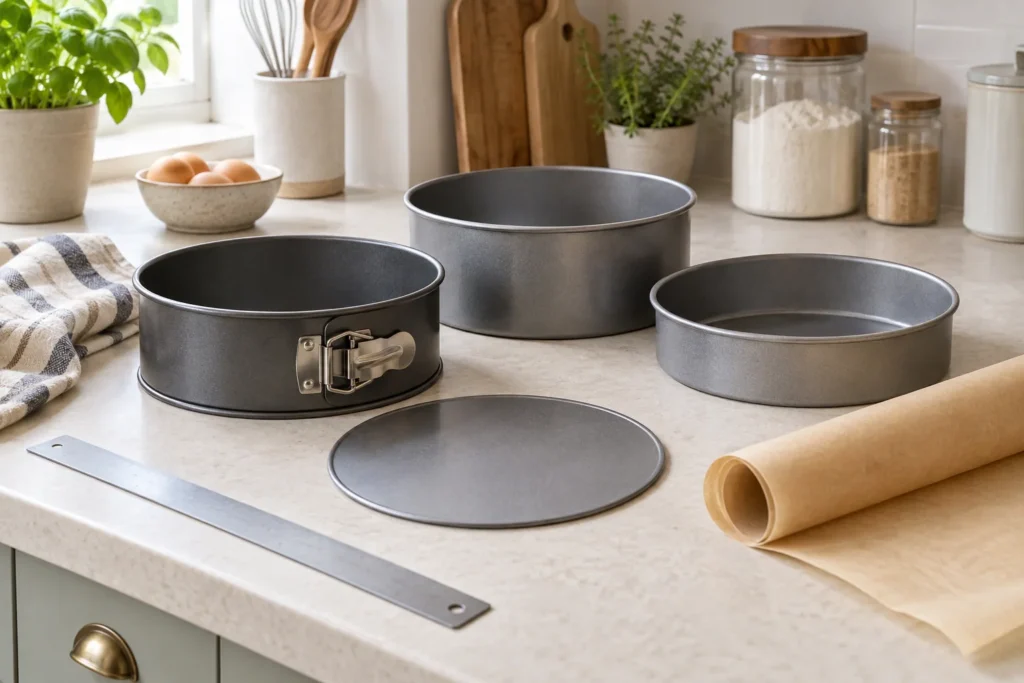
A deep cake tin provides a taller wall, but that extra height does not tell you how much cake mixture to add. Choose it because a recipe specifies the relevant diameter and depth, or because the recipe publisher explicitly supports that tin. Treat deep as a product description that still needs measurements.
Image: AI-generated editorial illustration of generic equipment; not a photograph of a reviewed product.
Table of Contents
Find an actual depth requirement
Read the equipment line and the first preparation step. Some recipes place an essential measurement in the method rather than the title. King Arthur Baking: Original Cake Pan Cake is a useful example: its pan instruction includes a minimum depth as well as alternative shapes. The lesson is to read the complete specification, not to transfer that recipe's dimensions to every cake.
If the recipe says only a deep 20cm tin, check whether additional notes identify the height. Measure the inside from the seated base to the rim and record the result. The external wall height may include a supporting foot or base construction that does not form part of the usable interior.
Separate headroom from recipe quantity
More empty space above a mixture does not require you to use more ingredients. If your chosen tin matches the recipe's required width and meets its depth requirement, follow the recipe quantity unless the publisher says otherwise. Do not fill extra space simply because it looks unused.
A tall cake and two thin layers are different recipe arrangements. Combining two sandwich-tin portions into one deep tin is an adaptation that needs specific guidance. An apparent match in total volume cannot provide a new baking time or demonstrate that the centre and exterior will develop as intended.
| Measurement | What it answers |
|---|---|
| Internal width | Does the tin match the recipe's cake footprint? |
| Internal height | Does it meet the stated depth requirement? |
| External height | Will the assembled tin fit the oven position? |
| Handle or clip projection | Can you grip it without an awkward reach? |
| Base design | How will a tall cake be supported during release? |
Check the complete oven position
Measure the tin with any supporting tray or accessory that the instructions require. Check the oven manual for shelf position and clearance. A tin fitting through the door is not the same as fitting comfortably in the intended baking position, especially if another shelf or a low grill element occupies space above it.
Practise moving the empty tin to a clear landing area while the oven is off and cool. Think about the filled weight and whether the sides or handles offer an accessible grip with suitable oven protection. Avoid choosing a deep, narrow shape that you can only grasp by stretching across other equipment.
Understand the release sequence
A tall cake may leave less room for fingers around a loose base or supporting surface. Read the recipe's cooling and removal instructions before choosing between a fixed base, loose base and springform design. The best mechanism is the one compatible with both the finished cake and your available working space.
Try the empty assembly first. Identify the correct base orientation and where each piece will be placed after removal. If the recipe expects inversion, ensure the specified support covers the tin adequately. If it expects the sides to lift away, check that you have enough vertical room to perform that movement as directed.
Keep the first bake tied to a known method
Use a recipe developed for the size you have chosen. Follow its temperature, time range and doneness checks instead of inventing a universal longer bake for anything in a deep tin. If you want to change the size later, start by seeking the publisher's validated adaptation rather than multiplying time by the increase in height.
Store the actual dimensions with the product reference and your recipe notes. Deep cake tins can be particularly difficult to distinguish when nested with similar widths. A precise label in your records helps you choose correctly next time and makes it easier to ask the manufacturer a focused question. Extra height is useful when it serves a specified recipe, not when it encourages an unplanned increase in mixture.