
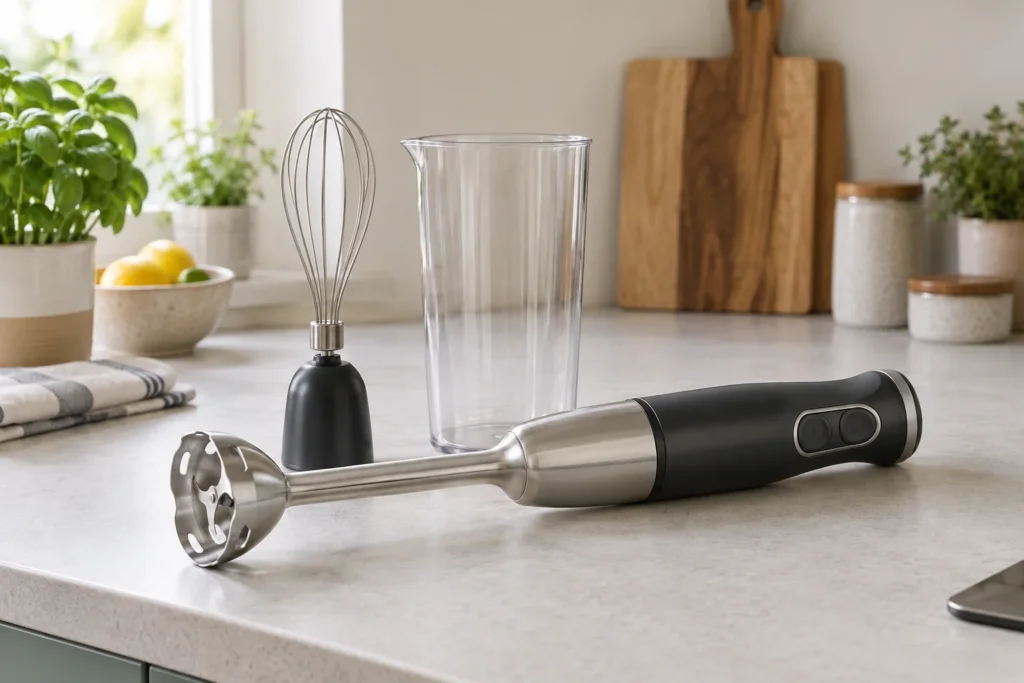
A whisk attachment can be a useful addition to a hand blender for occasional supported whisking tasks. It is a separate tool from the blending blade and is not automatically a replacement for every hand mixer or stand mixer job. Start with the mixture, quantity and exact compatible attachment.
Image: AI-generated editorial illustration of generic equipment; not a photograph of a reviewed product.
Table of Contents
Match the task to whisking rather than blending
Whisking is useful when the recipe needs ingredients combined or air incorporated in a particular way. A blending shaft cuts and mixes differently. Choose the tool specified by a suitable recipe rather than swapping between them because both connect to the same hand unit.
The Cuisinart RHB100U instruction booklet identifies its whisk for uses including cream, egg whites and batters. That is a model-specific example of intended tasks, not permission to process every thick mixture. The model is an ownership example; the UK product page is marked discontinued.
| Recipe need | What to verify | When another tool may suit better |
|---|---|---|
| Occasional cream whisking | Approved quantity, bowl and operating instructions. | The usual batch exceeds the attachment’s limits. |
| Egg-white mixture | Suitable recipe, clean equipment and controllable stopping. | You routinely need larger or more demanding batches. |
| A light batter | The recipe and attachment both permit the task. | The method specifies a different mixing action. |
| Bread dough | Explicit dough permission, not merely a whisk in the box. | A documented dough tool or manual method is required. |
Check the connector and gearbox
Use the official attachment code for the hand-blender model. A whisk wire may detach from a gearbox for cleaning, but that does not make the gearbox universal. Confirm every component needed to connect it to the motor before ordering a replacement or second-hand part.
Photograph the appliance’s model label and compare the manufacturer’s parts listing rather than relying on a seller’s claim that an item fits most models. If the connector needs force or does not engage as described, stop and resolve the mismatch.
Choose a bowl that supports the job
The bowl needs enough room for the recipe’s changing volume and the whisk’s movement. A narrow beaker may be convenient for one quantity and awkward for another. Use the supplied or approved vessel arrangement and the recipe’s batch guidance rather than filling a container to its rim.
Think about the working position as well. You need to control the hand unit while keeping the bowl stable. If an unpowered trial of the position feels cramped or tiring, a different bowl or mixer arrangement may be more convenient for repeated use.
Use texture cues without inventing a fixed time
Follow the recipe’s stated endpoint, such as a particular consistency, and the attachment’s operating limits. Different quantities and starting ingredients can affect how quickly a mixture changes. An arbitrary number of seconds copied from another machine is not a reliable substitute.
Stop before inspecting or removing the whisk as directed. If the texture is approaching the recipe’s endpoint, assess it deliberately rather than continuing because a timer has not finished. For a first attempt, make a modest supported batch so that you can observe the method without scaling it at the same time.
Treat cleaning as a parts question
Read separate instructions for the metal whisk, connector and motor housing. Some parts may detach for washing while geared components need a different method. Do not immerse the whole attachment simply because its wires are washable.
Allow approved washable parts to dry and refit them without forcing the connector. Store the whisk where its wires will not be crushed by heavier utensils. A bent or damaged attachment should be assessed through the manufacturer’s replacement route, not reshaped while attached to the motor.
Decide by how often and how much you whisk
If you already own a compatible hand blender and occasionally prepare a supported small mixture, the whisk may avoid another motorised appliance. If baking is frequent and batches are large, a dedicated mixer may better fit the workload and handling you need.
Choose based on those recurring tasks, with no promise that one attachment produces a lighter cake or faster result. The useful comparison is the complete method, capacity and comfort of the equipment you will actually use.
For frequent larger baking jobs, our stand-mixer comparison explains another equipment arrangement to consider.