
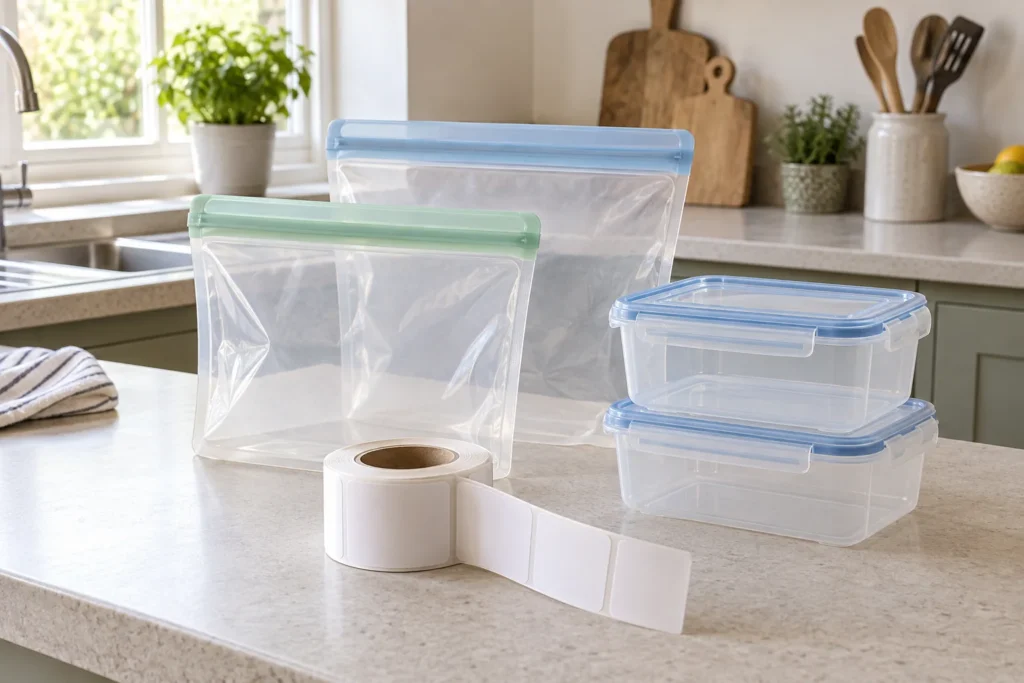
Reusable food storage bags are easiest to live with when their opening, closure and drying requirements match the food you normally pack. A slim shape can be convenient in a lunch bag, but it may be less convenient to fill than a rigid box. Compare the complete routine before replacing every container in the cupboard.
Image: AI-generated editorial illustration of generic equipment; not a photograph of a reviewed product.
Table of Contents
Start with the food and the filling task
List two or three regular uses, such as sandwiches, dry snacks or a portion of ingredients. Consider whether you need the bag to stand while filling, whether a spoon must fit inside and whether the opening is wide enough for the food to pass through without being squeezed.
Do not select capacity by the amount you can force into the bag. The closure needs to operate as instructed and the food should be accessible again afterwards. If you routinely eat directly from the container, look at depth and opening width rather than only the advertised volume.
Identify the material and complete closure
Reusable bags can have different bodies, bonded seams, sliders or press-together seals. Read the material and use instructions for the exact item. A silicone description does not establish that another manufacturer’s bag has the same construction or appliance permissions.
Look at the closure from end to end. Can you see where it begins and finishes, and can everyone using it operate the movement? If the maker provides a specific closing sequence, keep that information with the product reference. A closure described as leak resistant or leakproof should be understood within its stated conditions, not treated as permission for every food, temperature and carrying position.
Check cleaning access before buying
Stasher’s care guidance allows handwashing its bags with warm soapy water or dishwasher cleaning, recommends a brush for trapped material in the seal, and says not to turn the bags inside out because this can damage the seams. These are useful examples of construction-specific care instructions.
For any alternative, find its own guidance. Do not assume turning a flexible bag inside out is the best way to reach a corner. Check whether a brush can enter the opening and whether the maker permits the cleaning method you normally use. Examine the seal channel as carefully as the broad body panels.
Plan how the bag will dry
A flexible bag needs a place in the kitchen after washing, not just when it is full. Work out where it can remain open or supported in accordance with the care instructions. Check that the support you intend to use will not stretch the opening or press sharply against the body.
Think through several bags being washed together. One bag may fit neatly on the drainer; six may crowd out the rest of the washing-up. Buying gradually helps establish whether the drying arrangement works before you commit to a large matching collection.
Compare bags and boxes by movement
| Task | Question for a reusable bag |
|---|---|
| Filling | Does it stand, or will you need to support it? |
| Carrying | Are the closure and intended contents compatible? |
| Eating or emptying | Can you reach the corners without an awkward utensil angle? |
| Cleaning | Can you inspect the seal and follow its specific care method? |
| Storage | Where will clean, dry bags remain easy to retrieve? |
A rigid box may remain preferable for a food you want to protect from compression. A bag may suit another job where its shape fits the available space more conveniently. You can keep both formats without forcing every meal into one system.
If sandwiches are the intended use, check the opening against their ordinary width and thickness before focusing on a volume figure. If the bag is for loose ingredients, consider the spoon or scoop used to remove them. These two tasks can justify different shapes even when the advertised capacities are similar.
Begin with a repeatable use
Choose one regular packing task, use the bag through its whole wash-and-dry cycle, and note any inconvenience. That gives you a practical reason to add another size or keep a different container for another food. Our kitchen storage guide can help allocate a drawer or basket, but the purchase should be driven by a routine the bag genuinely fits.