
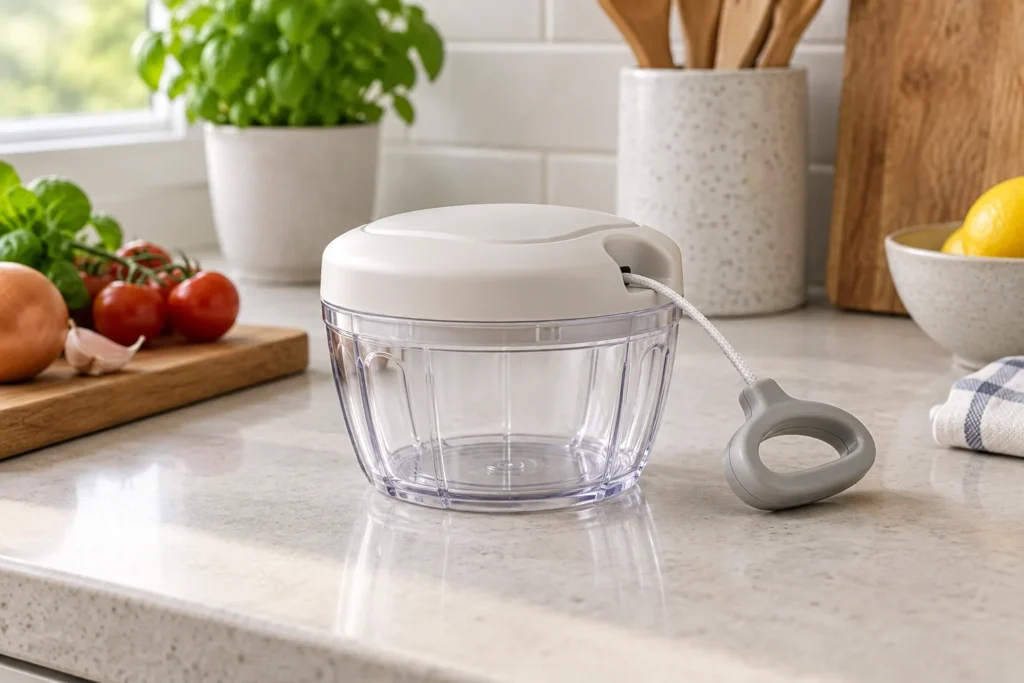
A manual food processor can handle suitable small preparation jobs without a socket or charging routine. The important difference between designs is the movement you make: pulling a cord, pressing a mechanism or turning a handle. Choose the action you can repeat comfortably, with a bowl and blade system suited to your ingredients.
Image: AI-generated editorial illustration of generic equipment; not a photograph of a reviewed product.
Table of Contents
Compare the movement before the capacity
A pull-cord design needs a controlled pulling motion and a way to keep the bowl stable. A push-operated design requires repeated downward movement. A hand crank requires room to turn the handle and a comfortable grip throughout that motion. These are mechanical differences, not a ranking of which requires least effort.
If possible, handle an empty display model in its intended position without touching the cutting parts. Think about the hand you use to stabilise it as well as the hand doing the work. A comfortable handle shape does not help if the whole arrangement slides or sits awkwardly on your worktop.
Use a documented example to check the details
The Tefal K1330404 uses a pull handle, two rotating blades and a 500ml bowl. Tefal describes a locking lid and non-slip base, with different washing arrangements for the lid and the dishwasher-safe bowl and blades. These details are useful specifications; the product’s speed-themed name is not a guarantee of your preparation time.
For another design, check the same categories independently. Do not carry a pull-cord model’s ingredient list over to a push chopper or assume a hand crank permits dough kneading. The manufacturer must support the task for the exact mechanism and blade.
| Mechanism | Space and handling to consider | What to inspect |
|---|---|---|
| Pull cord | Clear pulling path and stable bowl position. | Handle, cord return and lid lock. |
| Push action | Comfortable working height and repeated downward movement. | Stability and the required range of movement. |
| Hand crank | Clearance around the turning handle. | Grip, bowl support and permitted ingredients. |
Choose the bowl for the normal quantity
Name the job in ingredient terms: one small onion for a sauce, herbs for a dressing or nuts for a topping. A bowl’s total volume is not permission to fill it completely with every ingredient. Read any maximum load and preparation instructions, including required piece size.
A manual tool still needs preparation. Large, hard or awkwardly shaped ingredients may require cutting before loading, if they are permitted at all. Consider that work when comparing it with a knife and board. A machine that saves only a few cuts may not justify extra washing for a very occasional task.
Decide how much texture control you need
A clear bowl can make it easier to observe progress, but do not reach into it while the cutting system can move. Stop and open it only in the prescribed manner. Choose a coarse or fine endpoint according to the recipe rather than counting a universal number of pulls or turns.
For a mixed preparation, ingredients may need different treatment. It can be more useful to process permitted components separately and combine them afterwards than to chase one texture by repeatedly chopping everything together. Use a suitable recipe and stay within the appliance’s ingredient guidance.
Check cleaning access before buying
Look at how the blade assembly is handled, which parts separate and whether water can enter a mechanism that should remain dry. A manual appliance has no mains motor, but its lid can still contain components with specific cleaning restrictions.
Give sharp parts a defined storage place. Do not leave them loose in a sink of cloudy washing-up water or an ordinary drawer. If a cord, spring or handle is damaged, use the maker’s support route rather than dismantling a mechanism you are not instructed to service.
Choose for the recurring job
Manual processing can make sense when the supported task is small and the action suits your hands. For large repetitive preparation, the number of movements and clearing cycles may become the deciding factor.
Compare the complete task: preparation, loading, operation, emptying and cleaning. That is a more useful basis than promises of effortless chopping. Choose the mechanism that makes your actual routine manageable, without expecting it to duplicate every electric processor function.