
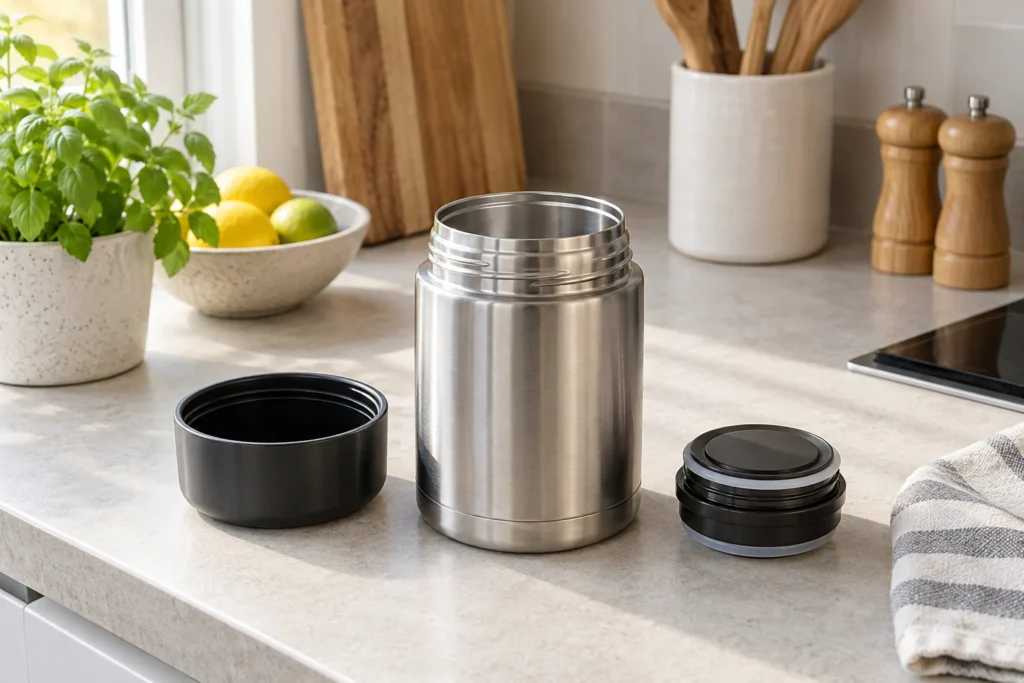
An insulated hot-food container needs to suit the meal, the person carrying it and the time between packing and eating. A headline claiming several hours of heat retention is only one part of that choice. It does not tell you whether the container holds your ordinary portion, fits your bag or has a lid you can comfortably open.
Image: AI-generated editorial illustration of generic equipment; not a photograph of a reviewed product.
Table of Contents
Start with the meal and the journey
Write down what you intend to carry and when you expect to eat it. Record whether you will eat from the container or transfer the food into a bowl. A tall, narrow flask may be easy to pack but require a different spoon or serving arrangement from a wide food jar.
Keep the intended use specific. A container bought for occasional soup lunches is a different purchase from one intended for a child’s daily meal. Check the manufacturer’s restrictions for the exact food and user, including any instructions about filling, opening and handling hot contents.
Read retention as a stated claim with conditions
Thermos lists different hot-retention claims for its FUNTAINER food flask and ICON food flask. The useful lesson is to compare the exact model and its instructions, rather than expecting every product from one brand to perform identically.
Ask what the stated duration measures and under which conditions. Starting contents, filling method and the test endpoint matter when interpreting a claim. If those details are not supplied, do not turn an “up to” duration into a promise that your particular meal will remain suitable to eat for that whole period. This is a purchasing guide, not a universal food-holding timetable.
Compare usable portions and opening width
Find the stated capacity and check any filling limit in the instructions. Then compare the portion with a container you already use. A capacity figure alone does not show whether a meal can be stirred, reached with a spoon or transferred easily through the opening.
Measure your usual spoon and lunch bag. Consider the container’s height with the lid fitted and any outer cup or handle attached. If you need to carry cutlery separately, include that in the packing arrangement. A neatly integrated spoon is only useful if it is comfortable for the food and person involved.
Examine the lid as an everyday task
Look at how the lid is gripped and how many components must be handled before eating. A wide opening can be convenient for serving, while the closure may still require a turning movement that some users find difficult. Where possible, handle an empty sample and compare the opening action before buying.
For a child’s container, assess the individual child’s ability to use it and the setting in which lunch is eaten. A manufacturer’s age suitability or product name cannot replace checking whether the actual opening and serving routine is manageable. Follow the maker’s hot-content cautions rather than improvising a filling or opening method.
Plan cleaning and parts storage
| Component | What to establish |
|---|---|
| Main vessel | Permitted cleaning method and access to the base |
| Lid | Whether its parts detach and how they refit |
| Seal | Inspection, cleaning and replacement instructions |
| Spoon or outer cup | Separate care instructions and a drying position |
Keep the exact model reference so a replacement lid or seal can be checked for compatibility. Do not assume a similar-looking part from another size will work. Decide where the clean, dry components will live between uses, particularly if the lid should be stored in a specific configuration.
Compare an ordinary day’s complete kit on paper: food jar, any outer cup, spoon, bottle and bag. Record which parts must be removed before eating and where they can be placed. This reveals whether an integrated accessory genuinely simplifies lunch or merely adds another component to wash and remember.
Choose a supported routine
Select the container whose instructions you can follow within your actual morning and lunch arrangements. If the retention information is insufficient for your intended use, obtain clarification before relying on it. Our kitchen storage guide can help find a home for lunch equipment; the food flask itself should be chosen around a verified use and a manageable handling routine.