
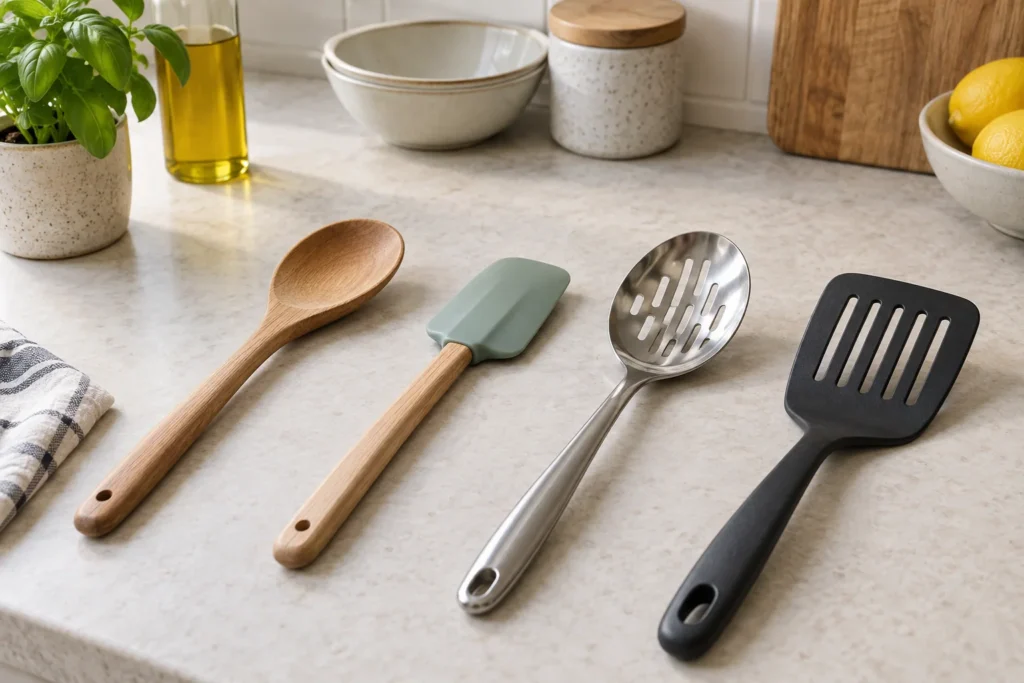
Stainless steel kitchen utensils make sense when their shape suits the task and your cookware permits metal tools. Look beyond the material label to the head's thickness, the finish of its edges, the handle and any joints. Two steel turners can be very different tools even when their product descriptions sound almost identical.
Image: AI-generated editorial illustration of generic equipment; not a photograph of a reviewed product.
Table of Contents
Start with the working edge
For a turner, look at how the leading edge approaches the pan. A broad head may support food well but be awkward inside a small frying pan. A narrow, flexible head may be easier to position yet offer less support for a large piece. Choose around the food you intend to lift, without treating either design as universally better.
For spoons and ladles, examine the bowl depth and the angle between head and handle. A deep ladle that fits a stockpot may be cumbersome in a small saucepan. Check whether its contents can be poured into your usual serving bowl without turning your wrist into an uncomfortable position. Use an empty, cool vessel when assessing the fit.
Look at the whole construction
A steel head may be attached to a plastic, wooden or composite handle. “Stainless steel utensil” is therefore not a complete materials specification. Look for rivets, welded areas, folded edges and any detachable component. Ask how those areas are cleaned and whether the care instructions cover the complete item.
IKEA GRUNKA material and care information provides a straightforward example of an identified stainless-steel set with published dishwasher care. That specification belongs to those tools. It cannot establish the washability of another steel-headed utensil with a different handle or join.
| Area to inspect | What matters in use |
|---|---|
| Leading edge | Smooth finish and a shape suited to the pan |
| Slots or perforations | Openings that suit the food and are accessible for cleaning |
| Head-to-handle connection | Secure assembly with no unexplained movement |
| Grip | Comfortable shape and usable length |
| Storage end | Fit in your drawer or on an existing hook |
A decorative hanging loop is useful only if you plan to hang the tool. In a drawer, it simply contributes to the total length. Include it when measuring rather than relying on the length of the working head alone.
Match metal contact to your pans
Check the instructions for every surface the tool will touch. Uncoated steel cookware, an enamelled casserole and a non-stick frying pan may have different utensil requirements. A manufacturer may permit particular metal tools while restricting sharp edges or scraping. Read the conditions, not just a compatibility icon.
Think about the other people who cook in your kitchen. If you keep metal tools for some pans and softer tools for others, give them clear, convenient homes. A special instruction is easy to forget when the suitable turner is buried under five similar items. Storage and selection need to work together.
Judge handling without assuming heavy means better
Pick up a display item if possible. Notice where it balances, whether the handle rotates in your grip and whether the head feels disproportionately heavy. Repeated stirring and brief serving are different tasks; a tool you like for one may be tiring or awkward for the other.
Check reach against your deepest pan and control against your smallest. There may be no single ideal length. A long serving spoon for a large casserole can sit alongside a shorter everyday spoon, but that is a reason to choose two purposeful tools rather than a large matching collection by default.
Make the purchase decision specific
Write down what you need the steel tool to do better than the one you already own. Perhaps you want a wider support surface, a deeper ladle or a more accessible join for cleaning. If you cannot name the improvement, keep using the existing tool until a real gap appears.
After delivery, inspect the edge and connection, read the supplied instructions and wash as directed before first use. Keep the maker and model details with your kitchen care notes. They make future cleaning questions much easier to answer than a drawer full of attractive but unidentified steel utensils.