
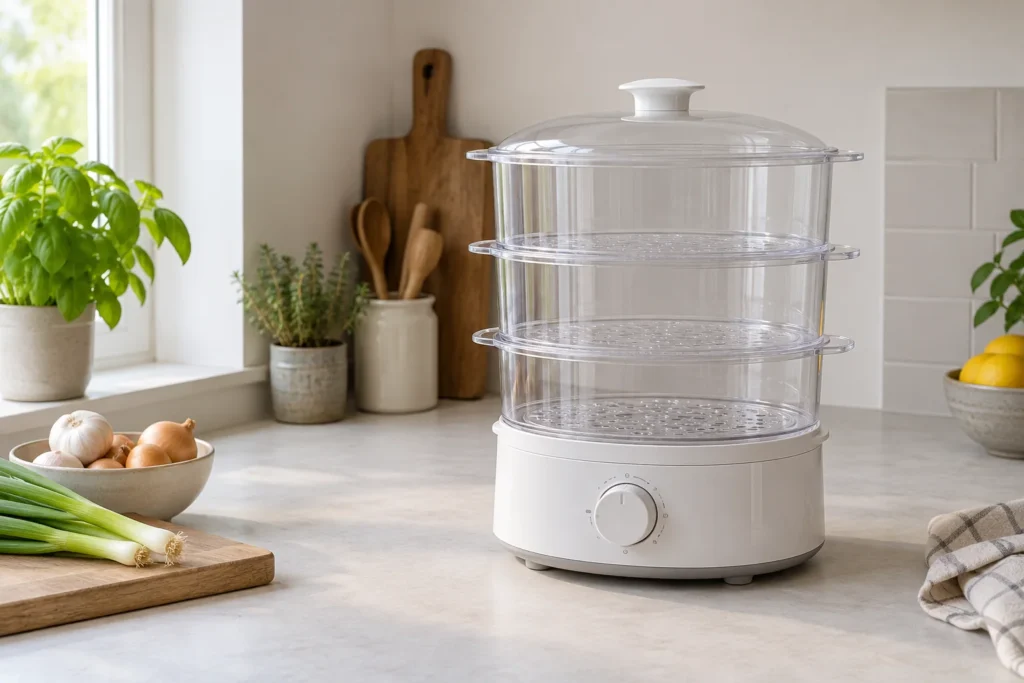
A three-tier electric steamer can organise several foods vertically, but advertised litres do not tell you exactly how a meal fits. Tray area, the permitted stack arrangement and food-specific cooking needs all matter. Start with the exact manual, then map the meal across the usable baskets without blocking steam circulation.
Image: AI-generated editorial illustration of generic equipment; not a photograph of a reviewed product.
Table of Contents
Look beyond the combined litre figure
The Morphy Richards 48755 listing gives a nine-litre capacity, a 60-minute timer and a visible water gauge. It does not provide enough tray measurements to calculate the usable area for your meal from those figures alone. Ask for missing dimensions or measure an unheated display model when possible.
Consider the foods you actually cook. Long vegetables, separate portions and a permitted rice bowl occupy space differently. A deep basket can have substantial nominal volume without providing the single-layer area you need. Do not infer a guaranteed number of portions from litres.
Follow the cooking stack, not the storage stack
Some baskets nest one way for storage and stack another way for use. The Russell Hobbs 21140 manual identifies baskets numbered one, two and three and specifies their cooking order. It also explains that its time guide concerns a single layer in the bottom basket, with other arrangements requiring adjustment. This is an ownership example, not instructions for a different steamer.
Find the corresponding diagram for your model before loading food. If a removable grid or spacer can be used, establish its approved configuration rather than removing parts simply to gain height. The lid and trays need to seat as designed.
| Meal-planning field | What to record | Why it helps |
|---|---|---|
| Food and quantity | The actual ingredient and prepared amount. | Separates several different cooking tasks. |
| Basket position | A position permitted by the model and method. | Avoids treating all tiers as identical. |
| Space needed | Layering and room around the food. | Shows whether nominal capacity is useful. |
| Timing basis | A suitable recipe or model-specific guide. | Prevents copying one time across the whole meal. |
| Doneness check | The check appropriate to that food. | A timer alone cannot establish the result. |
Coordinate different foods deliberately
A stack is not three independently controlled ovens. Plan each ingredient’s preparation and cooking needs, including any supported staged addition. Do not assume that a food in the top basket is ready simply because another component below it is cooked.
Consider juices and flavours moving through the stack. The 21140 instructions warn that liquid from upper baskets drips into lower ones. Food placement therefore needs to follow the appliance’s guidance and an appropriate food-safety plan, especially when combining raw animal ingredients with other foods. A tray is not automatically a sealed compartment.
Plan access around hot steam
Arrange serving dishes, suitable utensils and the heat protection required by your manual before heating. Think about where a removed basket or lid can stand and how you will reach it without leaning across escaping steam. Extra vertical capacity can create extra handling steps.
Use the manufacturer’s water-filling and topping-up procedure. A visible gauge is useful only if you can read it from the working position. Do not move the whole hot appliance or remove an unexpected part to gain access to the reservoir.
If you are comparing a dedicated steamer with a multicooker, our Ninja Combi and Speedi comparison helps you check the alternative layouts and documented programmes. Do not transfer a steamer’s basket arrangement or timings to another appliance simply because it also uses steam.
Compare the end-of-meal workload
Count the trays, grids, rice bowl, lid and drip collector that need cleaning. Inspect the component-level washing instructions and consider whether everything can dry conveniently before storage. A compact nested stack may save cupboard space, but only after the parts are clean and ready to put away.
For a shortlist, keep tray dimensions marked unknown until verified. Choose the steamer that accommodates a recurring meal in a supported arrangement, with manageable access and a clear timing plan. Our food-steamer guide provides a wider equipment comparison once those requirements are clear.
Plan the serving sequence on paper before loading a meal. Write each food beside its intended tray and note the checks its own method requires. This helps you see whether reaching one layer will interrupt another, and whether you have a clean resting place for the removed tray and lid.