
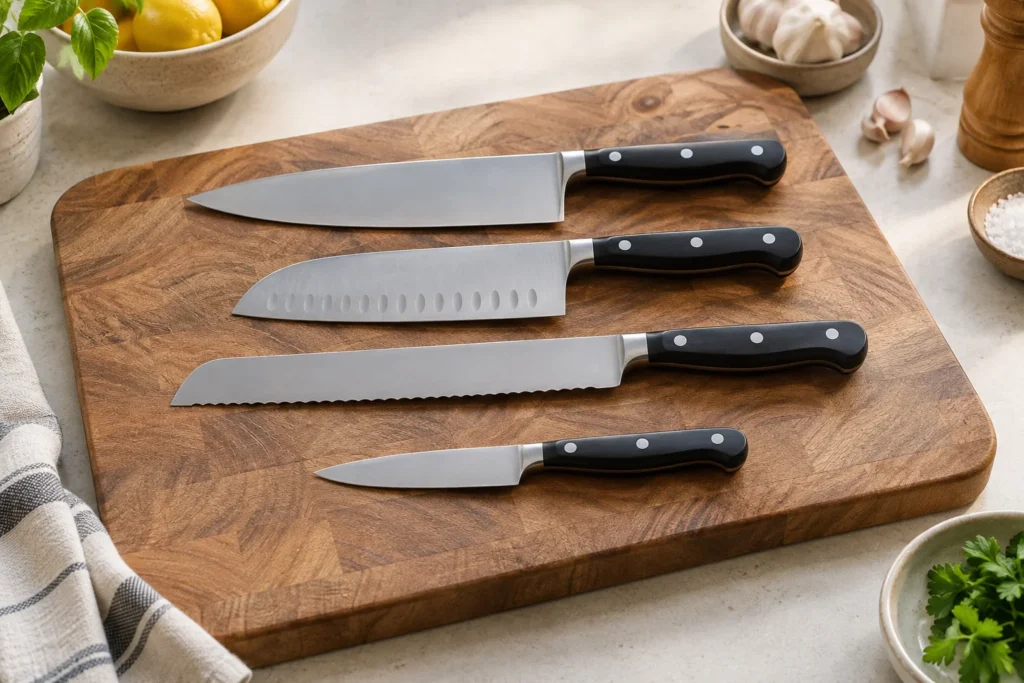
A ceramic kitchen knife needs to be chosen with its intended use and maintenance in mind. The material name does not make it a replacement for every steel knife in the drawer. Before buying, establish what the exact blade is designed to cut, how it should be handled and where you can obtain suitable sharpening support.
Image: AI-generated editorial illustration of generic equipment; not a photograph of a reviewed product.
Table of Contents
Start with the maker’s permitted tasks
Read the specific knife’s instructions rather than relying on descriptions such as lightweight or sharp. Those terms do not identify which foods or movements the blade is designed to handle. Keep any exclusions with the product information so other people using the kitchen can find them.
Kyocera’s ceramic-knife handling guidance excludes uses such as boning, levering and cutting frozen food. It recommends wooden or plastic cutting boards and warns against twisting the blade and dropping it on hard surfaces. These are useful ownership constraints for the maker’s knives, not a claim that every ceramic product has identical instructions.
Choose the size for a defined job
Compare blade length, height and handle dimensions with the task you expect it to perform. A compact blade might suit your existing small preparation station, while a longer one requires enough board and storage space. Do not select a blade purely because it is the largest in a set.
Consider who will use it. If a shared kitchen relies on grabbing any available knife for packaging, hard foods and general preparation, a more specialised tool needs an especially clear home and purpose. It should be easy to distinguish from another knife without leaving an exposed blade on the worktop.
Establish the cleaning routine
Check the blade and handle instructions together. Kyocera generally prefers hand cleaning for its ceramic knives; where its plastic-handled models permit dishwasher use, it specifies protection from contact with other items. Permission for one handle construction does not establish permission for another.
Plan a washing position where the knife remains visible and controlled. Follow the maker’s method and put the cleaned knife in its intended protected storage once dry. Do not treat a loose cutlery drawer or a sink full of other utensils as a convenient holding area for an exposed blade.
Investigate sharpening before it is needed
A sharpening tool intended for a steel knife is not automatically suitable for ceramic. Confirm both the knife manufacturer’s advice and the sharpener’s explicit compatibility. Marketing a device as suitable for kitchen knives is not enough if its supported materials are unspecified.
Kyocera provides information on authorised resharpening services and asks owners to contact the relevant partner before sending a knife. Check the current service area, condition accepted, packing instructions and charges directly. A damaged blade may need assessment rather than routine sharpening.
Keep the specialist role visible
If a ceramic knife is bought for a specific permitted task, store its instructions with the product information and make that role clear to other users. A shared drawer can make several knives look interchangeable even when their intended uses differ. For example, a blade chosen for a particular slicing job should not quietly become the household’s all-purpose tool because it is the first handle visible. Label the storage location if helpful, without adding material to the blade itself. Good organisation supports the maker’s restrictions rather than relying on everybody remembering an earlier conversation.
Keep a simple ownership record
| Record | Reason to keep it |
|---|---|
| Exact knife model | Find the correct instructions and service options |
| Intended tasks and exclusions | Keep everyday use within the design’s scope |
| Handle material and wash method | Avoid applying another model’s care advice |
| Storage or guard requirements | Protect the blade between uses |
| Sharpening contact | Have a supported route when performance changes |
Before ordering, imagine the full sequence: take the knife from storage, prepare the intended food on a suitable board, wash it and return it to its protected position. If any stage depends on equipment or habits you do not have, account for that in the purchase decision.
Our knife-set guide covers broader collections. A ceramic knife is best assessed as a specific addition with a clear purpose and a workable care route. Material alone does not establish cutting performance, durability or suitability for your kitchen.