
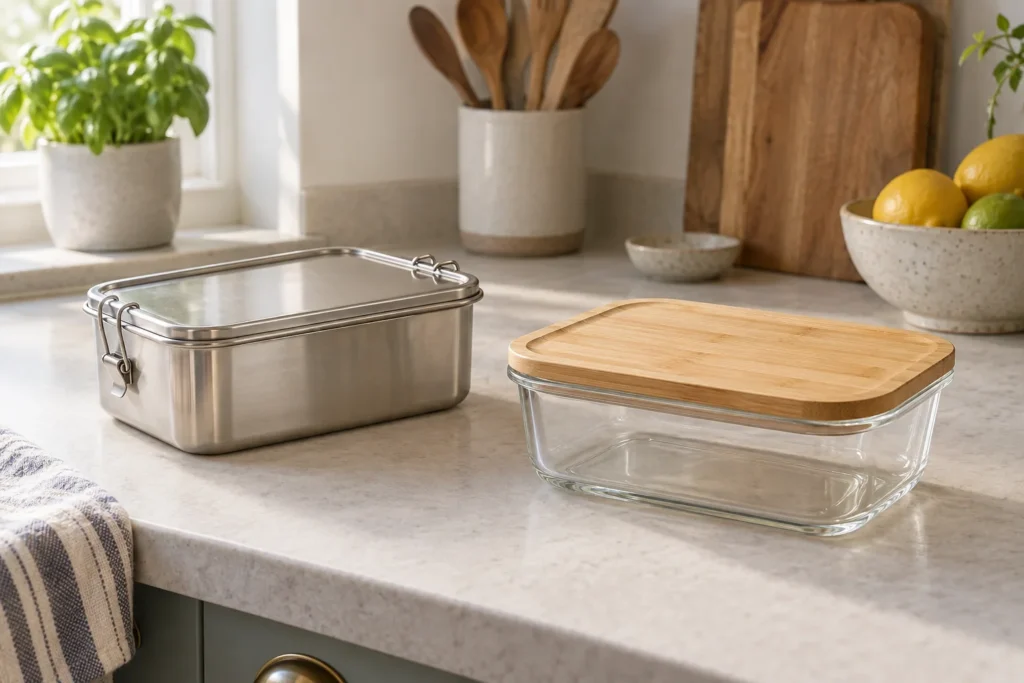
“Bamboo food storage container” can describe a product whose most visible bamboo part is only the lid. Before buying, identify the body, lid, finish and seal separately. This matters whether your preference concerns appearance, material choice or the way you intend to wash and store the container.
Image: AI-generated editorial illustration of generic equipment; not a photograph of a reviewed product.
Table of Contents
Read past the headline material
Look at the full materials section rather than stopping at the title. A jar might have a glass body and bamboo lid; another box could use metal for its body. The product name may emphasise the part that defines its appearance without describing everything that touches food.
Write each component on a separate line. Include coatings, lacquer, clips and seals where the manufacturer lists them. If the description says only “bamboo” and leaves the body unclear, ask for the missing specification rather than guessing from a photograph.
Distinguish bamboo from bamboo-plastic composites
The FSA and Food Standards Scotland advise against using plastic food containers or utensils containing bamboo and similar unauthorised plant additives. Their advice concerns the composite material, not an item made solely from bamboo. Do not treat a bamboo-filled plastic body as equivalent to a separate bamboo lid on a documented glass or steel container. If the material is uncertain, clarify it before food use.
Use a complete example to see the distinction
The 3 litre IKEA 365+ steel container with bamboo lid lists a stainless steel body, a bamboo lid with clear acrylic lacquer, and a silicone-rubber seal. IKEA specifies handwashing for that lid and says it is suitable for fridge storage but not the freezer.
Those details explain that particular assembly. They do not establish the materials or care requirements of an unrelated bamboo-labelled lunch box. Use the example as a model for the questions to ask, not as permission to apply one maker’s instructions across a whole category.
Decide which part of the appeal matters
If you mainly want a coordinated pantry appearance, consider whether the lid colour and profile fit your shelf layout. If you are trying to avoid a specific material, check the whole assembly and any food-contact surfaces. A natural-looking top does not make the entire product one material.
Avoid broad environmental conclusions based only on the word bamboo. Such a comparison would need evidence about the complete product, its manufacture, use and end of life. For an ordinary purchase, focus first on whether the container has a useful role and can be maintained according to its instructions.
Compare the care routine with your habits
Separate body and lid permissions for washing, refrigeration, freezing and heating. If your usual routine puts every lunch-box component into the dishwasher, a lid requiring handwashing creates an additional task. Decide whether you are willing and able to do that consistently before buying a large set.
Find the maker’s drying and storage advice. Check whether a seal is designed to be removed and how it should be refitted. Do not add an oil, cleaner or treatment merely because the surface resembles another wooden kitchen item. A finish may have its own restrictions.
Check the lid as a closure
| Question | Why it matters |
|---|---|
| Does the lid lift off or clip on? | It changes the opening movement and intended handling |
| What sits beneath the bamboo face? | The seal and underside may use other materials |
| Is liquid transport explicitly supported? | A pantry closure and a lunch carrier have different jobs |
| Can the lid be replaced? | Compatibility information may matter later |
Check clearance above the container as well. A lid with a broad knob or projecting edge can affect whether the jar fits under a shelf and whether another item may be stacked on it. Do not infer stackability from a flat-looking photograph; use the product’s actual design and instructions.
Buy the assembly that fits your task
Choose the complete container around its regular use, then decide whether the bamboo detail is a preference you want. Our kitchen storage guide helps place jars and boxes within a wider layout. A clear specification and workable lid-care routine are more useful than an attractive but incomplete material label.