
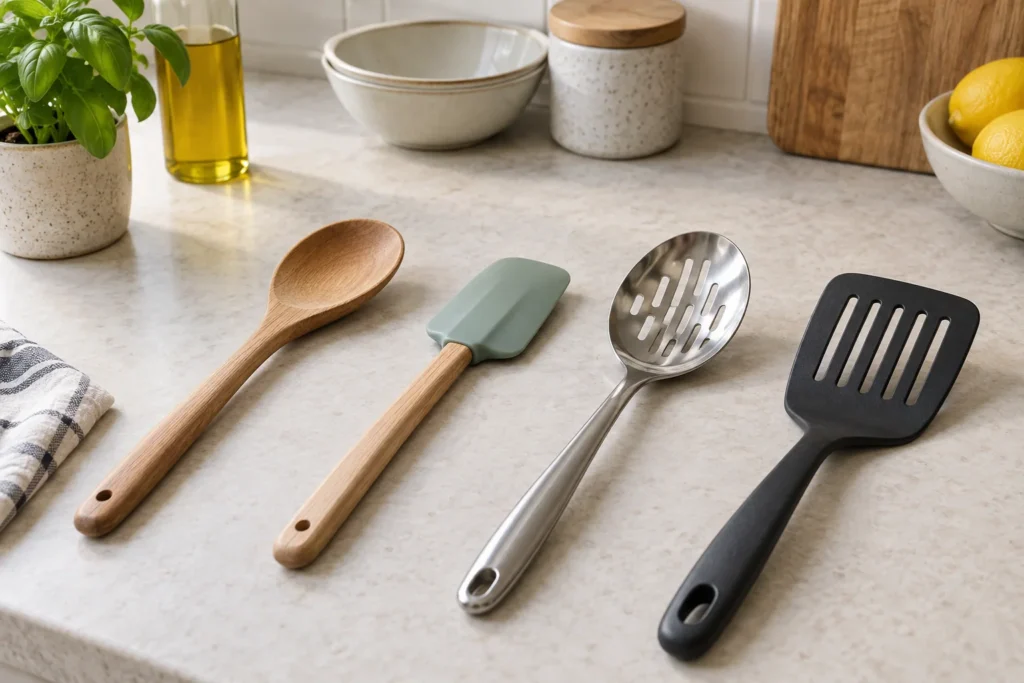
Choose utensils for a non-stick pan by checking that pan's care instructions first. Then inspect the tool's working edge and read its own use limits. Material names provide a starting point, but the useful decision concerns the actual head, any exposed parts and the movement you intend to make against the cooking surface.
Image: AI-generated editorial illustration of generic equipment; not a photograph of a reviewed product.
Table of Contents
Find the instruction for your exact pan
Identify the brand, range and model where possible. A general statement for a manufacturer's cookware may cover several surfaces, while an individual range can have more specific conditions. Look for a section headed utensils, tools, care or use. Keep the document or link with the pan's purchase details.
Le Creuset UK care and use illustrates why the wording matters: its guidance discusses silicone, wood and heat-resistant alternatives, and separately addresses careful metal-tool use and sharp edges. This is not a blanket permission for every pan with a non-stick label. Apply the instructions that belong to your cookware.
Compare the shape you actually need
A flexible scraper is useful for clearing a bowl but may not support food as well as a reinforced turner. A thick spoon can stir comfortably yet be awkward for reaching under a delicate item. Buying the right material in the wrong shape does not solve the cooking task.
| Task | Shape to consider | Detail to inspect |
|---|---|---|
| Stirring | Spoon with a suitable head and reach | Smooth edge and sound connection |
| Turning | Broad head with a usable leading edge | Support, flexibility and any exposed core |
| Scraping gently | Edge shaped for the vessel | Condition of the contact surface |
| Lifting individual pieces | Suitable tongs | Tip coverage and alignment |
Try the tool's fit in a cool, empty pan. Check whether the head can move without forcing an awkward angle and whether the handle clears the rim. This tells you more about practical access than choosing the largest tool in a matching set.
Look for wear on the utensil too
A familiar tool deserves an occasional inspection. Check for a split head, rough edge, loose component or exposed internal reinforcement. If the material or construction has changed through damage, the original compatibility description may no longer describe what touches the pan.
Remove an uncertain tool from the cooking routine while you identify it or ask the maker about the defect. Do not use the pan as a place to test a rough edge. A replacement utensil is only useful once you have also understood the old problem, particularly if storage or cleaning contributed to the damage.
Separate cooking from cutting and scraping
Choose a utensil for the action it was designed to perform. A turner is not automatically a cutting tool, and an instruction allowing metal contact does not imply permission to saw or force a sharp edge across the surface. Transfer food to an appropriate board or serving dish when the recipe calls for a separate cutting step.
If food is difficult to release, review the recipe and cookware guidance rather than applying progressively more force with a harder implement. A different tool may help with access, but it cannot establish the cause of sticking or restore a damaged coating.
Make a mixed-pan kitchen easy to use
If some pans permit tools that others restrict, arrange storage so the everyday choice is obvious. Keep the utensils chosen for your coated pans close to those pans, or use a clearly identified compartment. Explain the arrangement to other household cooks in terms of which tool belongs with which pan.
There is no need to replace every metal implement if it still has an appropriate use elsewhere. The useful goal is reliable selection during a busy meal. A suitable turner that can be found quickly is more valuable than a large collection whose restrictions nobody remembers.
Check both sets of care instructions
A pan may allow a certain utensil while that utensil still has its own heat, washing or resting restrictions. Read both. Provide a convenient resting place outside the pan and follow the tool maker's instructions between uses.
Choose one sound spoon and one suitable turner for your most-used coated pan, then add other shapes when your cooking calls for them. Keep the selection specific to the cookware you own. That approach remains useful even when you replace the pan or change to a different coating later.