
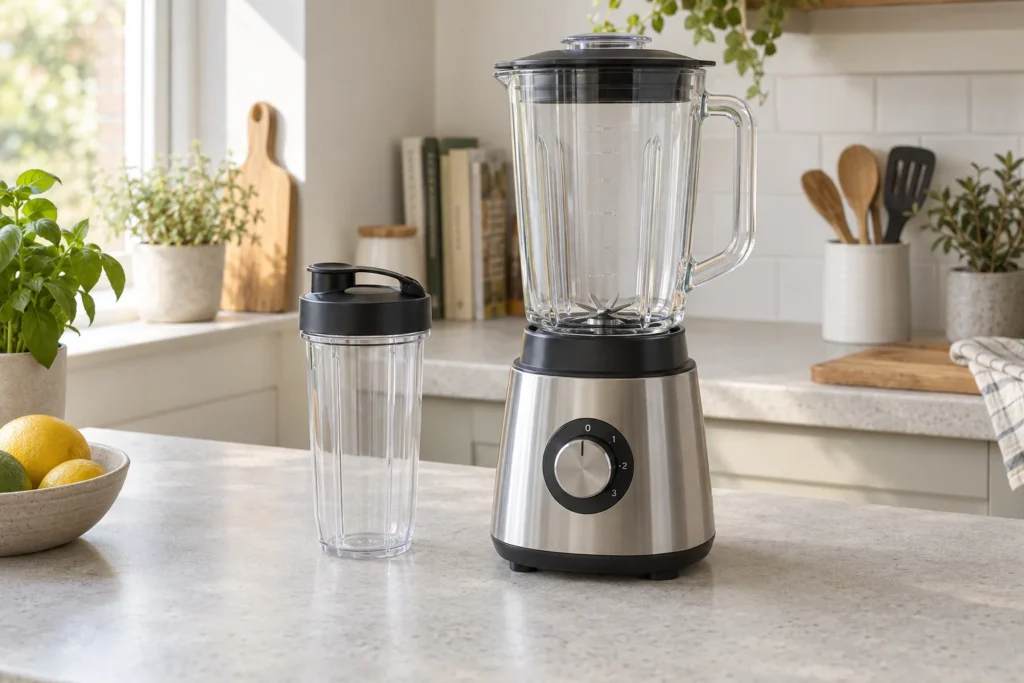
Before putting hot soup into a blender, check the instructions for the exact blender and container. A soup button, a glass jug or a powerful motor does not by itself establish that you can add a pan of hot liquid. The permitted temperature and lid arrangement belong to the complete appliance system.
Image: AI-generated editorial illustration of generic equipment; not a photograph of a reviewed product.
Table of Contents
Separate three different jobs
An ordinary cold blender combines ingredients without a heater. A heat-rated blender may accept hot ingredients within stated limits. A heated blender or soup maker can cook using an approved programme. Some high-speed machines also have programmes that warm ingredients during blending. Those descriptions are different jobs, so match the instruction to what you actually intend to do.
For example, you may have already cooked lentil soup in a saucepan and want to smooth it. That is a hot-input question. Starting with cold ingredients in a machine’s soup programme is a programme question. Both finish with soup, but the same starting procedure cannot be assumed.
Read beyond the name of the programme
The Sage Super Q manual includes a soup programme but warns that ingredients must cool to room temperature before being placed in its jug. Its programme name therefore does not authorise pouring in boiling soup. Follow the exact English manual for your model and revision.
Locate the permitted ingredient temperature, maximum quantity for the task, required lid and cap position, and starting speed or programme. If any is missing, ask the manufacturer before using hot contents. Do not borrow an internet instruction to remove a cap, cover the lid with a towel or fill the jug halfway: a method for one design may conflict with another.
Sealed cups need particular care
nutribullet’s UK Portable support says its cups must not be used to make hot soups or beverages. A cup that screws onto a blade assembly should never be assumed to have a steam escape route. Adding a little cold water to a hot mixture is not a reliable way to prove that the contents meet its permitted temperature.
A travel lid is also not necessarily a blending lid. Keep the correct parts together and read the container identification if your machine came with several vessels. A household with a jug blender and a portable blender should not transfer the jug’s permissions to the portable cup because both carry the same brand name.
| Your starting point | Decision before blending |
|---|---|
| Hot soup in a saucepan | Confirm that the exact vessel accepts its temperature; otherwise use a permitted alternative. |
| Cold ingredients for a soup programme | Follow the machine’s recipe, fill marks and programme instructions. |
| A sealed personal cup | Read its restrictions; do not assume hot-liquid suitability. |
| Missing or damaged lid parts | Replace the correct parts before using the appliance. |
Plan the transfer and serving route
Set out a stable landing place, the serving vessel and any suitable ladle before moving hot food. Consider how heavy the loaded jug will be and whether you can pour without bringing your face above the opening. Keep the counter dry and route the cord away from the saucepan. If you cannot handle the quantity comfortably, use a smaller authorised batch.
If you need to cool cooked soup for a cold-only blender, plan safe cooling, refrigeration where needed and reheating according to food-safety guidance. Do not leave a saucepan on the worktop indefinitely while waiting for convenience. A compatible hand blender may avoid the transfer, but it has its own temperature, depth and cookware rules.
Stop when the setup is uncertain
A loose lid, damaged seal, cracked jug or unexpected leak is a reason to stop, disconnect safely and seek the correct replacement or support advice. Never hold damaged components together to finish the batch. Wait until moving parts stop and follow the model’s instructions for opening after a heated programme.
When choosing an appliance specifically for cooking soup, the soup maker guide is a useful starting point for comparing formats. Check the current manual yourself before purchase: the practical benefit is a verified hot-food workflow, not simply a button labelled soup.