
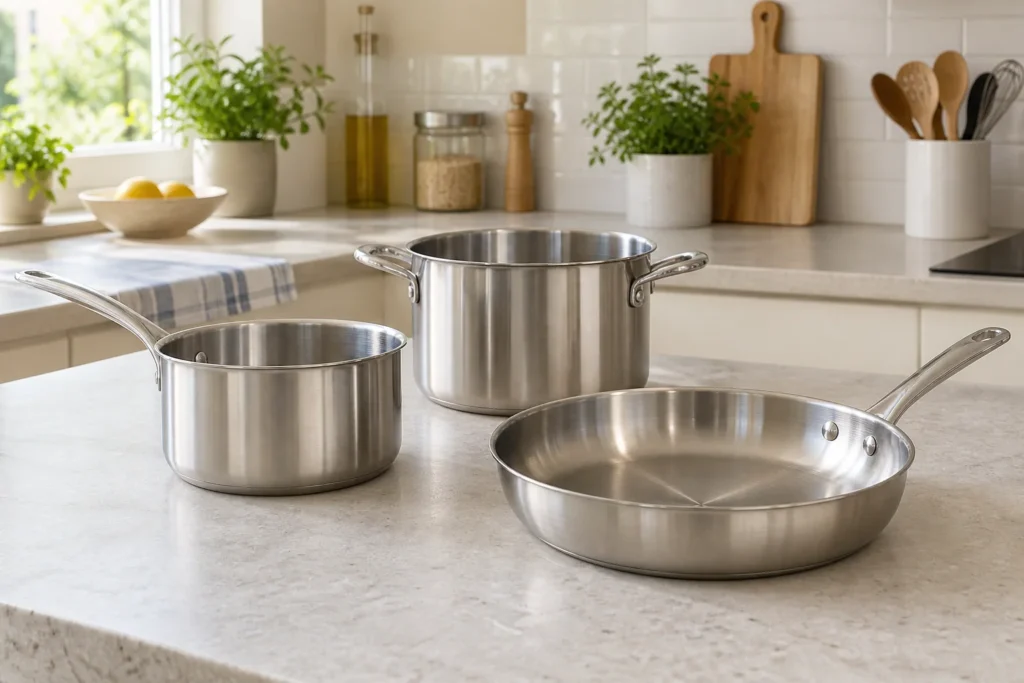
Affordable stainless steel cookware is cookware that covers the jobs you need within your budget. Start by counting useful cooking vessels, then check their sizes, base construction and handling. A large discount or a high piece count cannot make a set good value if half the included pans duplicate equipment you already own.
Image: AI-generated editorial illustration of generic equipment; not a photograph of a reviewed product.
Table of Contents
Define the gap in your kitchen
List the pans you actually use and the task each covers. Record any problem precisely: a saucepan is too small for a regular batch, a lid no longer fits, or a handle makes pouring awkward. Decide whether you need a complete set or one replacement before comparing offers.
Set a total budget that includes delivery and any genuinely necessary accessory. Keep optional additions separate. A matching frying pan or storage stand may be attractive, but it should not consume money allocated to the saucepan you need most.
Count vessels and lids separately
IKEA 365+ six-piece cookware contents describes a six-piece set made up of three vessels and their three lids. This is a normal way of counting a cookware set, but it shows why “six pieces” does not mean six pans. Read the contents and capacities rather than comparing headline numbers.
Use a worksheet like this with current prices you verify at the shop:
| Cost line | Illustrative amount |
|---|---|
| Set containing three useful vessels | £90 |
| Delivery | £5 |
| Total to pay | £95 |
| Useful vessels | 3 |
| Total divided by useful vessels | About £31.67 |
These figures are an arithmetic example, not an observed offer or a target price. If only two vessels are useful to you, the same £95 purchase represents £47.50 per useful vessel. That change can alter whether individual pans are worth comparing.
Check construction at the base
Find out whether the cookware has a layered base, layers through the body or another documented construction. A shiny exterior does not answer that question. Compare the actual base diameter with your hob and read the maker's compatibility statement, especially for induction.
Do not assume a more elaborate layer count is automatically necessary for your task. Ask what difference the construction makes to the particular pan you are choosing, and avoid paying for a label whose practical role is unexplained. Capacity, stable fit and comfortable handling remain essential checks.
Inspect the details you will use every day
Hold a cool display pan where possible. Check handle shape, balance, lid fit and whether a pouring action feels manageable. Include the lid's weight and the clearance needed for oven gloves if the pan is intended for oven use. A low purchase price will not compensate for an uncomfortable everyday task.
Measure your cupboard and sink. Sets often include a largest vessel that is useful only occasionally. If that pan is awkward to store or wash, decide whether its inclusion really improves the purchase. A smaller set plus one existing pot may suit your kitchen better.
Read care and warranty terms
Check dishwasher permission, recommended utensils and the approved response to stubborn residue. Read the warranty's coverage and exclusions instead of treating its duration as a predicted lifespan. Keep the receipt and product codes, particularly when a set contains several sizes with different replacement parts.
Look for available lids or handles if long-term repairability matters to you, but do not assume today's accessory listing guarantees future stock. The practical question is whether the maker currently supplies clear support information and identifies the parts correctly.
Make a comparison you can revisit
Record two or three suitable options with current delivered cost, useful contents, capacities, construction and any unresolved questions. Exclude an unsuitable pan before comparing price. This keeps a tempting promotion from overturning the basic requirements you identified at the start.
Choose the option whose useful pieces justify the money and space for you. If the budget is tight, buying one well-specified pan now and adding another when needed can be a sensible plan. Affordable cookware does not need to arrive as a complete matching collection on the same day.