
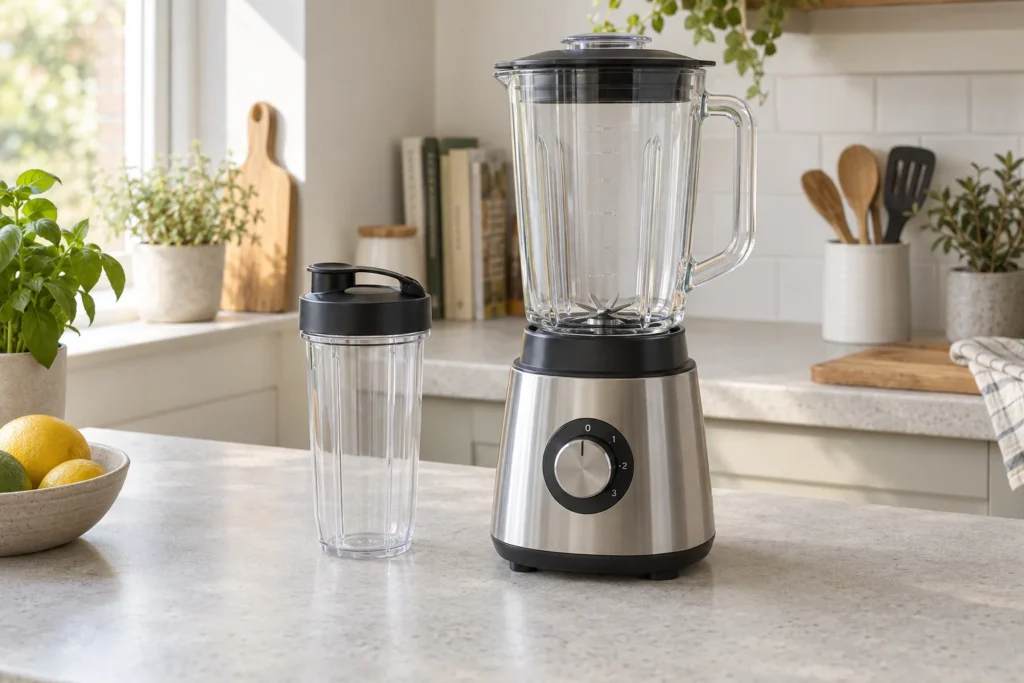
Choose a blender jug as part of the machine it belongs to, then compare how that complete assembly will work in your kitchen. Glass and plastic both appear in manufacturer-designed systems. The material name alone does not tell you the permitted temperature, useful capacity or cleaning method.
Image: AI-generated editorial illustration of generic equipment; not a photograph of a reviewed product.
Table of Contents
Start with verified examples
Ninja’s HB150-compatible replacement jug is described as glass. The Sage Fresh & Furious SBL620 manual identifies an Eastman Tritan jug. Those are different appliance designs with their own instructions; they do not establish a universal winner between materials.
List the exact models you are considering rather than making an abstract glass-versus-plastic choice first. A jug that feels attractive on its own may have an awkward handle, difficult lid or unsuitable minimum batch. Conversely, an unremarkable-looking container may suit your cupboard and daily portion very well.
Consider the loaded weight
The relevant weight is the jug, lid and food together. Check whether a published figure refers to the whole appliance or the removable jug; retailers sometimes display only total product weight. If comfortable lifting is important, ask for the empty jug’s weight and consider the quantity you will normally add.
In a shop, handle an empty display jug only with permission and remember that a filled one will be heavier. Check the space inside the handle, the wrist angle needed to pour and whether you can set it down securely. Do not assume that every glass jug is heavier than every plastic jug of a different size: compare actual products.
Do not infer hot-liquid permission from material
A glass vessel can still be unsuitable for hot ingredients or sudden temperature changes. A plastic vessel may be approved for a particular heated programme, or only cold contents. The complete jug, blade bearing, seals, lid and motor arrangement determines the permitted use.
If soup is a priority, find the manual’s exact hot-input and programme rules. Keep those separate from dishwasher permissions, since dishwasher-safe does not mean suitable for blending boiling contents. Never replace the supplied container with a household glass jug or a jar that appears to engage with the base.
| Comparison | What to record for each model |
|---|---|
| Handling | Jug-only weight if available, handle clearance and pouring angle. |
| Temperature | Permitted input temperature and any separate hot fill mark. |
| Cleaning | Approved parts, dishwasher placement and whether the blade is removable. |
| Condition | How to inspect chips, cracks, scratches, seals and bearing leaks. |
| Replacement | Exact official part number and compatible models. |
Look closely at cleaning access
A smooth interior is useful only if you can clean around the blade and lid safely. Inspect the underside, seal channels and pouring lip, then read how they should be cleaned. A self-clean programme can help loosen food without making every part clean or removing the need to rinse.
If you often blend strongly flavoured ingredients, consider whether the lid and seals can be cleaned separately according to the manual. Avoid abrasive scouring or improvised chemical treatments to remove a mark. A cloudy surface may need different care from physical cracking; seek the manufacturer’s advice if you cannot tell what changed.
Budget for a correct replacement
Find the official jug assembly before purchase and check whether it includes the lid, seal and blade unit. A headline replacement price for an empty container may not cover the complete assembly. The availability of one part today is not a promise that it will remain stocked throughout ownership, but an identifiable part is more useful than a generic description.
Treat chips, cracks, leakage or a damaged attachment as reasons to stop using the affected assembly and obtain support. Do not try a heavier or lighter aftermarket jug on the assumption that it upgrades the machine. Check compatibility explicitly and retain the part number with your appliance manual.
Make the decision around your routine
For daily drinks, the best material choice may be the one available in a machine with a comfortable jug and manageable cleaning. For heated recipes, verified temperature permissions come first. Our blender guide covers broader format choices; use this comparison to assess the container itself. No scratch-resistance, health or durability ranking is claimed here without comparative testing.