
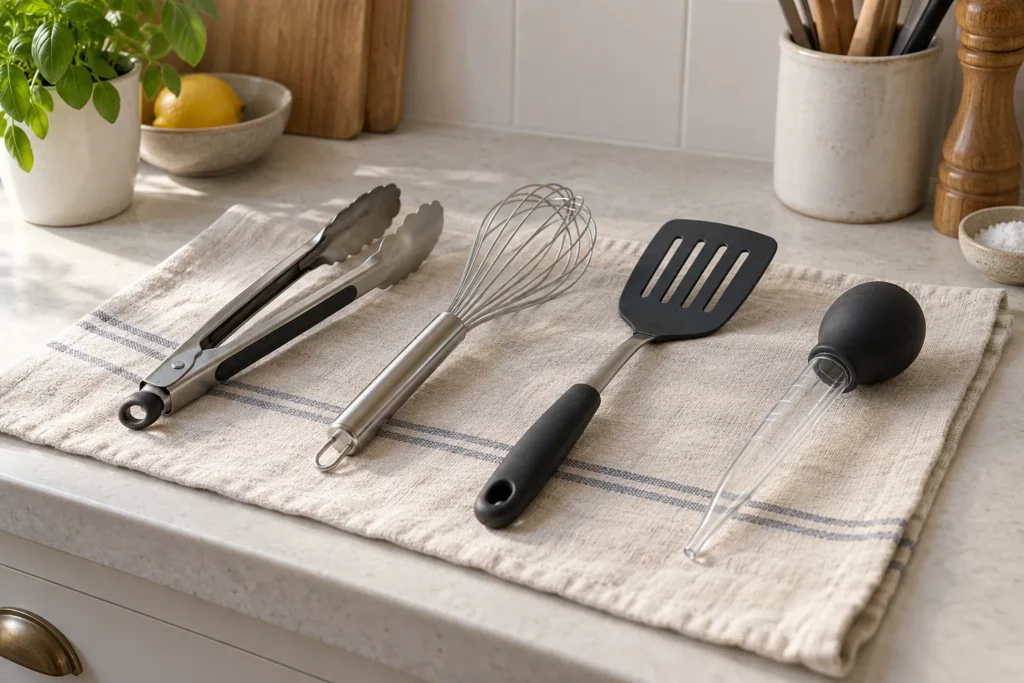
Choose kitchen tongs by the food you need to lift, the reach you need and how comfortably you can open and close them. Length is only one measurement. Tip width, spring resistance, maximum opening and the storage lock can make two similar-looking pairs feel quite different during the same task.
Image: AI-generated editorial illustration of generic equipment; not a photograph of a reviewed product.
Table of Contents
Match reach to the cooking position
Use your usual pan or serving dish as a reference. Imagine gripping food near the centre and at the far side without leaning across the vessel. A longer pair may provide useful reach, but the extra length can be awkward for a small bowl or precise serving. There is no reason to choose the longest available pair by default.
Measure the actual storage space too. Nominal tong length may differ from the complete dimensions, especially when a locking ring projects beyond the handle. Check the product drawing or ask the seller for total closed length. A pair that works at the hob still needs a convenient home afterwards.
Inspect the tips as a pair
Look at the gripping surfaces together. Do they meet evenly? Are the tips broad, narrow, spoon-shaped or scalloped? A wide head supports a different area from a pointed serving tip. Consider whether the food can sit securely between them without requiring more pressure than you find comfortable.
| Use you have in mind | Detail worth checking |
|---|---|
| Lifting individual pieces from a pan | Tip alignment and controllable pressure |
| Serving from a shallow dish | Head width and manageable length |
| Handling a larger item | Opening width and suitable support |
| Working with coated cookware | Exact tip material and cookware permission |
Do not confuse a product photograph of a large food item with a documented lifting capacity. If a task involves an unusually heavy or awkward load, choose equipment explicitly intended for it rather than assuming ordinary kitchen tongs are sufficient.
Try the spring and lock
With a clean display item, open and close the tongs several times in the intended way. Notice whether the spring feels manageable and whether the handles fit your grip. A soft-looking grip insert does not tell you how much force is needed to keep the tips together.
OXO silicone-headed locking tongs is an example of silicone-headed tongs with a storage lock. That feature is useful to inspect, but its presence alone does not establish that you will find it easy to operate. Check whether the lock is a pull ring, sliding part or another mechanism, and whether you can use it without an awkward hand position.
A lock should also suit your storage. If a pair lives upright in a jar, consider whether removing and replacing it interferes with the mechanism. If it lies in a drawer, check its closed width and whether the tips catch on neighbouring tools.
Confirm material and heat instructions
Read the specification for the tips and any handle covering separately. Silicone-headed tongs may still have exposed steel elsewhere. Follow your cookware's guidance about contact materials and the tong maker's instructions about heat and resting between uses.
Provide a suitable place to put the tongs down. Do not rely on a high temperature rating as permission to leave the complete tool against a heat source. A clean resting plate or an approved integrated rest should be positioned so the handles remain easy to pick up.
Include cleaning in the comparison
Inspect the hinge, spring area and the connection between tips and arms. Ask whether parts detach and how the maker expects those areas to be cleaned. Follow the actual washing instructions rather than assuming that all metal-and-silicone tools share the same care requirements.
After delivery, check the tips and mechanism before first use. If the pair twists unexpectedly, the tips are damaged or the lock does not work as described, resolve that with the seller instead of compensating by gripping harder.
Buy one purposeful pair first
Write a short requirement such as “everyday pan tongs, tips approved for my coating, comfortable spring, fits the drawer”. Add a longer or smaller pair only when a different task calls for it. This keeps the choice grounded in handling and fit, rather than a matching set whose extra lengths spend most of their time tangled together.