
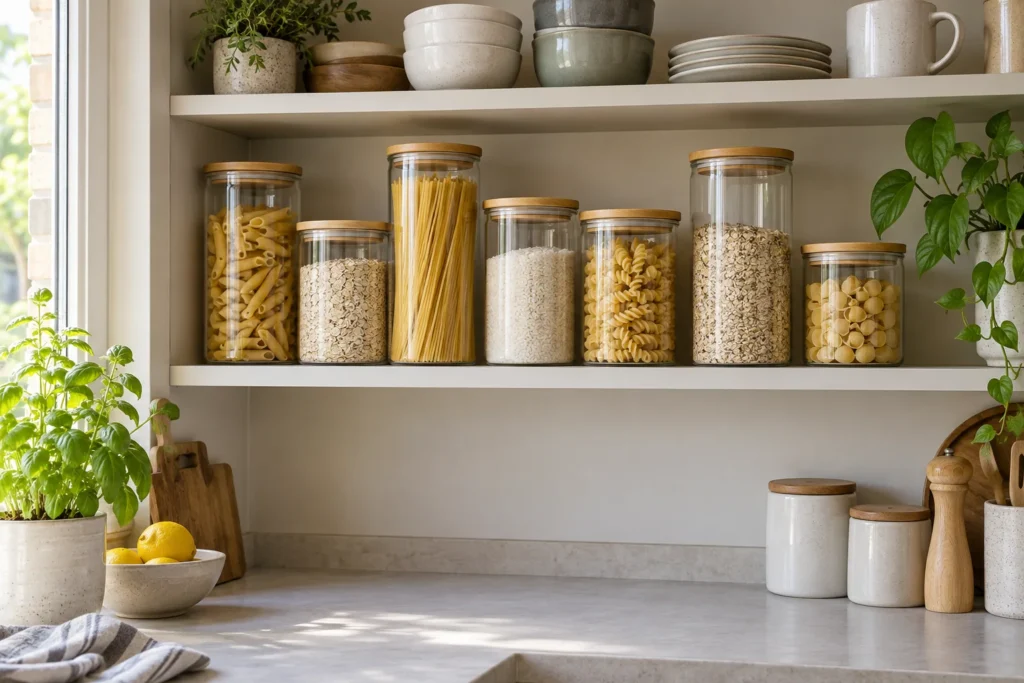
Food storage rotation works best when it is a small part of shopping and meal planning. You do not need a complex inventory for every packet. You need a reliable way to see the food already present, identify what should be considered next and avoid buying an extra item because the first one disappeared behind another row.
Image: AI-generated editorial illustration of generic equipment; not a photograph of a reviewed product.
Table of Contents
Start with the food’s actual instructions
The FSA’s food-safety guide explains that use-by dates concern safety while best-before dates concern quality. Rotation should preserve those meanings. Putting an item at the front is a reminder to make a decision; it does not extend the date or override storage instructions.
Read after-opening instructions too. The oldest purchase is not automatically the item with the most immediate use requirement. An opened product may need attention before an unopened one bought earlier. Let the actual labels guide the order rather than relying solely on receipt dates.
Separate working stock from backup
Choose a clear area for the packet or container currently in use and another for unopened extras. Keep the backup area visible enough to check before shopping. This can be as simple as a short section of shelf rather than a new set of baskets.
Avoid scattering duplicates across several cupboards. If there is a practical reason for keeping them in different places, note that in your shopping routine. Otherwise, bring each food type together so the total is easy to understand at a glance.
Give a “consider next” area a precise purpose
You can use a small, clearly labelled section for foods that need a near-term decision, provided their required storage conditions remain correct. The section should prompt checking the label and planning a suitable use, not imply that everything in it is automatically safe or interchangeable.
Keep unlike foods separated as required rather than placing them together simply because they share a reminder category. For a fridge or freezer, the appliance layout and official food-storage guidance remain more important than the convenience of a single reminder basket.
Make freezer records brief and current
List identifiable portions in a format your household will maintain. Food name, quantity and freezing date may be enough for the stock overview, with the necessary food instructions retained separately. Update the count when a portion is removed so the list does not become an optimistic record of meals that are no longer there.
Place new items in a defined location and arrange access so older suitable stock is not buried indefinitely. Do not leave the freezer open while rewriting the list; make notes promptly and finish the planning outside the appliance.
Use the same check before each shop
| Step | Question |
|---|---|
| Look at working stock | Which ingredients are already open or in use? |
| Check backup stock | Is there another packet before I buy one? |
| Review relevant dates | Which foods need a decision under their instructions? |
| Review frozen portions | Which identified meals fit the coming week? |
| Write the shopping list | What is actually missing for the planned meals? |
Keep the routine short enough to repeat. If you stop using it after one busy week, reduce the level of detail instead of abandoning visibility altogether. A dependable five-item freezer list is more helpful than an elaborate spreadsheet nobody updates.
A useful trial is to review only the ingredients for the next three planned meals. Check their working supply, backups and any suitable frozen portions, then write the missing items. This keeps the task bounded and exposes the kinds of duplicate purchase your household actually makes, without turning every shopping trip into a full inventory exercise.
Adjust buying to the space you use
Notice repeated leftovers, duplicate packets and ingredients that remain untouched. Those observations can inform the next shopping list without requiring you to calculate a universal household stock level. Our kitchen storage guide helps create accessible zones. Rotation succeeds when that layout and your ordinary buying habits support one another.